
Three Ghosts on the Airwaves

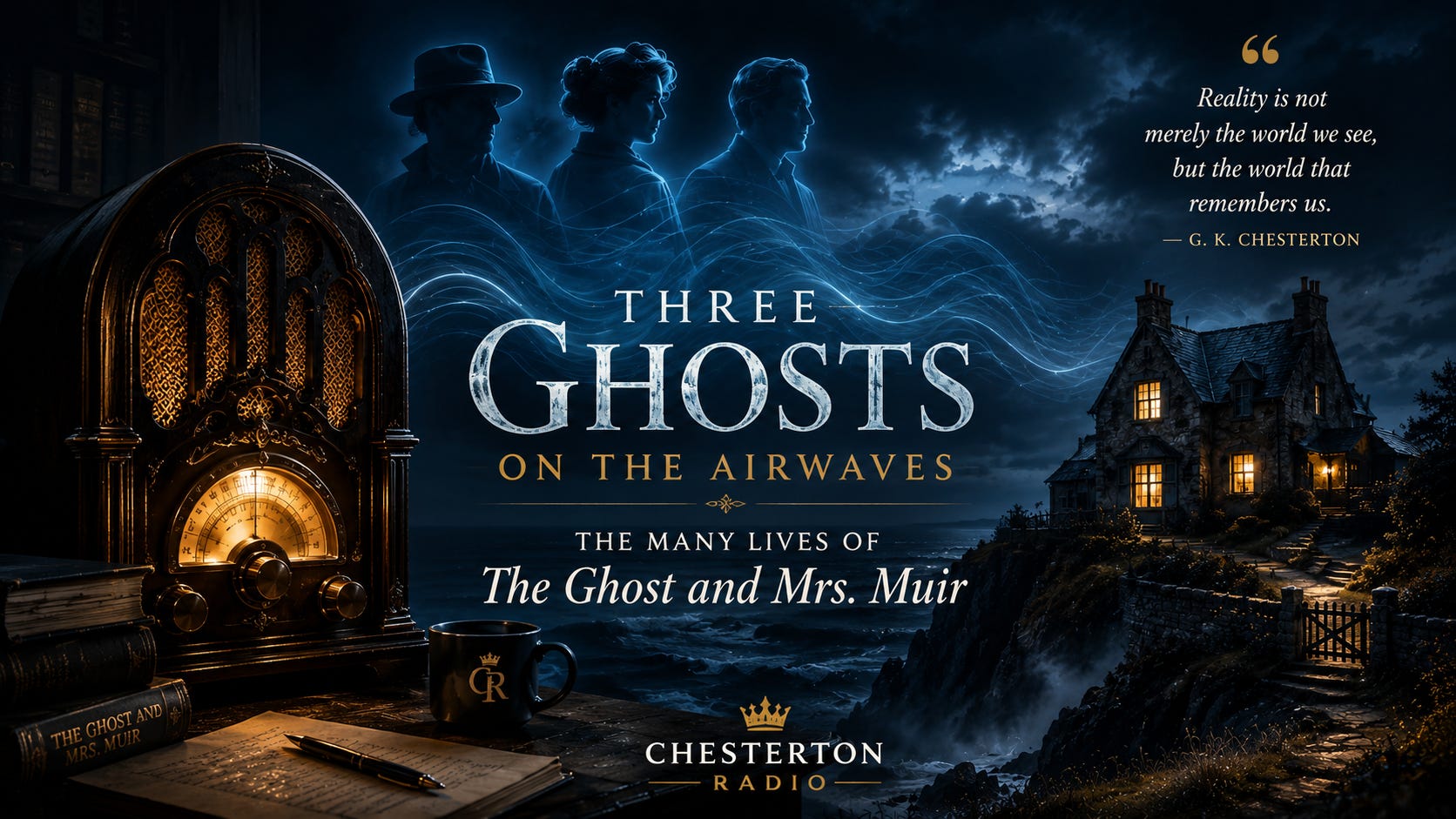
Intro
There are stories that entertain us for an evening.
And then there are stories that linger like distant music long after the room has gone dark.
The Ghost and Mrs. Muir belongs to the second kind.
It is one of those rare tales that seems less invented than remembered—as though it had always existed somewhere beyond the edge of ordinary life, waiting patiently for each new generation to rediscover it. Over the decades it returned again and again: first as a novel, then as a beloved film, and later across the airwaves themselves through Lux Radio Theatre, Screen Directors Playhouse, and BBC Saturday Night Theatre.
Three productions.
Three interpretations.
Three voices calling out across the darkness.
And perhaps radio was always the perfect home for this particular story. After all, radio itself is a kind of haunting. Invisible people enter silent rooms. The dead speak again. Entire worlds emerge from shadows and static while listeners sit alone beside glowing dials deep into the night.
Modern ghost stories often ask us to fear the unseen world.
But The Ghost and Mrs. Muir comes from an older imagination—one that understood that mystery is not always terror, and that some presences remain not because they are evil, but because they are loved.
Tonight on Chesterton Radio, we return to Gull Cottage once more.
The lamp is lit.
The sea is restless beyond the cliffs.
And somewhere in the darkness, the captain is still speaking.
There are some stories that seem incapable of disappearing.
They drift quietly from generation to generation like melodies remembered from another room. They return in different voices, different decades, and different forms, yet somehow remain unmistakably themselves. Long after fashions change and entire genres collapse into obscurity, these stories continue moving silently through the culture like lantern light through fog.
The Ghost and Mrs. Muir is one of those stories.
At first glance, it appears deceptively simple: a young widow rents a seaside cottage haunted by the spirit of a dead sea captain. But stories do not survive for generations merely because of their plots. They survive because they touch something permanent in the human imagination. And this strange, gentle tale has persisted with remarkable tenacity—through novel, film, television, and perhaps most beautifully of all, through radio itself.
For listeners of old-time radio, the story became a recurring visitor on the airwaves through Lux Radio Theatre, Screen Directors Playhouse, and later BBC Saturday Night Theatre.
Three productions.
Three interpretations.
Three ghosts speaking through the wireless.
And perhaps that is fitting, because The Ghost and Mrs. Muir was never really a ghost story in the modern sense at all.
Monday Night on the Airwaves
There was once a particular feeling to Monday night.
The day’s work was over. The weekend had receded into memory. Lamps glowed softly in living rooms while dishes were cleared away and windows darkened against the evening sky. Somewhere beyond the walls, trains moved through distant crossings, tires whispered over wet pavement, and radios hummed quietly to life in kitchens and parlors across the country.
For millions of listeners, Monday night belonged to radio drama.
And few programs embodied that era more completely than Lux Radio Theatre. Week after week, Lux transformed Hollywood films into broadcasts of orchestral music, famous voices, elegant sponsors, and carefully constructed atmosphere. It was entertainment presented with confidence and ceremony. Radio did not yet apologize for seriousness. Popular culture still believed that ordinary audiences deserved beauty, wit, romance, and emotional intelligence.
In many ways, The Ghost and Mrs. Muir was perfectly suited to that world.
It possesses the qualities old radio handled best: longing, silence, wit, emotional restraint, and atmosphere. It unfolds slowly, like fog rolling across a harbor. The story does not depend upon spectacle. It depends upon presence. That is why radio embraced it so naturally.
Radio itself has always been faintly supernatural.
Invisible voices enter darkened rooms. Entire worlds emerge from sound alone. People long dead speak again with startling immediacy. Even now, there remains something haunting about listening late at night while distant voices drift through static and shadow.
Old radio dramas understood this instinctively.
They did not merely tell stories.
They summoned them.
The Story That Refused to Disappear
The original novel, The Ghost and Mrs. Muir, appeared during the final years of the Second World War. That timing matters more than modern readers may initially realize. The world had endured devastation, separation, loss, and uncertainty on a massive scale. Entire populations were haunted by absence. And yet The Ghost and Mrs. Muir arrived not as a work of horror, but as something gentler and stranger: a supernatural story rooted not in fear, but in companionship.
Lucy Muir is newly widowed and quietly suffocating beneath the expectations of polite society. Seeking independence, she rents Gull Cottage, a lonely house overlooking the sea. The house, however, already has an occupant: the ghost of Captain Daniel Gregg, a retired sailor whose blunt manners and volcanic temper conceal deep loyalty and surprising tenderness.
What follows is not terror.
It is conversation.
That distinction is the secret of the story’s endurance.
Modern storytelling often treats ghosts as intrusions upon reality. Something monstrous enters the ordinary world. The supernatural becomes an assault upon normality itself. But older stories—especially English stories—frequently imagined the unseen world differently. The supernatural could be melancholy, mysterious, romantic, even comforting. Ghosts were not always enemies. Sometimes they were reminders that the world remained larger than materialism allowed.
Captain Gregg does not haunt Gull Cottage like a demon.
He inhabits it like memory refusing extinction.
That idea runs through every version of the story.
Hollywood by Lamplight
The Lux Radio Theatre adaptation embraces the full emotional grandeur of Hollywood’s golden age.
Lux productions always carried a sense of occasion. The orchestras swelled confidently beneath dialogue. Announcers spoke with ceremonial warmth. Stars arrived not merely as performers, but as cultural presences. Listening to Lux Theatre today is to encounter an America astonishingly confident in its own artistic seriousness. Popular entertainment was allowed to be elegant.
Their version of The Ghost and Mrs. Muir leans naturally into romance.
The emotional currents become broader and more luminous. The relationship between Lucy and the captain feels almost mythic at moments, suspended somewhere between dream and memory. Hollywood understood how to elevate longing without collapsing into cynicism. The production never mocks its own sincerity. That may be one reason modern audiences still find these dramas emotionally disarming. We have grown accustomed to irony as a defense mechanism. Older storytellers often possessed the courage to be earnest.
Yet beneath Lux Theatre’s polish remains the same haunting emotional truth: loneliness is answered not by excitement, but by presence.
Lucy does not discover freedom through rebellion alone. She discovers it through friendship, courage, imagination, and ultimately through the realization that life itself remains enchanted.
The supernatural in older stories rarely existed merely to terrify.
It existed to enlarge reality.
The Smaller Room and the Quieter Voice
The Screen Directors Playhouse adaptation approaches the story differently.
Where Lux expands emotionally outward, Screen Directors Playhouse narrows inward. The scale becomes more intimate. The pacing tightens. The production feels less like a grand cinematic adaptation and more like a conversation unfolding beside a lamp late at night.
And strangely enough, this smaller scale may bring the story even closer to its emotional center.
Without the larger orchestral sweep of Lux, the dialogue itself carries greater weight. Silences linger longer. The relationship between Lucy and Captain Gregg feels deeply personal rather than theatrical. One begins to understand why audiences returned repeatedly to this story across decades and mediums. The captain is not compelling merely because he is a ghost. He is compelling because he possesses personality in the fullest sense of the word.
He argues.
He laughs.
He insults.
He protects.
He remains vividly alive despite being dead.
That paradox gives the story its extraordinary emotional texture.
Captain Gregg represents a form of masculinity modern storytelling increasingly struggles to portray: strength without cruelty, authority without vulgarity, affection without sentimentality. He belongs to an older moral imagination in which dignity and tenderness were not considered opposites.
The smaller emotional scale of Screen Directors Playhouse allows these qualities to emerge quietly and naturally.
It is a deeply human production.
The House by the Sea
Then there is the BBC Saturday Night Theatre version, which perhaps comes closest to the spirit of the original English atmosphere from which the story emerged.
The BBC rarely hurried mystery.
British radio drama often understood that atmosphere requires patience. Rooms must breathe. Wind must move through empty hallways. Silence itself must become part of the story. In the BBC adaptation, Gull Cottage feels ancient before Lucy ever enters it. The sea beyond the cliffs becomes a living presence. One can almost hear the gulls circling above dark water.
Most importantly, the supernatural is treated with restraint.
No elaborate explanation is required.
The ghost simply exists.
Older cultures were often more comfortable with mystery because they did not feel compelled to dismantle reality before believing in it. The unseen world could remain unseen without becoming irrational. In the BBC version, Captain Gregg does not appear as spectacle. He emerges naturally from the landscape itself, like fog rising from the harbor at dusk.
That emotional restraint gives the story remarkable power.
The romance remains understated, and therefore becomes more believable. The loneliness feels quieter and more profound. The audience senses that the veil separating the living from the dead may be far thinner than modern civilization wishes to admit.
And somehow the old cottage itself becomes the center of everything.
Gull Cottage is not merely a setting.
It is a sanctuary against the sterility of the modern world.
Why the Story Endured
Why did this particular story survive when so many others vanished?
Part of the answer lies in its gentleness.
Modern entertainment frequently assumes intensity is depth. Stories become louder, darker, more violent, more cynical. Yet human beings do not live by adrenaline alone. Beneath all modern distraction remains a profound hunger for tenderness, permanence, beauty, and emotional sincerity.
The Ghost and Mrs. Muir speaks directly to that hunger.
It is fundamentally a story about companionship.
Not passion alone.
Not fantasy alone.
Companionship.
Lucy and Captain Gregg rescue one another from isolation. Their affection grows not through spectacle, but through conversation, loyalty, mutual respect, and shared solitude. The relationship unfolds with extraordinary patience. That patience allows the emotional truth of the story to deepen gradually, almost invisibly, until the audience realizes it has become deeply attached to these characters.
Modern ghost stories often ask us to fear death.
This story asks us to consider whether affection itself might survive death.
That is a very different kind of haunting.
Captain Gregg remains because love remains.
And perhaps audiences return to the story because they hope that something within themselves might also remain.
The Chestertonian Ghost
There is something unmistakably Chestertonian about The Ghost and Mrs. Muir.
G. K. Chesterton believed modern civilization suffered not from an excess of belief, but from a loss of wonder. The world had become spiritually flattened. Mystery was treated as embarrassment. Fairy tales mattered precisely because they restored astonishment.
Chesterton once famously observed that fairy tales do not tell children that dragons exist. Children already know dragons exist. Fairy tales tell them dragons can be defeated.
But fairy tales also perform another task.
They remind adults that reality itself is enchanted.
That enchantment runs quietly through The Ghost and Mrs. Muir. The story insists that homes matter. Memory matters. Loyalty matters. The dead are not merely discarded machinery. Human personality possesses weight and continuity. The world remains filled with invisible meanings modern life cannot entirely erase.
The supernatural in older stories often strengthened reality rather than escaping from it.
That is exactly what happens here.
The cottage by the sea becomes more real because it is haunted.
The ordinary world becomes more beautiful because mystery still inhabits it.
And perhaps that explains why old radio itself continues to exert such emotional power over listeners today. These broadcasts are not merely nostalgic curiosities. They are reminders of a civilization that still trusted silence, imagination, emotional intelligence, and atmosphere. Radio once assumed audiences possessed patience enough to listen carefully and imagination enough to participate in the story itself.
It trusted listeners to feel wonder.
Which Version Should You Hear First?
For sweeping Hollywood romance and emotional grandeur, the Lux Radio Theatre adaptation remains magnificent.
For intimacy, character, and quiet emotional depth, Screen Directors Playhouse may be the most affecting.
For atmosphere, literary melancholy, and the haunting poetry of the English seaside, the BBC Saturday Night Theatre version is unforgettable.
Or perhaps the proper answer is all three.
Late at night.
With the lights low.
And the sea somewhere beyond the darkness.
The Light in the Window
There is a reason people still listen to old radio in an age of endless digital noise.
These productions offer something modern entertainment increasingly struggles to provide: stillness. They allow emotions to unfold gradually. They leave room for imagination. They trust atmosphere. Most importantly, they understand that loneliness is not cured by stimulation, but by presence.
And that may be the true secret of The Ghost and Mrs. Muir.
It survives because it reminds us that human beings do not merely long for excitement. They long to believe the world itself is alive—that homes remember, that voices linger, that love endures, and that the veil separating memory from eternity may be thinner than we suppose.
Some stories remain alive because they remind us that reality itself is still alive.
And somewhere tonight, in some quiet room, an old radio is still glowing softly in the dark while the captain’s voice drifts once more across the sea.
Outro
There is a reason stories like The Ghost and Mrs. Muir continue to survive while so much modern entertainment vanishes almost instantly into the noise.
They remember something we have forgotten.
They remember that loneliness cannot be cured by distraction. That homes possess souls. That memory is a kind of presence. That love leaves traces behind it stronger than time. And that the world itself may be far more mysterious, merciful, and enchanted than modern life usually allows us to believe.
Perhaps that is why old radio still feels so strangely alive late at night.
These broadcasts are not merely nostalgic relics from a vanished age. They are reminders of a civilization that still trusted atmosphere, silence, imagination, and emotional sincerity. A civilization that believed stories should enlarge the soul rather than merely stimulate the senses.
And somewhere tonight, while the modern world rushes endlessly forward beneath glowing screens and restless headlines, an old radio still hums softly in the dark.
The sea wind still moves beyond Gull Cottage.
The lamp still burns in the upstairs window.
And the captain’s voice still drifts quietly across the airwaves.
Thank you for spending another Monday night with Chesterton Radio.
Until next time—keep the dial glowing, keep the lamp lit, and help keep the signal alive.