
The Two Leos
From the Factory Age to the Algorithm Age

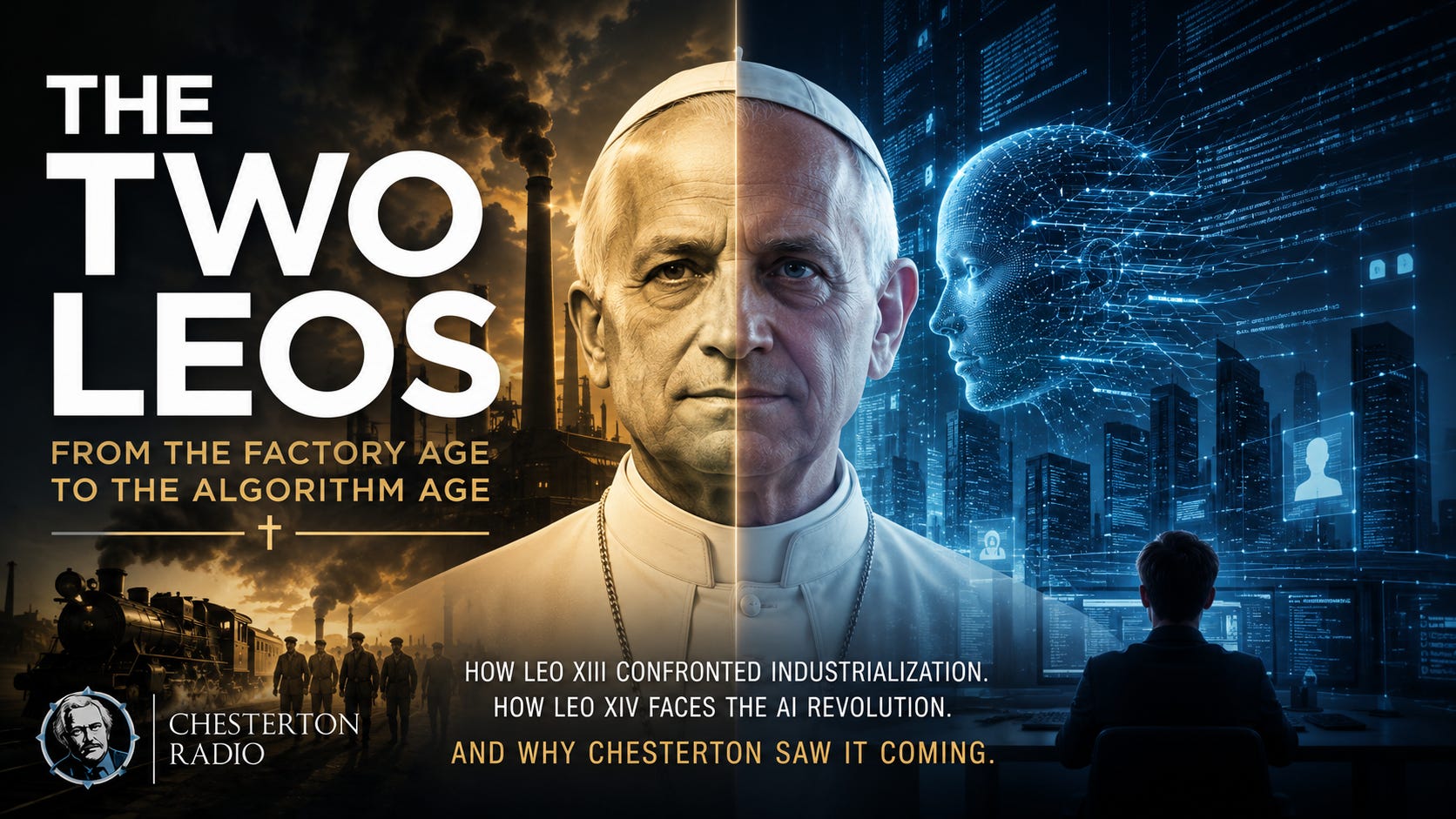
When the white smoke rose above Rome and the new Pope chose the name Leo, many assumed it was simply a respectful nod toward tradition.
It was something far more deliberate than that.
Papal names are never accidental. They are manifestos in miniature. They announce continuity, direction, ambition, and sometimes warning. A man who chooses the name Francis invokes one set of memories. A man who chooses Benedict invokes another. And when a Pope chooses the name Leo, Catholic history immediately turns toward one towering figure: Pope Leo XIII.
For Leo XIII was not merely a caretaker pontiff or administrative reformer. He was the Pope who stood at the threshold of the industrial age and attempted to answer one of the defining questions of modern civilization:
What happens to the human person when society reorganizes itself around machines?
That question has returned.
Only now the machines are different.
The furnaces and steam engines of the nineteenth century have become server farms and neural networks. The mechanization of muscle has become the mechanization of cognition. And with Magnifica Humanitas, Pope Leo XIV appears to be attempting for the age of artificial intelligence what Leo XIII attempted for the age of industrial machinery.
The first Leo confronted the factory.
The second confronts the algorithm.
And between them stands a strange prophetic figure who now appears startlingly modern: Gilbert Keith Chesterton.
Because Chesterton understood something that modern technological civilization still struggles to understand:
The danger of machinery is never merely mechanical.
It is spiritual.
I. The First Machine Age
To modern eyes, the Industrial Revolution often appears inevitable. We see railroads, steamships, electric lights, steel bridges, textile mills, and assembly lines as merely the natural beginning of modern prosperity.
But for those living through it, the experience was deeply disorienting.
The Industrial Revolution did not simply introduce new tools. It reordered civilization itself.
Villages emptied into factory cities. Ancient trades collapsed within decades. Family economies disappeared. Men who once worked according to seasons, weather, feast days, parish life, and local rhythms suddenly found themselves disciplined by whistles, clocks, and mechanized production schedules.
Time itself changed.
Historian E.P. Thompson famously described this transformation as the rise of “time-discipline” — the conversion of human life from organic rhythms into industrial rhythms. Workers no longer labored when crops demanded it or daylight permitted it. They labored according to machine pacing. Railroads required synchronized clocks. Factories required standardized shifts. Human beings increasingly adjusted themselves to systems built for efficiency rather than humanity.
This transformation was not merely economic.
It was anthropological.
And Pope Leo XIII saw the danger with extraordinary clarity.
In Rerum Novarum he wrote:
“Working for gain is creditable, not shameful, to man… but to misuse men as though they were things in the pursuit of gain is truly shameful and inhuman.”
That sentence remains astonishingly modern.
Because Leo XIII recognized that industrial capitalism was beginning to treat human beings not as persons but as components.
The machine age fragmented labor into repeatable tasks. Craftsmen who once created entire products became operators performing partial motions inside larger industrial systems. Work became increasingly specialized, repetitive, abstracted, and de-skilled. The worker ceased to be a craftsman and became an interchangeable labor unit.
The great fear of the nineteenth century was not merely poverty.
It was depersonalization.
Would modern society continue recognizing the dignity of the worker once machines proved more efficient than traditional human labor?
That was the crisis of the first machine age.
And now the question returns with terrifying new dimensions.
II. The Second Machine Age
The modern technological revolution differs from the Industrial Revolution in one profoundly important respect.
The first mechanized physical labor.
The second mechanizes intellectual labor.
Steam engines replaced muscle.
Artificial intelligence now threatens to replace cognition itself.
This distinction changes everything.
The Industrial Revolution automated repetitive bodily tasks:
weaving
transportation
manufacturing
extraction
assembly
The AI revolution increasingly automates cognitive tasks:
writing
analysis
translation
coding
design
research
pattern recognition
customer interaction
even artistic imitation
This is not theoretical.
Entire industries are already reorganizing themselves around automated systems capable of performing white-collar tasks once believed uniquely human. Large language models generate prose. AI systems analyze legal documents. Algorithms manage logistics, finance, advertising, hiring, and information flow. Synthetic media can now imitate human speech, music, photography, and video with astonishing realism.
The first industrial age threatened to make men into machines.
The second threatens to make them economically unnecessary.
And beneath this technological transformation lies a philosophical revolution even more radical than the technical one.
Modern AI culture increasingly implies that consciousness itself may simply be advanced information processing. Human thought becomes reducible to data patterns. Creativity becomes recombination. Personality becomes prediction. Memory becomes storage.
Man himself becomes computational.
This is the true revolution.
And once civilization accepts that premise, replacement becomes not merely possible but logical.
For if human beings are fundamentally information systems, why should superior systems not eventually replace them?
The old industrialists sought cheaper labor.
The new technocrats seek labor elimination altogether.
III. The New Industrialists
The parallels between the nineteenth century and the twenty-first become even more striking when one examines the structure of power itself.
The Industrial Revolution produced entirely new classes of elites:
railroad barons
steel magnates
banking dynasties
industrial monopolists
Control over infrastructure became the source of civilization-scale power.
Whoever controlled railroads controlled transportation.
Whoever controlled steel controlled industry.
Whoever controlled oil controlled energy.
The result was enormous concentrations of wealth and influence.
Now observe the modern world.
The new industrialists no longer primarily control physical infrastructure.
They control informational infrastructure.
Cloud computing.
Data centers.
Search engines.
Social platforms.
App ecosystems.
AI training systems.
Digital identity systems.
Recommendation algorithms.
The old industrial monopolies controlled the movement of goods.
The new monopolies increasingly control the movement of thought itself.
And just as nineteenth-century industrialization naturally favored massive concentrations of capital, artificial intelligence may accelerate centralization even more dramatically.
Training frontier AI models now requires:
enormous computational infrastructure
vast proprietary datasets
advanced semiconductor access
hyperscale energy resources
billions of dollars in capital
The result is obvious:
Only a tiny number of corporations and governments can realistically compete at the highest levels.
Chesterton would have recognized the danger instantly.
One of his great recurring themes was the moral danger of gigantism. He distrusted systems too large to remain human — whether monopolistic corporations, centralized bureaucracies, financial empires, or technocratic states.
His criticism was never merely economic.
It was personal.
Chesterton feared societies organized around abstraction rather than human scale.
And perhaps no civilization in history has been more abstract than the digital civilization now emerging.
The railroad barons controlled steel rails.
The AI barons increasingly control information, memory, communication, and perhaps eventually cognition itself.
IV. The Industrialization of Attention
One of the most overlooked parallels between the two revolutions is the industrialization of human attention.
The first industrial age disciplined the body to the rhythm of machines.
The second disciplines the mind to the rhythm of algorithms.
Nineteenth-century workers adapted themselves to:
factory whistles
shift rotations
synchronized clocks
assembly pacing
Modern humanity increasingly adapts itself to:
notifications
engagement metrics
algorithmic feeds
infinite scrolling
recommendation loops
dopamine optimization systems
This transformation may prove even more invasive than industrial labor itself.
For modern systems no longer merely organize work.
They organize consciousness.
Human attention — perhaps the most sacred and irreplaceable of all human resources — has become economically extractable.
Technology companies compete not merely for purchases, but for hours of perception itself. Platforms increasingly optimize content not for truth, beauty, wisdom, or virtue, but for engagement. Algorithms learn emotional triggers, behavioral patterns, and psychological vulnerabilities with astonishing sophistication.
The result is a civilization perpetually distracted yet spiritually exhausted.
Never has humanity possessed more information while appearing less capable of contemplation.
Chesterton anticipated this spiritual condition long before smartphones existed.
“The madman,” he wrote in Orthodoxy, “is not the man who has lost his reason. The madman is the man who has lost everything except his reason.”
That sentence may describe technological civilization with frightening precision.
For modernity increasingly possesses technical intelligence detached from moral wisdom, metaphysical meaning, or spiritual orientation.
The machine can optimize endlessly while possessing no understanding whatsoever of what life is for.
V. The Worker Then and Now
The worker of 1891 and the worker of 2026 face different conditions but increasingly similar anxieties.
The nineteenth-century worker feared:
mechanization
dangerous factories
exploitation
de-skilling
replaceability
The modern worker increasingly fears:
automation
algorithmic management
digital surveillance
cognitive displacement
economic irrelevance
The similarities are profound.
Both eras involve labor becoming abstracted from human identity.
In the industrial age, the worker became:
a labor unit
a payroll number
a production input
In the AI age, the person increasingly becomes:
a data profile
a behavioral model
an engagement pattern
a predictive entity
This abstraction is spiritually dangerous because Christianity insists that human beings are not reducible to utility.
A human person possesses intrinsic dignity independent of economic efficiency.
This is the heart of Catholic social teaching.
And this is why Pope Leo XIV’s warnings about artificial intelligence matter far beyond technology itself.
Because the AI revolution is ultimately forcing civilization to answer an ancient theological question:
What is man?
If man is sacred, technological civilization must remain subordinate to human dignity.
If man is merely functional, then replacement becomes inevitable.
VI. Chesterton and the Prophecy of Technocracy
Chesterton matters now because he saw the philosophical roots of technocracy before technocracy fully existed.
He understood that modern civilization increasingly confused management with wisdom.
He saw experts replacing communities.
Systems replacing traditions.
Scale replacing intimacy.
Efficiency replacing meaning.
And he recognized that modernity often becomes less humane precisely when it becomes more rationalized.
“The business done by machines,” Chesterton wrote, “is a business of repetition.”
That observation suddenly feels astonishingly prophetic.
For artificial intelligence excels precisely at repetition:
pattern replication
predictive synthesis
probabilistic imitation
statistical continuation
But repetition is not creativity.
Prediction is not wisdom.
Simulation is not consciousness.
And imitation is not soul.
Chesterton’s deepest insight may have been that mystery itself is essential to human civilization.
Modern technocracy increasingly seeks to eliminate mystery in favor of optimization. Everything becomes measurable, quantifiable, predictable, and engineerable. But human beings do not live by optimization alone.
A marriage cannot be reduced to metrics.
A friendship cannot be automated.
A prayer cannot be industrialized.
A civilization cannot survive merely on efficiency.
The modern world will never starve for lack of information.
It may starve for lack of wonder.
VII. The New Rerum Novarum
This is why Magnifica Humanitas matters.
Pope Leo XIV appears to understand that artificial intelligence is not merely another technological innovation.
It is a civilizational turning point.
The Industrial Revolution reorganized labor.
Artificial intelligence may reorganize humanity itself.
And the Church once again finds herself asking the same ancient question she asked in the nineteenth century:
Will technological civilization continue recognizing the irreducible dignity of the human person?
Or will man become merely another component within systems too large, abstract, and efficient to remain fully human?
The furnaces of the first industrial age glowed red against the night sky.
The server farms of the second glow blue.
But the deeper struggle remains unchanged.
Whether civilization will continue seeing man as a creature made in the image of God —
or merely as data awaiting optimization.