
The Servile Conspiracy
Episode II — The Contract of Bread — A Sherlock Holmes & Father Brown Mystery

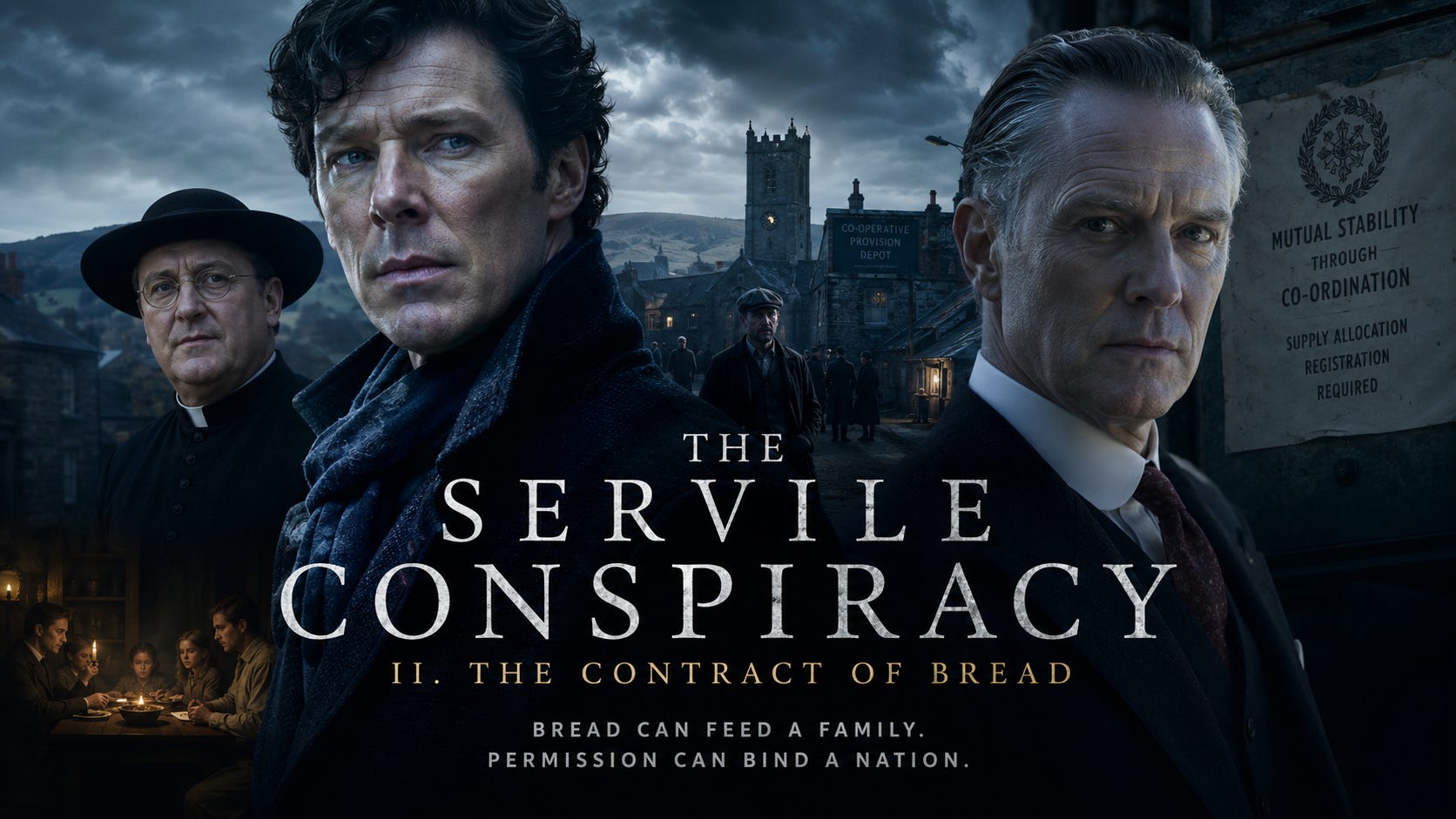
Act I — The Village of Quiet Hunger
There are some conspiracies which announce themselves with drums.
Men hear them coming across frontiers. They appear beneath banners, beneath symbols painted in aggressive colors, beneath speeches shouted from balconies by men who wish to be feared before they are obeyed.
England had always distrusted that sort of thing instinctively. The English preferred their dangers softened by procedure. They liked tyranny to arrive politely, with signatures and minutes recorded by committees. A foreign despot might storm a parliament; an English despot was more likely to chair one.
It was for this reason, perhaps, that Sherlock Holmes regarded villages with slightly greater suspicion than cities.
London at least possessed the honesty of visible corruption. One could smell ambition there as plainly as smoke. But villages—particularly prosperous-looking villages nestled among green hills and old churches—often concealed moral decay beneath a surface so peaceful that conscience itself fell asleep in admiration.
The train from London arrived at Greyford Junction shortly after seven o’clock on a damp autumn morning. Mist drifted low across the platform in pale ribbons, dissolving the edges of people and luggage alike until everyone seemed temporarily uncertain of his own outline.
Holmes descended first from the carriage with the quick precision of a man already mentally occupied elsewhere. He wore a dark travelling coat buttoned high against the cold, and his narrow face possessed that severe alertness which Watson had once compared to a hawk scenting movement beneath snow. Behind him came Father Brown, carrying an umbrella whose age appeared almost ecclesiastical.
The little priest paused immediately upon the platform to look toward the freight yard.
Holmes noticed.
“You see something?” he asked.
Father Brown blinked mildly.
“Only flour,” he said.
“That is not usually sufficient to interest you.”
“Oh yes it is,” Father Brown replied. “Bread is always interesting. Especially when people begin discussing it morally.”
Holmes gave the faintest smile.
Inspector Harker awaited them beside the station gate. He was a broad-shouldered man in his middle forties with a heavy moustache and the permanently exhausted expression of someone who had spent half his professional life discovering that respectable people lied more elegantly than criminals.
“You came quickly,” he said, shaking Holmes’s hand.
“The letter suggested urgency.”
“It suggested bread,” said Father Brown.
Harker looked confused.
Holmes sighed softly.
“That,” he explained, “is Father Brown’s method of indicating he already suspects the philosophical structure of the crime.”
“Oh no,” said the priest cheerfully. “I merely suspect that whenever food becomes political, someone is preparing to treat human beings as inventory.”
They crossed the station yard toward a waiting motorcar.
The morning possessed the peculiar cold dampness common to English counties near harvest’s end—a chill that seemed less to descend from the sky than to rise patiently from the earth itself. Coal smoke drifted from the station chimney and mingled with the smell of wet timber and machine oil.
Holmes paused before a public noticeboard fixed beside the freight office.
Several printed notices had been pasted there recently.
REVISED DELIVERY PROCEDURES FOR COOPERATIVE HOUSEHOLDS.
AUTHORIZED CARRIER REGISTRATIONS.
MUTUAL SECURITY PARTICIPATION ENROLLMENT.
Holmes read them carefully.
Then he touched one page lightly with a gloved finger.
“Interesting,” he murmured.
“What is?” asked Harker.
“Someone has discovered that coercion sounds considerably less alarming when typeset by a clerk.”
They climbed into the motorcar, and Harker drove north toward Marchmere while the countryside emerged slowly from the mist around them.
The road wound through fields divided by hedgerows darkened with rain. Sheep appeared and vanished like scraps of cloud upon distant hillsides. Here and there stood farmhouses with low chimneys and windows glowing faintly gold against the gray morning.
Harker explained the case in fragments while driving.
Marchmere had once been unremarkable.
A farming village.
A mill district.
A place where families borrowed from one another, argued with one another, attended church beside one another, and survived with the ordinary mixture of resentment and affection common to English rural life.
Then difficulties arrived.
Two weak harvests.
Railway disputes.
Transport delays.
Rising grain prices.
At first the troubles merely inconvenienced people.
Then they frightened them.
“And frightened people,” Holmes observed quietly, “become organizationally imaginative.”
“Sir Julian Vale certainly did,” Harker replied.
He explained that Vale owned Greyford Hall and much of the surrounding land. He was wealthy, educated, politically connected, and admired across the county for his charitable work.
When shortages began, Vale proposed a cooperative distribution system called the Ring of Provision.
Initially it seemed admirable.
Families pooled purchasing power.
Bread prices stabilized.
Waste decreased.
Transport became centralized and efficient.
The local papers praised Vale as a modern reformer bringing rational coordination to rural economics.
Then peculiar things began happening.
Families declining membership found deliveries delayed.
Mill contracts vanished.
Carriers refused service.
Credit disappeared unexpectedly.
Nothing dramatic.
Nothing prosecutable.
Merely enough inconvenience to make independent life steadily impossible.
“And now?” Holmes asked.
“Now Thomas Harrow has vanished.”
Harker slowed the motorcar slightly as the road narrowed between wet hedges.
“He criticized the Ring publicly two weeks ago at a parish meeting. Said no man should require permission to feed his children.”
“And after that?”
“Supplies stopped arriving at his cottage regularly. Then three nights ago neighbors heard voices after midnight. By morning the entire family was gone.”
“Any signs of violence?”
“None obvious.”
Holmes leaned back slightly.
“Which means either extraordinary efficiency,” he said, “or extraordinary consent.”
Father Brown had been gazing silently through the window.
“Mothers do not ordinarily consent to disappearing children,” he said quietly.
The road curved downward into Marchmere.
The village appeared gradually through the thinning mist.
It possessed exactly the kind of beauty tourists photograph enthusiastically and residents cease noticing altogether. Stone cottages crouched beneath damp roofs. Smoke rose from chimneys in soft blue columns. A narrow stream crossed beneath an old bridge greened by centuries of rain.
Yet Holmes noticed something else almost immediately.
Silence.
Not literal silence. Hammers sounded somewhere distant. Dogs barked intermittently. Wheels rattled faintly upon stone.
But social silence.
Conversations stopped when strangers passed.
Men standing outside the smithy lowered their voices abruptly.
A woman carrying milk glanced toward nearby windows before answering a neighbor.
Shopkeepers smiled too quickly.
“A village under ordinary poverty remains noisy,” Holmes murmured. “A village under pressure grows careful.”
Harker parked beside the Harrow cottage near the village edge.
The small house stood beside a narrow stream beneath two leaning ash trees. Its door had already been forced previously by police inquiry and now hung slightly crooked upon its hinges.
Inside remained the strange intimacy of interrupted life.
A kettle sat cold upon the stove.
A child’s wooden soldier lay beneath the table.
One chair had been overturned near the hearth.
Father Brown quietly righted it before removing his hat.
Holmes meanwhile moved through the room with swift concentration.
He examined windows first.
Then floorboards.
Then ash within the hearth.
Then shelves.
Then the pantry.
Finally he opened the bread cupboard.
Empty.
He stood motionless for several seconds.
“Inspector,” he said, “when was flour last delivered here?”
Harker consulted notes.
“Nearly ten days ago.”
“And neighboring households?”
“Every two or three days.”
Holmes nodded slowly.
“So deprivation preceded disappearance.”
Father Brown touched the inside shelf of the cupboard gently, almost sadly.
“There is something particularly cruel,” he said, “about making hunger bureaucratic.”
Holmes crossed to the kitchen table.
There he found a folded document.
Not concealed.
Displayed deliberately.
The heading read:
MARCHMERE MUTUAL COVENANT
Holmes read silently while rain ticked faintly against the window.
The document contained clauses regarding approved supply participation, coordinated labor obligations, emergency mediation procedures, and recognized household status.
At the bottom remained an unsigned line.
Thomas Harrow had refused.
“Remarkably sophisticated,” Holmes murmured.
Harker frowned.
“You mean criminal.”
“No,” Holmes replied softly. “I mean sophisticated first. Criminal second. The distinction matters because sophisticated wickedness survives longer.”
Father Brown leaned over the paper.
“What does emergency mediation mean?”
Holmes smiled humorlessly.
“It means someone wished coercion to sound pastoral.”
Outside, church bells began ringing faintly through the mist.
And somewhere beyond the village, invisible in the rain-dark hills, Greyford Hall waited patiently like a spider at the center of an increasingly orderly web.
Episode II — The Contract of Bread
Part II — The Machinery of Cooperation
The bells of Marchmere church did not ring joyfully.
They had, at one time, no doubt rung for weddings, harvest suppers, baptisms, funerals, parish feasts, and the ordinary Christian insistence that time itself ought to be interrupted occasionally by eternity. But that morning they sounded different. The damp air thickened their notes before releasing them over the village, so that each peal seemed to arrive bruised, softened, and uncertain.
Father Brown stood in the doorway of the Harrow cottage and listened.
Holmes, who had returned to the kitchen table, continued examining the Covenant with the expression of a man reading a confession written by someone too proud to know he had confessed.
Inspector Harker paced by the hearth.
“I don’t like it,” said Harker.
“No,” Holmes replied without looking up. “That is because you are an honest policeman and still prefer crimes to resemble crimes.”
“I prefer victims to be found.”
“A sensible professional prejudice.”
Harker stopped pacing. “You think they’re alive?”
Holmes folded the Covenant carefully and slipped it into his inner pocket.
“I think they were meant to remain alive long enough for Thomas Harrow to sign this.”
Father Brown turned from the door.
“That is worse than murder in one way.”
Harker stared. “Worse?”
“Not in punishment,” said the priest gently. “In imagination. Murder may be a moment of passion. This required planning. Someone sat somewhere, perhaps after luncheon, and decided exactly how much fear a family could endure before a father surrendered his name.”
Holmes looked at him sharply, not because he disagreed, but because Father Brown had put into moral language what he himself had already inferred from evidence.
“Yes,” Holmes said. “And if we find the place where that calculation was made, we shall find our man.”
Harker glanced toward the village street. “We begin where?”
“With bread,” Holmes answered.
They left the cottage by the front door, though Holmes paused before closing it. His eye moved over the latch, the hinges, the threshold, the boot scrapes near the lower panel, and the mud dried along the inside edge of the floor.
“Three men entered,” he said. “One waited outside. No struggle sufficient to wake the street. Mrs. Harrow opened the door herself.”
“Why would she?”
“Because someone she recognized knocked.”
“Lambert?”
“Possibly. Or someone more trusted. The chair was overturned after entry, but not during an attack. It fell when someone stood suddenly from the table. The kettle was still warm when they left, which suggests conversation before departure. Persuasion first, compulsion second.”
Father Brown looked back at the cottage.
“That is how many souls are stolen,” he said. “Not by breaking down the door, but by being invited in because they know the family.”
Holmes stepped into the lane.
The village had resumed movement around them, yet nothing resumed naturally. A cart rolled slowly toward the mill road. Two women spoke beside a pump and fell silent as the three men approached. A boy carrying a basket of kindling looked at Holmes with curiosity until his mother seized his shoulder and pulled him inside.
Harker muttered, “They know something.”
“Of course,” Holmes said. “The question is whether they know facts, or merely the shape of fear.”
They walked toward the bakery.
The shop stood on the village square beside a grocer’s window and opposite the post office. A painted sign above the door read A. BLETCHLEY, BAKER, though flour dust had faded the letters until they appeared almost ghostly.
Inside, the air was warm, fragrant, and tense.
Anne Bletchley stood behind the counter kneading dough with unnecessary violence. She was a broad-shouldered woman in her forties, with gray beginning in her dark hair and the steady eyes of one who had survived grief without becoming soft.
A bell rang over the door when they entered.
She did not look surprised.
“I wondered how long it would take before you came here.”
Holmes removed his hat.
“Then you have had time to prepare either truth or lies.”
Anne gave him a hard look. “I have no skill for lies.”
“Most people say that shortly before displaying considerable talent.”
Father Brown moved toward the counter and looked at the loaves stacked behind her.
“They look very good,” he said.
Anne blinked at him.
“They are.”
“It is a noble craft.”
“It is a necessary one.”
“Yes,” Father Brown said. “That is why wicked men always want to manage it.”
Anne’s hands stopped in the dough.
For a moment the only sounds were the crackle of the oven and the faint bell from the church still dying outside.
Holmes watched her.
“You delivered no bread to the Harrow cottage for ten days.”
Anne’s face tightened. “No.”
“Why?”
“Because I was told not to.”
“By whom?”
She resumed kneading, but more slowly.
“The allocation office.”
“Who operates the allocation office?”
“On paper? The Mutual.”
“And in reality?”
Anne said nothing.
Harker stepped forward. “Mrs. Bletchley, a family is missing.”
Her eyes flashed. “Do you think I don’t know that?”
“Then help us.”
She pressed both hands flat into the dough and looked down at it.
“I have six sacks of flour left that are mine. The rest comes through the Ring. If I bake outside allocation, the mill delays my next delivery. If I sell to suspended households, my account becomes irregular. If my account becomes irregular, I cannot buy flour except at market rate from Greyford carriers. And if I buy at market rate, the village pays twice for bread and blames me for it.”
Holmes said quietly, “So you obey.”
Anne looked up fiercely.
“I feed people.”
“Some people.”
Her anger faltered.
Father Brown’s voice softened.
“No one is accusing you of inventing the machine, Mrs. Bletchley.”
“No,” she said bitterly. “Only of turning the handle.”
The phrase remained in the room like smoke.
Holmes moved along the counter and examined a stack of delivery slips weighted beneath a chipped mug.
“May I?”
“No.”
He took them anyway.
Anne almost smiled despite herself.
“You ask permission badly, Mr. Holmes.”
“I frequently find permission less useful than accuracy.”
He spread the slips across the counter.
Dates.
Households.
Weights.
Symbols in red pencil.
Some names bore circles.
Others small crosses.
A few had a neat diagonal mark through them.
Holmes placed the Harrow slip beside three others.
“Phelps. Ward. Lanner. All reduced allocation.”
Anne wiped her hands upon her apron. “They refused.”
“The Covenant?”
“Yes.”
“And yet they were not taken.”
“No.”
“Why Harrow?”
Anne looked toward the window before answering.
“Because Tom could read figures.”
Holmes’s eyes sharpened.
“Explain.”
Anne leaned closer, lowering her voice.
“Most of us knew things were wrong, but Tom could prove it. He kept prices from before the Ring. He wrote down dates, weights, deliveries. He knew which wagons passed through when they were supposed to be empty. He said scarcity was being staged.”
“Artificial scarcity?”
“He said there was flour enough for Marchmere, but not flour enough for independence.”
Father Brown looked at Holmes.
Holmes’s face had become very still.
“Did Harrow speak to anyone outside the village?”
Anne hesitated.
“Bell of Duncaster.”
“The miller?”
“Aye. Independent man. Old-fashioned. Doesn’t like Sir Julian.”
“And Bell could supply flour outside the Ring?”
“If carriers would take it.”
Holmes gathered the slips neatly.
“Did Harrow receive an answer from Bell?”
Anne said nothing.
Holmes waited.
The oven crackled.
Finally she reached beneath the counter and withdrew a folded envelope.
“I found this pushed under my rear door two days after Tom vanished. I think Bell sent it to me because he knew I’d try to help Ellen if I could.”
Holmes opened the envelope.
Inside was a brief letter written in a blunt hand.
Harrow was right. Marchmere shortfall not real. Two consignments held at Vale storage under cooperative reserve. If he comes by night, I can send flour through Pike’s lane. Tell him not to sign anything.
Holmes read it twice.
“Pike’s lane,” he murmured. “Where is that?”
“Farm track behind the smithy. Comes out near the quarry road.”
Harker leaned in. “That track leads toward Greyford Hall.”
“Yes,” Holmes said. “So does almost everything in this case.”
Anne Bletchley looked suddenly tired.
“I should have gone to Ellen.”
“Why didn’t you?” Harker asked.
She answered him, but looked at Father Brown.
“Because I had customers in the morning. Because my oven was lit. Because everyone said not to make things worse. Because the mind can invent ten practical reasons for not doing the one Christian thing.”
Father Brown nodded sadly.
“It is one of the mind’s most efficient industries.”
Anne’s mouth trembled once, then steadied.
“If they are alive,” she said, “bring them back. I will bake for them whether the Ring permits it or not.”
Holmes returned Bell’s letter to his pocket.
“That decision may prove inconvenient.”
Anne lifted her chin.
“I am tired of convenience.”
They left the bakery by the rear door.
Behind the shop lay a yard of wet cobbles, ash barrels, and stacked crates. Holmes crouched near the flour shed, examining wheel marks pressed faintly into mud.
“A small cart was loaded here two nights ago,” he said.
Anne, standing in the doorway, answered before he asked. “Mine.”
“With flour?”
“With bread.”
“For whom?”
“For the rectory pantry.”
Holmes looked up.
“Delivered by whom?”
“Reverend Ainsworth’s man.”
Father Brown’s round face grew more serious.
“The rector again,” he said.
The rectory stood beyond the churchyard, half-hidden behind dripping yews. It was a narrow, bookish house, the sort that appeared to have been designed not for comfort but for the storage of sermons. Ivy covered one wall and had begun climbing toward the upper windows like a persistent moral argument.
Reverend Ainsworth received them in his study.
He was a thin man with anxious eyes and hands that seemed perpetually apologizing to one another. His room smelled of damp paper, tobacco, candle wax, and old theological compromise.
“Inspector,” he said weakly. “Mr. Holmes. Father.”
Holmes did not sit.
“You sent bread from Mrs. Bletchley’s bakery to the rectory pantry two nights ago.”
Ainsworth swallowed.
“Yes.”
“Why?”
“For distribution.”
“To whom?”
“The poor.”
Holmes’s gaze sharpened.
“Names, Reverend.”
Ainsworth looked down.
“Several households.”
“Thomas Harrow?”
The rector flinched.
“No.”
“Why not?”
“He had refused mediation.”
Harker made a disgusted sound.
Father Brown sat slowly beside the fire, which had burned low and smoky.
“My dear Reverend,” he said, “who told you that hunger should wait upon mediation?”
Ainsworth pressed his hands together.
“You must understand the circumstances. The Ring had stabilized the village. Before it, there were quarrels, panic buying, accusations. Sir Julian brought order.”
“Order is a good thing,” Father Brown said. “So is sleep. But a man can still be murdered in bed.”
The rector looked pained.
“I never wished harm to the Harrows.”
“No,” Holmes said. “You merely cooperated with a mechanism that harmed them.”
Ainsworth’s face whitened.
“That is unjust.”
“Possibly. But it is rarely useful to begin with justice in these matters. We begin with facts. Did Thomas Harrow come to you before his disappearance?”
The rector sank into a chair.
“Yes.”
“When?”
“Two weeks ago. After the parish meeting.”
“What did he want?”
Ainsworth’s voice dropped.
“He wanted the church to distribute bread independently if the Ring cut him off. He said others would refuse the Covenant if they knew they could still eat.”
“And your reply?”
“I told him confrontation would divide the parish.”
“Did he accept that?”
“No.”
“What did he say?”
Ainsworth looked toward the window, where rain gathered and slid down the glass.
“He said the parish was already divided—between those who could still say no and those who couldn’t afford to.”
Father Brown closed his eyes briefly.
“That sounds like a man who had begun to see clearly.”
Ainsworth leaned forward suddenly, his distress spilling past caution.
“You think I do not know what I did? You think I have slept? Sir Julian spoke of discipline, yes, but also of mercy. He said temporary pressure might prevent greater suffering later. He said if Harrow’s refusal spread, deliveries would collapse. He said children would go hungry because proud men wanted liberty in the abstract.”
“And that persuaded you?” asked Harker.
The rector’s answer came very quietly.
“It relieved me.”
Holmes’s expression changed slightly.
“How?”
“It allowed me to believe that doing nothing was a form of prudence.”
Father Brown looked at him with pity rather than anger.
“That is one of the devil’s neatest arrangements. He rarely asks good men to do evil. He merely asks them to postpone courage until the opportunity has expired.”
Ainsworth covered his face with one hand.
Holmes began walking slowly around the study.
He examined the rector’s desk, the papers stacked beside it, the inkstand, the wastebasket, the ash near the hearth.
“What is beneath the church?”
The question landed with startling force.
Ainsworth’s hand dropped.
“Beneath?”
Holmes picked up a scrap of paper from the wastebasket.
“Your man delivered bread from Mrs. Bletchley’s bakery, supposedly to the pantry. But the cart tracks behind the bakery show a heavier return load than outgoing. Bread came here. Something left here. The scuffing near your rear passage suggests crates dragged across stone rather than lifted. The church sits upon old foundations. The notice in your vestry window indicates building repairs to the east wall, yet no mason’s tools are visible outside. Therefore either you have an unusually tidy mason, or access below the church has recently been used.”
Ainsworth stared at him.
Holmes held up the scrap.
“And this, though burned, still shows the words ‘lower passage.’ Shall we continue pretending?”
The rector seemed to shrink into himself.
“There is an old passage,” he whispered.
Harker stepped forward. “Where does it lead?”
“Originally to monastic storehouses. Most of it is sealed. One branch runs beneath the churchyard toward the old tithe barn. Another toward the east lane.”
“Who has access?”
“I do. The sexton. Sir Julian knew of it from estate records. Lambert has used it for deliveries.”
“Deliveries,” Holmes repeated.
Ainsworth nodded miserably.
“At first food for the pantry. Then cooperative reserve goods. I objected, but Sir Julian said secrecy prevented panic.”
Father Brown stood.
“And three nights ago?”
The rector did not answer.
Father Brown’s voice remained gentle, which somehow made it more terrible.
“Three nights ago, Reverend, did you hear something beneath the floor?”
Ainsworth’s lips moved before sound came.
“A child coughing.”
No one spoke.
The house seemed to hold its breath.
Even Holmes, who had expected something of the kind, became utterly still.
“Where?” Harker demanded.
“Below the vestry.”
“And you did not go down?”
Ainsworth began to tremble.
“I went to the stair door. I stood with my hand on the latch. Then I heard Lambert’s voice. He said the boy would be better once the father became reasonable. He said it would all end in the morning if Harrow signed.”
“And you walked away,” said Harker.
The rector closed his eyes.
“Yes.”
Father Brown looked at the low, smoking fire.
“When St. Peter denied his Lord,” he said softly, “at least he did it in a courtyard where he could hear the cock crow. Modern men deny Christ in committee rooms and call it policy.”
Ainsworth began to weep silently.
Holmes turned toward the door.
“Enough. Inspector, the passage.”
The church was colder inside than the rain.
Its stone walls held centuries of dampness, and the air smelled of wax, old hymnals, and wet wool. Light entered through narrow stained-glass windows in diluted colors that fell across the flagstones like fragments of a broken jewel.
Ainsworth led them behind the altar rail to a loose panel near the vestry floor. His hands shook so violently that Harker finally pushed him aside and lifted it himself.
A narrow stair descended into darkness.
Holmes took the lantern.
“I shall go first.”
“Not alone,” said Harker.
“Of course not. Bring your revolver. It will reassure you and inconvenience anyone waiting below.”
Father Brown followed last, his umbrella tucked under one arm like a relic of some comic saint.
The passage below was low, damp, and ancient. Moisture shone upon stone walls. Roots had forced their way through cracks in the mortar, pale and twisting like dead fingers. The floor was packed earth marked by recent activity.
Holmes crouched immediately.
“Two men carrying weight. One woman. One child dragged or supported. Another child walking.”
Harker lowered the lantern. “You can tell all that?”
Holmes pointed.
“Here—the deeper heel marks of two men moving backward with a load, likely crates or perhaps luggage. Here—a lighter print, narrow, repeatedly hesitating. A woman. Here—the small uneven marks of a child stumbling. And here—see the scrape along the wall? Someone leaned heavily while coughing or faint.”
Father Brown touched the damp stone.
“Joseph Harrow.”
“Likely.”
They moved deeper.
The passage widened into a chamber beneath the churchyard. Old niches lined the walls where barrels or sacks might once have been stored. Now the space bore newer marks: candle stubs, bits of straw, a broken crate, wool threads caught on rough timber.
In one corner lay a child’s tin cup.
Father Brown picked it up.
It was ordinary, dented, blue at the rim.
The sort of object no adult would invent for melodrama because children bring their own small proofs of reality.
Holmes examined the straw.
“Occupied within twenty-four hours. Perhaps less.”
Harker swore.
“Then they were here when we arrived.”
“Yes.”
“And moved because someone warned them?”
Holmes looked toward Ainsworth.
The rector recoiled.
“I told no one!”
Holmes continued staring until Ainsworth understood that the detective was not accusing him, but measuring him.
“No,” Holmes said finally. “You are frightened, not efficient. Someone else observed our arrival.”
He turned toward the far end of the chamber.
A timber door stood partly open.
Beyond it, another passage descended and turned eastward.
Holmes knelt again.
“Wheel marks.”
“A barrow?” asked Harker.
“Not exactly. Narrow iron rims. A handcart used for crates. But here—mud over the wheel mark. Recent boots afterward. They removed the family through this way, then returned to fetch supplies.”
The eastern passage ended at a concealed door half-hidden beneath ivy beside the old tithe barn.
Outside, rain fell steadily.
The lane beyond was empty.
Holmes stood under the dripping eaves and studied the ground.
Mud recorded what fearful people wished forgotten.
A van had waited there.
Heavy.
Rear doors opened toward the passage.
One patched rear tire.
A slight misalignment in the front axle caused the left wheel to cut deeper on turns.
Holmes followed the tracks a dozen yards before stopping.
“Lambert’s van,” he said.
Harker looked toward the road.
“Can we catch it?”
“Not yet. We must know where it went.”
“Greyford Hall?”
“Eventually. But perhaps not directly.”
Father Brown had remained near the tithe barn, looking back at the church.
“Do you see something?” Holmes asked.
“Only the shape of the sin,” said the priest.
“Ah.”
“It began as bread for the poor beneath the church. Then bread became registration. Then registration became obedience. Then disobedience became hunger. Then hunger became a cellar.”
Holmes nodded slowly.
“A concise chain of causation.”
“Yes,” said Father Brown. “A rosary of respectable sins.”
They returned to the rectory shortly before dusk.
Ainsworth looked aged by twenty years.
Harker wanted him detained, but Holmes objected.
“Not yet. His guilt is moral, and moral guilt is often more useful at liberty.”
“I don’t like leaving him free.”
“Nor do I. But our immediate concern is Harrow. Reverend Ainsworth will now do precisely what frightened men do once terror changes direction.”
“What is that?”
Holmes glanced toward the rector, who sat staring at his own hands.
“He will try to become brave too late. We must make use of the interval before he discovers how difficult it is.”
Ainsworth looked up.
“I will help.”
Father Brown nodded.
“Yes,” he said. “And this time, Reverend, do not confuse helping with regretting.”
Holmes spread a map of the district across the rector’s desk.
Marchmere lay near the center.
Greyford Hall to the north.
Duncaster mill to the west.
The quarry road curved behind the old smithy and rose toward the Vale estate.
Lambert’s depot stood near the carrier yard along the south lane.
Holmes placed markers: bakery, rectory, tithe barn, Harrow cottage, mill road, quarry bend.
Then he drew lines.
“Observe. The Ring’s strength lies in lawful surfaces and hidden passages. Publicly, goods move through approved carriers. Privately, pressure moves through information. The bakery obeys allocation because the mill controls flour. The mill obeys because carriers control movement. Carriers obey because Vale controls contracts. Clergy obey because charity has become dependent upon the system. Villagers obey because each thinks himself alone.”
Harker frowned at the map.
“And Harrow threatened that?”
“Harrow threatened the illusion of isolation. Bell of Duncaster could supply independent flour. Anne Bletchley could bake it. The church could distribute it. If three institutions acted together—mill, bakery, parish—the Ring’s power would visibly fail.”
Father Brown added, “Which means the Harrows were not punished merely for refusing. They were taken because they might prove refusal possible.”
Holmes pointed to Greyford Hall.
“Tomorrow the county representatives meet to consider adoption of the Covenant beyond Marchmere. Sir Julian requires a demonstration that resistance can be reconciled.”
“Reconciled?” Harker said.
“Signed.”
The room grew colder though the fire had been stirred.
Ainsworth whispered, “Tom would never sign.”
Father Brown looked at him.
“Every man has a signature somewhere inside him. The devil is very patient in looking for it.”
Holmes folded the map.
“Then we must reach Greyford before Sir Julian finds it.”
Outside, evening settled upon Marchmere with a damp and watchful quiet.
Lights appeared behind cottage windows. The bakery chimney smoked late into the dark. Somewhere near the mill road a cart rolled without bells.
Holmes stood at the rectory window, watching the village arrange itself for another night of obedience.
Father Brown joined him.
“You think the machinery can still be stopped?”
“I think machines stop when a necessary gear breaks.”
“And Harrow is the gear?”
“No,” Holmes said. “Harrow is the proof that the machine is a machine. Until now, every villager has mistaken pressure for misfortune.”
Father Brown smiled faintly.
“Yes. Men can endure injustice a long time if it is dressed as weather.”
Holmes looked toward Greyford Hall, invisible beyond the dark ridge.
“Sir Julian has made one error.”
“What is that?”
“He believes consent obtained under fear will satisfy the law.”
“And you?”
“I believe it will satisfy too many men unless fear itself is exposed.”
Father Brown’s face grew grave.
“Then tomorrow we must not merely rescue a family.”
“No,” Holmes said.
The church bell struck six.
Its note trembled over Marchmere, over the silent cottages, over the empty Harrow house, over the hidden passage beneath the church, and out toward Greyford Hall where lamps burned steadily through the rain.
Holmes finished the thought.
“We must rescue the meaning of the word free.”
Episode II — The Contract of Bread
Part III — The County Scheme
Rain fell through most of the night.
Not violently. English rain seldom considered theatrics necessary. It descended instead with patient persistence, darkening roofs, filling wagon ruts, softening roads into black ribbons of mud, and wrapping Marchmere in that peculiar atmosphere of damp silence which makes even ordinary sounds seem secretive.
Holmes slept scarcely at all.
Father Brown, by contrast, slept deeply for precisely two hours upon the rectory sofa, snored faintly, woke at four in the morning entirely refreshed, and requested tea with the calm satisfaction of a man whose conscience remained more exhausting than his body.
Inspector Harker emerged from the guest room shortly afterward looking as though sleep had only sharpened his irritation.
Holmes stood beside the rectory window watching dawn gather slowly over the village.
The mist had returned.
It drifted low among the cottages so that Marchmere appeared partially submerged beneath a gray sea.
“What time is the county meeting?” Holmes asked.
“Nine,” said Harker.
“And representatives are already arriving?”
“Some stayed overnight at Greyford.”
Holmes nodded.
“That improves Sir Julian’s position considerably.”
Father Brown stirred sugar into his tea.
“How?”
“Because men become more persuadable after dining together.”
The priest looked mildly amused.
“I thought that was one of civilization’s advantages.”
“It is also one of conspiracy’s.”
Holmes turned from the window.
“We must understand precisely what Vale intends before we move openly. If we arrive too soon, he hides the family elsewhere. Too late, and Harrow signs.”
Harker frowned.
“You still think this is about legitimacy.”
“My dear Inspector, everything important in England is about legitimacy. We are the only nation capable of transforming coercion into precedent merely by recording it in orderly handwriting.”
Father Brown looked over the rim of his teacup.
“That may be the most patriotic thing I’ve ever heard you say.”
Holmes ignored him.
“Where is Lambert’s depot?”
“South lane near the carrier sheds.”
“Good. We begin there.”
The village remained quiet as they crossed it shortly after dawn.
Smoke rose from chimneys.
A milk cart rattled across the square.
The bakery already glowed warmly behind rain-streaked windows where Anne Bletchley worked alone among her ovens.
Yet beneath the ordinary motions of morning something strained invisibly.
Holmes sensed it everywhere.
A door closed too quickly.
A conversation interrupted.
Faces turning away.
Marchmere had entered that dangerous condition in which fear no longer required direct supervision because citizens had begun supervising themselves.
Lambert’s depot stood beside the carrier yard beyond the south lane.
The building itself was plain enough: timber walls blackened by weather, broad loading doors, stacked crates beneath tarpaulins, two wagons under shelter, and a motor lorry parked beside the main shed.
Holmes stopped immediately upon seeing the vehicle.
“There,” he said softly.
The patched rear tire remained visible even beneath mud.
Harker moved toward the office door.
Locked.
He looked at Holmes expectantly.
Holmes sighed faintly.
“You policemen are extraordinarily fortunate that I possess flexible moral standards regarding locks.”
Three minutes later they entered the depot office.
The room smelled of wet canvas, tobacco, and machine oil. Ledgers lined the shelves beside freight schedules and allocation notices bearing the seal of the Ring of Provision.
Holmes moved quickly.
Not hurriedly.
There was a difference.
Hurried men searched randomly. Holmes searched structurally.
He examined filing systems first.
Then desk drawers.
Then the waste bin.
Then the wall map showing delivery routes through the county.
Finally he opened a locked cabinet near the rear office wall.
Inside lay several ledgers bound in dark cloth.
Harker lifted one.
“Delivery records.”
“No,” Holmes said quietly. “Pressure records.”
He spread the ledger across the desk.
Columns filled the pages.
Households.
Supply status.
Employment status.
Credit standing.
Cooperation index.
Beside many names appeared annotations in red pencil.
PENDING.
RELIABLE.
WATCH.
ISOLATE.
Harker swore under his breath.
Father Brown read silently beside him.
There was something especially terrible about the calmness of the entries.
No fury.
No threats.
No cruelty of language.
Merely administration.
One household marked for delayed flour.
Another for transport refusal.
Another for “neighbor discouragement.”
As though human pressure had become no more morally significant than inventory accounting.
Holmes turned pages rapidly.
Then stopped.
“Here.”
Thomas Harrow.
The entries beneath his name extended across two pages.
LABORER. LITERATE. INFLUENTIAL AMONG YARD MEN.
FOLLOWING PARISH MEETING: INCREASE OBSERVATION.
SUPPLY REDUCTION SUCCESSFUL.
CONTACT WITH BELL OF DUNCASTER CONFIRMED.
LOCAL SYMPATHY RISK MODERATE.
MEDIATION REQUIRED BEFORE COUNTY ADOPTION.
Then, lower upon the page:
WIFE LIKELY LEVER.
BOY UNWELL.
USE URGENCY.
For several moments nobody spoke.
Rain tapped softly upon the depot roof.
Father Brown closed the ledger very carefully.
“Who wrote this?”
Holmes touched the margin notation.
“Sir Julian himself.”
“How can you tell?”
“The downward pressure on the pen stroke increases during strategic entries. The writer enjoys control intellectually. Lambert merely executes orders.”
Harker’s face darkened.
“This is enough to arrest half the county.”
“No,” Holmes corrected. “It is enough to frighten half the county. That may prove more useful.”
He continued searching.
Within another ledger Holmes discovered coordinated delivery schedules extending far beyond Marchmere.
Greyford.
Ashcombe.
West Hallow.
Duncaster fringe districts.
Each village marked with cooperation percentages and adoption projections.
At the bottom of one page appeared a phrase underlined twice:
COUNTY CONSOLIDATION PHASE.
Father Brown read it slowly.
“It sounds like a military operation.”
“In a sense it is,” Holmes replied. “Only the territory being conquered is economic dependence.”
Harker slammed the ledger shut.
“Good God.”
“No,” said Father Brown quietly. “Something colder.”
Holmes walked toward the wall map.
Colored pins marked transport routes across the county. Red threads connected mills, bakeries, carrier depots, parish storehouses, and estate granaries.
It resembled less a business arrangement than a nervous system.
“Remarkable,” Holmes murmured.
“You admire it?” Harker demanded.
“I admire complexity wherever I find it. One must understand a machine before dismantling it.”
Father Brown stood beside the map.
“The tragedy,” he said softly, “is that much of it probably worked.”
Holmes glanced at him sharply.
“Yes.”
“Food likely moved more efficiently.”
“Yes.”
“Waste reduced.”
“Yes.”
“Families perhaps even ate better for a time.”
“Undoubtedly.”
Father Brown nodded sadly.
“That is why people surrendered to it.”
The words lingered heavily in the room.
Because that was the true danger.
Not obvious wickedness.
Not cartoon tyranny.
But a system sufficiently beneficial that people accepted gradually increasing control as the reasonable price of order.
Harker broke the silence.
“We raid Greyford now.”
Holmes shook his head.
“No.”
“What?”
“Not yet.”
“We have evidence!”
“We have administrative evidence. Useful later. But if Vale suspects exposure before the county meeting concludes, Harrow disappears permanently.”
Harker stared at him.
“You think he’d kill them?”
Holmes considered.
“No. I think he still prefers legitimacy to violence. That preference may save them.”
Father Brown moved toward the office window.
Outside, the village road curved north toward Greyford Hall through rising mist.
“Sir Julian does not believe himself a villain,” he said.
“No,” Holmes agreed. “Which makes him infinitely more persuasive.”
The priest turned back.
“You know, Mr. Holmes, the odd thing about devils is that they are usually logical.”
Holmes allowed himself the faintest smile.
“And saints?”
“Oh, saints are frequently unreasonable. That is why civilization depends on them at crucial moments.”
Harker opened another drawer suddenly.
“Here.”
Inside lay invitation cards.
COUNTY PROVISIONAL ADOPTION SESSION
GREYFORD HALL
TEN O’CLOCK
Several names had been crossed out and replaced.
One line, however, caught Holmes’s attention.
SPECIAL MEDIATION DEMONSTRATION.
He took the card slowly.
“There it is.”
“What?” asked Harker.
“The center of the scheme.”
Father Brown looked over his shoulder.
“They intended to present Harrow publicly.”
“Yes. Not as prisoner. As convert.”
Holmes’s eyes hardened.
“The man’s surrender was meant to become evidence that resistance itself had been irrational.”
Harker muttered, “The prisoner certifies the prison.”
Father Brown looked at him approvingly.
“You are learning.”
Holmes slipped the invitation card into his pocket.
“Now we understand the timing. Sir Julian needs Harrow before witnesses.”
“Then why delay?” Harker demanded again.
“Because we still do not know where the family is being held.”
The inspector swore softly.
Holmes continued examining the map.
Then he stopped.
“Interesting.”
“What now?”
“Observe the transport routes. Every allocation route passes openly through the village. But one private service lane bypasses Marchmere entirely.”
He traced the line northward.
“Quarry road.”
“Leading where?”
“Greyford service entrance.”
Father Brown nodded slowly.
“The hidden road for hidden goods.”
“Precisely.”
Holmes’s gaze sharpened further.
“And if Harrow is intended for dramatic presentation rather than concealment, he will not be imprisoned in some crude cellar. He will be kept nearby, controlled, persuaded, exhausted, and produced at the proper moment.”
“At Greyford itself?”
“Almost certainly.”
Rain intensified outside.
For a moment the depot darkened beneath the shifting clouds.
Father Brown looked again at the ledgers.
“There is something almost sad about all this.”
Harker stared at him incredulously.
“Sad?”
“Yes. Because one can see how it happened. None of these people woke intending evil. Someone proposed organization. Someone else proposed efficiency. Another proposed emergency measures. Then fear justified pressure. Then pressure justified secrecy. Then secrecy justified coercion.”
Holmes closed the ledger.
“The history of civilization in six sentences.”
“No,” Father Brown replied quietly. “The history of fallen civilization.”
They left the depot shortly before eight.
The rain had softened again into drifting mist. Marchmere appeared half-asleep beneath it, though Holmes sensed movement everywhere beneath the surface stillness.
At the bakery they found Anne Bletchley loading fresh loaves into baskets.
She looked up sharply as they entered.
“Well?”
Holmes placed one of the ledgers upon her counter.
Her face changed while reading.
“Oh Lord.”
“No,” said Father Brown gently. “Mostly paperwork.”
Anne looked up at Holmes.
“What happens now?”
“That depends how brave the village becomes before noon.”
She laughed once bitterly.
“Villages are rarely brave before noon.”
Holmes leaned against the counter.
“Mrs. Bletchley, if independent flour arrived tonight from Duncaster, would you bake it?”
“Yes.”
“Even openly?”
Her jaw tightened.
“Yes.”
“And if the Ring cut your allocation entirely?”
She looked toward the ovens.
Then toward the square outside.
Then back at Holmes.
“My husband died in the influenza years. I kept this bakery alive with two sacks of flour and a broken oven door. Sir Julian thinks dependence began with him. He mistakes organization for creation.”
Holmes smiled very slightly.
“Excellent.”
Father Brown selected a loaf from the cooling rack.
Anne frowned. “You’re stealing bread now?”
“No,” said the priest cheerfully. “I’m preventing temptation by paying immediately.”
He placed coins on the counter.
Then paused.
“Mrs. Bletchley.”
“Yes?”
“When this is over, people will suddenly become very moral in retrospect. They will insist they always distrusted the Ring.”
Anne snorted softly.
“They already do.”
“Try not to despise them too much. Fear makes cowards of most men before it makes villains.”
She looked down at the ledger again.
“And what makes villains?”
Father Brown’s expression grew unexpectedly grave.
“The moment they begin enjoying the fear.”
They left the bakery and crossed the square.
Near the churchyard Holmes abruptly slowed.
A black motorcar stood beside the curb.
Not local.
London registration.
Two men in dark coats emerged from it carrying leather cases.
“Representatives?” Harker asked.
“No,” Holmes replied quietly. “Journalists.”
“How can you tell?”
“One pair of boots polished professionally. One pair neglected creatively. Government men maintain their shoes from anxiety. Journalists neglect theirs from vanity.”
Father Brown smiled.
“You really do observe everything.”
“No,” Holmes replied. “Only the useful things.”
The journalists disappeared toward the inn.
Holmes watched them thoughtfully.
Then his expression sharpened.
“Inspector.”
“Yes?”
“When scandal begins, Sir Julian’s greatest danger ceases to be criminal prosecution.”
“What then?”
“Public embarrassment.”
Harker frowned.
“That seems a small thing beside kidnapping.”
“On the contrary. Men like Vale can survive accusations privately. What they cannot survive is ridicule publicly.”
Father Brown nodded.
“Yes. Pride fears laughter more than prison.”
Holmes looked northward toward Greyford Hall, invisible beyond the mist-dark ridge.
“Then perhaps,” he said quietly, “we shall give the county a performance instead of a mediation.”
Episode II — The Contract of Bread
Part IV — The Library at Greyford Hall
By half past nine the rain had thinned into a gray drifting mist that moved low across the valley like smoke from some invisible furnace.
Greyford Hall emerged through it gradually.
First the upper chimneys.
Then the slate rooflines.
Then the long Georgian façade itself, pale as old bone against the dark trees behind it.
The house possessed that unmistakable confidence common to English country estates built during eras when wealth expected permanence. Its proportions were restrained without modesty. Tall windows overlooked descending lawns and formal gardens now blurred by rain. Two later wings extended from the original structure with slightly heavier ornamentation, suggesting descendants who had inherited money more rapidly than taste.
Motorcars already crowded the gravel approach.
Holmes counted them immediately.
“County men,” he murmured. “Mill representatives. Carriers. Parish delegates. One solicitor from London. Two journalists.”
Harker glanced sideways.
“You can identify all that from motorcars?”
“Of course. Lawyers buy reliability. Journalists buy spectacle. Rural committees buy whatever appears respectable after three years of deferred maintenance.”
Father Brown peered through the mist.
“And what do philosophers buy?”
Holmes stepped from the motorcar.
“Usually trouble.”
The gravel crunched wetly beneath their shoes as they approached the Hall. Servants moved quickly beneath the portico carrying umbrellas and luggage while guests entered in small clusters, speaking in the subdued tones of people attending something they wished to regard as civic duty rather than political consolidation.
Holmes slowed near the entrance.
He was studying the servants.
Not their faces.
Their movement.
One footman avoided looking toward the west wing.
Another carried papers twice between the same corridor and the main staircase without apparent purpose.
A maid crossing the entrance hall nearly collided with a clerk, apologized distractedly, and glanced instinctively toward the rear passage before continuing.
Fear.
Not panic.
Containment.
Holmes’s eyes sharpened.
“Interesting.”
Harker followed his gaze.
“What?”
“The household knows something unusual is occurring, but not precisely what. Which means the secret remains compartmentalized.”
Father Brown adjusted his damp hat.
“In ordinary language?”
“Sir Julian trusts systems more than people.”
They entered the Hall.
Warmth enveloped them immediately along with the smells of coal fires, polished wood, damp wool, and expensive tobacco.
The entrance hall rose two stories beneath a painted ceiling depicting allegorical figures so serene that Father Brown privately suspected they had never attempted to balance a household budget.
Voices drifted from the main drawing room where the county representatives gathered before the meeting.
Holmes paused only briefly.
He listened.
Not to content.
To tone.
Confidence.
Nervousness.
Hierarchy.
Sir Julian Vale’s voice carried above the others with practiced ease.
“…coordinated resilience…”
“…temporary emergency measures…”
“…regional stability…”
Every phrase sounded perfectly reasonable.
That was the difficulty.
Father Brown stood beside Holmes listening quietly.
“He speaks like a headmaster explaining arithmetic,” said the priest.
“Yes,” Holmes replied softly. “Which is why half the county mistakes obedience for education.”
A footman approached.
“Mr. Holmes, Sir Julian will receive—”
Holmes interrupted smoothly.
“Not yet.”
The servant blinked.
“We should prefer to observe the meeting first.”
“I’m afraid the county session is private.”
Harker produced his police identification.
The footman’s expression changed immediately into that uniquely English blend of alarm and obedience reserved for official authority entering respectable houses unexpectedly.
Holmes leaned slightly toward him.
“My good fellow, has a family been brought into the Hall recently?”
The footman hesitated.
Only for a second.
But Holmes saw it.
“Yes,” the servant admitted quietly. “A woman and children yesterday evening.”
“Where?”
“I don’t know, sir.”
Holmes smiled faintly.
“You do. You merely dislike knowing it.”
The footman swallowed.
“The west library.”
“Guarded?”
“Mr. Lambert is there.”
Harker’s hand tightened instinctively near his coat.
Holmes touched his arm lightly.
“Patience.”
The footman lowered his voice further.
“They said there was illness.”
“There is,” said Father Brown softly. “But not the sort they mean.”
The servant looked at him uncertainly.
Then Holmes dismissed him with a nod.
“Thank you. You have been considerably more useful than your employers deserve.”
The man departed rapidly.
Harker turned immediately.
“We go now.”
“No.”
“For God’s sake, Holmes—”
“Not yet.”
Harker stared at him furiously.
Holmes’s voice remained calm.
“If we force entry immediately, Vale presents us as hysterical intruders disrupting a lawful county session. We require witnesses positioned correctly before the revelation.”
Father Brown nodded slowly.
“Yes,” he said. “The truth is strongest when overheard by the people most invested in avoiding it.”
Holmes glanced toward the drawing room doors.
“Exactly.”
They moved instead through the entrance hall toward the public meeting chamber.
Nearly thirty men had gathered there already.
Mill owners.
Carriers.
Parish representatives.
Land agents.
Two journalists seated discreetly near the rear.
Several clergy.
Everyone wore the expression of respectable men attending something administrative enough to soothe their consciences.
Sir Julian Vale stood near the fireplace speaking to a cluster of delegates.
He turned smoothly as Holmes entered.
Not startled.
Not angered.
Merely inconvenienced.
“Mr. Holmes,” he said warmly. “What an unexpected pleasure.”
Holmes removed his gloves.
“I find pleasure an increasingly inaccurate description of the morning.”
A faint smile touched Vale’s face.
The man possessed remarkable control.
Tall, silver-haired, elegantly dressed, he carried authority so naturally that many men likely obeyed him before considering whether agreement had occurred.
Father Brown observed him carefully.
There was nothing theatrical about Sir Julian.
That was important.
Real social power rarely resembled melodrama.
It resembled confidence.
Vale extended his hand toward the room.
“You arrive at a fortunate moment. We are discussing county stabilization procedures.”
“How comforting,” Holmes said. “One always enjoys hearing liberty described in agricultural terminology.”
A few men laughed uncertainly.
Vale’s smile sharpened almost imperceptibly.
“You remain skeptical of cooperative organization.”
“No,” Holmes replied. “Only of cooperation enforced through starvation.”
The room quieted slightly.
One of the journalists looked up immediately.
Vale’s tone remained pleasant.
“You continue to exaggerate village tensions into political drama.”
“And you continue translating coercion into policy language. Between us we may eventually arrive at plain English.”
Father Brown wandered toward the tea table.
He poured himself a cup calmly while several delegates stared at him with vague ecclesiastical suspicion.
One clergyman cleared his throat.
“Father, surely you acknowledge that desperate times require collective sacrifice.”
Father Brown stirred sugar thoughtfully.
“Oh yes. Christianity depends upon collective sacrifice. The difficulty begins when one group volunteers another group to perform it indefinitely.”
Several men shifted uncomfortably.
Vale intervened smoothly.
“Perhaps we should postpone philosophical discussion until after the session.”
Holmes looked directly at him.
“I think not.”
The air in the room altered subtly.
Like weather changing pressure before a storm.
Vale recognized it too.
His expression remained controlled, but Father Brown saw the first faint hardening around the eyes.
“Mr. Holmes,” said Vale quietly, “if you intend accusations, I suggest you produce evidence.”
“Oh, I fully intend to.”
The journalists sat straighter now.
One uncapped his pen.
Vale noticed.
For the first time a flicker of genuine irritation crossed his face.
Holmes continued conversationally.
“I spent the morning examining Lambert’s depot.”
Silence spread outward through the room.
A carrier representative shifted visibly.
Vale folded his hands behind his back.
“Did you indeed?”
“Yes. Remarkably organized operation. I especially admired the household categorization system.”
No one spoke.
Holmes reached into his coat and withdrew the ledger.
Several delegates visibly recognized it.
One mill owner went pale immediately.
“A fascinating document,” Holmes continued. “It appears your cooperative system distinguishes between compliant households, pending households, difficult households, and isolated households.”
The journalists were writing furiously now.
Vale’s voice cooled several degrees.
“You unlawfully seized private business materials.”
“On the contrary. Inspector Harker discovered evidence connected to an active disappearance inquiry.”
All eyes turned toward Harker.
The inspector stepped forward grimly.
“I did.”
A murmur spread through the room.
Vale realized something important then.
Not that Holmes possessed evidence.
But that the atmosphere of inevitability had broken.
Fear was moving in a new direction.
And fear, once redirected, becomes remarkably difficult to govern.
Vale recovered quickly.
“Even if administrative irregularities exist,” he said smoothly, “that scarcely justifies sensationalism.”
Holmes nodded.
“Quite right. Which is why we should discuss Thomas Harrow.”
The room became still.
Father Brown set down his teacup very gently.
Vale’s expression hardened fully now.
“I fail to see—”
“Oh, I think you see perfectly.”
Holmes took a step forward.
“Thomas Harrow refused your Covenant because he discovered the Marchmere shortages were artificial. He established contact with Bell of Duncaster regarding independent flour supply. If successful, he would demonstrate that your Ring depended less upon cooperation than upon controlled dependency.”
One of the delegates spoke suddenly.
“Surely this is absurd—”
Holmes ignored him.
“So Harrow required mediation.”
Vale said nothing.
Holmes’s voice remained calm and devastatingly precise.
“First his flour deliveries were delayed. Then employment pressure increased. Then transport access narrowed. Finally his family disappeared.”
The room erupted in overlapping protests.
Vale raised a hand.
And astonishingly, the room quieted again.
Such authority had not been built in a day.
“My dear gentlemen,” Vale said smoothly, “you are witnessing a detective intoxicated by theory. Mr. Harrow left voluntarily after refusing reasonable community obligations.”
“Did he?” Holmes asked softly.
“Yes.”
“With his children?”
“Yes.”
“And where precisely did he volunteer to go?”
Vale’s pause lasted barely half a second.
But Holmes saw it.
So did Father Brown.
And now, perhaps, so did others.
The journalist nearest the fireplace looked up sharply.
Vale realized the danger immediately.
“Inspector,” he said coldly, “unless you possess evidence of actual criminal confinement, I suggest this performance ends now.”
Holmes smiled.
“Oh, I possess considerably more than that.”
He turned toward the rear corridor.
“Inspector.”
Harker understood instantly.
Without another word he crossed the hall toward the west passage.
Two constables who had entered quietly moments earlier followed him.
Vale moved at last.
Not dramatically.
Not violently.
But quickly.
“Stop them.”
No servant obeyed.
That, Father Brown thought, was the first real collapse of the Ring.
Because systems survive not through orders, but through reflexive obedience.
And for one crucial second, no one moved.
Then raised voices echoed faintly from the west corridor.
A door opened violently.
Someone shouted.
Another voice protested.
Then came the unmistakable sound of a child coughing.
The room froze.
Not metaphorically.
Literally.
Thirty respectable men stood motionless while that small sound traveled through Greyford Hall like judgment.
Father Brown closed his eyes briefly.
Because in that instant every abstraction died.
No more policy.
No more allocation systems.
No more cooperative discipline.
Only a sick child hidden in a locked room.
Vale understood it too.
For the first time his composure cracked visibly.
“Idiots,” he muttered.
Then Harker reappeared in the corridor doorway.
Behind him stood Thomas Harrow.
The laborer looked exhausted nearly beyond recognition. His clothes were wrinkled and damp. His face had grown hollow with strain and sleeplessness.
Beside him stood Ellen Harrow holding Joseph wrapped in blankets.
Mary Harrow clung silently to her mother’s sleeve.
And behind them, restrained between the constables, stood Lambert.
The room seemed to recoil collectively.
Not because the sight was theatrical.
Because it was undeniable.
Thomas looked across the assembly of county men with an expression Father Brown would later remember for years.
Not hatred.
Not triumph.
Only weary disappointment.
As though he had finally seen the full size of the thing that had tried to own him.
Holmes crossed the room slowly.
“Mr. Harrow,” he said quietly, “were you here voluntarily?”
Thomas looked at Sir Julian Vale.
Then at the assembled delegates.
Then at his son coughing weakly against Ellen’s shoulder.
Finally he answered.
“No.”
The word struck harder than any speech.
One of the clergy sat down abruptly.
The journalists wrote furiously.
A mill representative removed his spectacles and stared at the floor.
Vale spoke immediately, desperation hidden beneath anger.
“This is absurd. Protective accommodation during mediation has been grotesquely misrepresented.”
Father Brown looked at him sadly.
“My dear Sir Julian,” he said, “if a man must lock the door to persuade another man morally, he has already lost the argument.”
Vale rounded on him.
“You sentimental fool. Do you know what disorder looks like? Do you know what panic buying does to villages? What shortages do? I built stability here.”
“Yes,” Father Brown replied quietly. “And then you became unwilling to discover whether people still desired it freely.”
Holmes removed the final document from his coat.
The private registry.
He opened it before the room.
“Perhaps we should examine the language of stability.”
He read clearly.
“Thomas Harrow. Wife likely lever. Boy unwell. Use urgency.”
Silence followed.
Not ordinary silence.
The kind that arrives when civilized men suddenly hear themselves described accurately.
Ellen Harrow made a small wounded sound.
Thomas lowered his head.
Mary stared directly at Sir Julian with the terrible clarity children sometimes possess before adults teach them to dilute truth for comfort.
“You frightened Joseph,” she said.
The sentence destroyed more of Vale’s authority than Holmes’s evidence had.
Because children reduce systems to morality instinctively.
Vale looked around the room.
And for the first time in many years, he realized persuasion had left him.
The delegates no longer saw a reformer.
They saw a man who had used a sick child as leverage.
Holmes closed the registry quietly.
“You wished to demonstrate reconciliation today,” he said. “Instead you have demonstrated coercion.”
Harker stepped beside Vale.
“Sir Julian Vale, I am placing you under arrest pending formal charges relating to unlawful confinement, conspiracy, coercive intimidation, and associated offenses.”
Vale stared at him in disbelief.
“You cannot possibly imagine this will survive politically.”
“Perhaps not,” said Holmes calmly. “But it will survive journalistically, which is often more dangerous.”
One of the reporters coughed politely.
“Quite right.”
Lambert suddenly lunged toward the side corridor.
Harker’s constable caught him before he managed three steps.
The movement shattered the remaining pretense of dignity in the room.
Men began speaking all at once.
Some angry.
Some frightened.
Some already attempting to explain their distance from the scheme.
Father Brown watched them sadly.
There was something profoundly melancholy about public evil collapsing.
Not because evil deserved sympathy.
But because so many ordinary weaknesses lay tangled inside it.
Cowardice.
Comfort.
Fear.
Ambition.
The endless human temptation to surrender responsibility upward into systems.
Thomas Harrow stood silently while the room unraveled around him.
Holmes approached.
“You refused.”
Thomas looked confused.
“What?”
“The Covenant.”
Thomas glanced toward Ellen and Joseph.
“They made it sound practical.”
“Yes,” Holmes said softly. “That was the cleverest part.”
Rain beat harder suddenly against the windows.
Outside, the mist swallowed the valley entirely.
Inside Greyford Hall, the Ring of Provision was beginning to break apart—not merely legally, but psychologically.
And once men cease believing fear inevitable, entire systems can collapse with astonishing speed.
Episode II — The Contract of Bread
Part V — Bread Without Permission
The rain continued into evening.
By the time the last county representatives departed Greyford Hall, the roads had become black rivers of mud reflecting the pale glow of carriage lamps and motor headlights. Constables moved steadily through the house collecting ledgers, correspondence, allocation records, transport schedules, and the other dull mechanical organs by which the Ring of Provision had lived.
Holmes remained beneath the entrance portico for some time watching them.
The Hall behind him no longer felt imposing.
Only tired.
That, Father Brown reflected, was often the final humiliation of false grandeur. Once fear departed, oppressive things rarely looked majestic for very long. They looked administrative.
Harker emerged carrying a dispatch box beneath one arm and wiping rainwater from his moustache with visible irritation.
“We’ve enough documents to bury half the district,” he announced.
Holmes accepted a cigarette from him absently but did not light it.
“No,” he said. “You have enough documents to frighten half the district into claiming they barely attended the meetings.”
Harker snorted.
“Same thing politically.”
“Quite different psychologically.”
Father Brown stood nearby beneath the dripping stone arch, his umbrella tucked under one arm while rain whispered beyond the gravel drive.
Joseph Harrow had been settled temporarily in one of the downstairs servants’ rooms where the doctor from Greyford village examined him. Ellen remained there beside the boy. Mary had finally fallen asleep wrapped in blankets before the kitchen fire.
Thomas Harrow, however, had refused rest.
He now stood alone at the edge of the terrace overlooking the valley.
Holmes watched him quietly.
“He still thinks he failed,” the detective said.
Father Brown nodded.
“Yes.”
“Absurd.”
“Entirely.”
“Then why does he believe it?”
Father Brown looked out across the rain-dark landscape.
“Because fathers often judge themselves by whether fear entered the house at all, rather than by whether they surrendered to it.”
Holmes considered this silently.
Below the terrace the lawns dissolved into drifting mist. Beyond them lay Marchmere, almost invisible now except for occasional lamps glowing faintly through the rain.
The village seemed very far away.
And yet everything had happened there.
That was the strange thing about evil organized bureaucratically. It often looked enormous while functioning, and provincial once exposed. Men who had spoken of county stabilization and regional security now appeared merely as frightened local officials preserving influence through supply pressure and social intimidation.
The machinery had never been mystical.
Only efficient.
A constable emerged from the Hall carrying another crate of documents.
Harker shook his head.
“Do you know the worst part?”
Holmes glanced sideways.
“I assume you intend to tell me regardless.”
“Half these papers read like charity work. Relief allocations. Emergency supply plans. Community welfare memoranda. If you didn’t know what happened to the Harrows, you’d think Vale built a saintly organization.”
Father Brown answered quietly.
“That is because evil improves with education.”
Harker frowned.
“What?”
“The old tyrants demanded obedience openly. Modern tyrants prefer moral vocabulary. People submit more easily when they think resistance sounds selfish.”
Holmes finally lit the cigarette.
“Yes,” he said softly. “Sir Julian’s true achievement was not controlling bread. It was convincing decent people that dependency was virtue.”
They fell silent again.
Rain drifted across the terrace in pale silver threads.
At length Thomas Harrow approached from the far side of the lawn.
He walked slowly, not from weakness alone but from the strange uncertainty of a man returning gradually from prolonged fear. During the previous days every movement, every word, every hour had been measured against pressure exerted upon his family. Now the pressure had vanished so abruptly that ordinary freedom itself felt unreal.
He stopped near Holmes.
“They said Joseph will recover.”
“Yes,” said Holmes.
Thomas nodded once.
Then he looked toward the open doors of Greyford Hall.
“I still can’t understand why he needed me to sign.”
Holmes removed the cigarette from his mouth.
“Because power seeks ritual.”
Thomas frowned slightly.
“What does that mean?”
“It means coercion is never satisfied merely controlling people. Eventually it requires moral recognition from them. Sir Julian did not merely wish you obedient. He wished you converted.”
Father Brown added gently, “He wanted your surrender to become proof that resistance itself had been unreasonable.”
Thomas looked down at his rough hands.
“And if I’d signed?”
Holmes answered honestly.
“Marchmere would likely have become the model for the entire county.”
The laborer stared out into the rain.
“All this over flour.”
“No,” said Father Brown quietly. “Never merely flour.”
Thomas looked at him.
The priest’s round face appeared very tired in the gray evening light.
“It was about whether men still possessed the right to refuse fear,” Father Brown said.
Something shifted in Thomas’s expression then.
Not pride.
Not triumph.
Only comprehension.
As though he had finally understood why the pressure against him had grown so relentless.
One ordinary laborer refusing publicly.
One cottage remaining outside the machine.
One man insisting bread should not require permission.
Holmes watched the realization settle.
“You became dangerous,” he said, “the moment other people discovered you might survive saying no.”
Inside the Hall, raised voices echoed briefly from one of the side rooms where solicitors and constables argued over warrants.
The sound seemed distant.
Thomas looked toward it and shook his head slowly.
“They all seemed so certain.”
“Yes,” Holmes replied. “Systems often appear invincible shortly before collapse. Their confidence depends upon everyone believing resistance impossible simultaneously.”
Father Brown smiled faintly.
“Which means tyranny is really a sort of synchronized pessimism.”
Harker groaned.
“That sounds like something philosophers say before making policemen miserable.”
“It is something priests say before making everyone miserable,” Father Brown corrected.
For the first time since arriving at Greyford Hall, Thomas Harrow laughed.
It was brief.
Rough.
Exhausted.
But genuine.
And somehow that small sound felt more significant than the arrests inside the house.
Because fear had loosened enough to permit humor.
Holmes noticed it too.
He dropped the cigarette into the rain and crushed it beneath his heel.
“We should return to Marchmere.”
The journey back through the valley took nearly an hour.
Rain and darkness reduced the roads to uncertain tracks bordered by hedges that emerged suddenly from the mist before vanishing again. The motorcar lamps illuminated only fragments of the world at a time: dripping stone walls, flooded ruts, trees bending under wet wind, occasional cottages glowing dimly behind curtained windows.
Joseph slept across Ellen Harrow’s lap beneath blankets in the rear seat.
Mary leaned against her father’s shoulder, half asleep herself but refusing entirely to surrender consciousness, as children often do after terror, as though vigilance itself might preserve safety.
Father Brown sat beside them quietly.
Holmes rode in front with Harker.
Neither spoke much.
The detective remained occupied reconstructing consequences.
The Ring would fracture quickly now.
Some members would deny knowledge.
Others would insist they merely followed procedure.
A few would attempt preserving fragments of the system under different names.
That was inevitable.
Institutions rarely vanished entirely.
They molted.
But the psychological spell had broken.
And that mattered more.
When they reached Marchmere, the village appeared transformed despite the weather.
Not outwardly.
The cottages remained the same.
The muddy streets remained the same.
The rain still drifted across the square beneath weak lantern light.
Yet people were awake.
Doors opened as the motorcar passed.
Curtains moved.
Figures emerged cautiously beneath umbrellas and shawls.
Word had traveled ahead of them.
Anne Bletchley stood outside the bakery holding a lantern.
Beside her waited Reverend Ainsworth in a soaked black coat, looking like a man attending simultaneously a funeral and a confession.
The motorcar stopped before the Harrow cottage.
For several moments no one moved.
Then Ellen stepped out slowly carrying Joseph while Thomas helped Mary down into the wet lane.
The cottage windows glowed warmly.
Smoke rose from the chimney.
Someone had lit the fire.
Anne approached first.
“I brought soup,” she said awkwardly. “And bread.”
She held out a basket.
Thomas stared at it silently.
Not because the gesture was grand.
Because it was ordinary.
And ordinary kindness after organized fear can feel almost unbearable.
Ainsworth stepped forward next.
Rain ran down his pale face.
“Thomas,” he began, “I—”
The laborer looked at him steadily.
The rector faltered completely.
Words failed.
Father Brown came quietly beside him.
“Do not apologize first,” the priest said softly. “Help first. Repentance works better in that order.”
Ainsworth swallowed hard.
Then, without another word, he took Joseph’s blankets from Ellen and carried them inside.
Anne followed with the bread.
Soon others appeared from the mist-dark lane.
A farmer carrying coal.
The widow Phelps with tea.
A mill worker bringing potatoes.
No speeches.
No declarations.
Just neighbors arriving awkwardly with practical things.
Fear dissolving slowly back into community.
Holmes remained beside the gate watching.
Harker joined him.
“Well,” said the inspector, “there’s your alternative supply chain.”
Holmes smiled faintly.
“Yes.”
“Funny thing.”
“What?”
“Looks less efficient.”
“It is less efficient.”
“And yet?”
Holmes looked toward the cottage where warm light spilled into the rain.
“And yet it possesses one immense advantage over Sir Julian’s system.”
“What’s that?”
“No one must surrender dignity in order to enter it.”
Inside the cottage the fire crackled brightly.
The room smelled of soup, damp wool, fresh bread, and wet earth carried in on boots. Joseph had been settled upstairs to sleep. Mary sat near the hearth wrapped in blankets while Anne Bletchley spread food across the table with the commanding energy of a woman who trusted bread more than politics.
Ainsworth stood uncertainly near the doorway until Thomas finally handed him a bowl.
The gesture nearly broke the rector entirely.
Father Brown watched all this quietly from beside the hearth.
Then his eyes moved toward the bread upon the table.
A plain loaf.
Still warm.
Nothing symbolic about it except everything.
Thomas noticed him looking.
“Father?”
Father Brown smiled gently.
“Go on.”
Thomas hesitated.
Then he picked up the loaf and broke it in half.
No permission slip.
No allocation stamp.
No registry notation.
Just bread freely shared among frightened people trying imperfectly to become neighbors again.
Holmes understood suddenly that this—not Greyford Hall, not the ledgers, not the arrest—formed the true defeat of the Ring.
Because Sir Julian had believed human beings could ultimately be governed through managed dependency.
Yet here, in one small cottage, the village had already begun rebuilding itself through voluntary obligation instead.
Not efficiently.
Not systematically.
Humanly.
Later, long after midnight, Holmes and Father Brown walked together beyond the village lane while mist drifted low across the sleeping fields.
The rain had finally stopped.
Water still fell occasionally from branches overhead with soft ticking sounds in the darkness.
For some time neither man spoke.
Then Holmes said quietly:
“You realize this will happen again.”
Father Brown nodded.
“Yes.”
“Elsewhere. Under different language.”
“Yes.”
Holmes walked a few more yards before continuing.
“Vale was intelligent.”
“Very.”
“Cultured.”
“Yes.”
“And genuinely wished to reduce suffering.”
“I believe so.”
Holmes looked out across the dark valley.
“Then perhaps that is the real danger.”
Father Brown smiled faintly beneath his shabby umbrella.
“Oh, certainly.”
“The desire to improve mankind?”
“No,” said the priest softly. “The desire to improve mankind without first understanding that mankind includes oneself.”
Mist moved across the lane ahead of them like pale smoke.
Behind them, Marchmere slept uneasily beneath the wet autumn sky.
Not transformed.
Not perfected.
Only freer than it had been the day before.
And perhaps, Father Brown thought, freedom always looked slightly untidy compared to systems built by clever men.
There would still be quarrels in Marchmere.
Still selfishness.
Still shortages.
Still foolishness.
Human beings would continue disappointing one another in all the ordinary ancient ways.
But tonight at least, no family in the village required official permission to eat.
Holmes stopped near the crest of the hill and looked back once toward the scattered lights below.
“Tell me something, Father.”
“Yes?”
“If men are always capable of building such systems again… what prevents civilization from collapsing into them permanently?”
Father Brown considered the question seriously.
Then he answered:
“Usually some stubborn person who refuses to sign.”
The mist swallowed them gradually as they continued down the dark road together, leaving behind the valley, the Hall, the ledgers, and the broken machinery of the Ring of Provision.
But somewhere far beyond Marchmere, other men were already discussing order, efficiency, coordination, security, emergency powers, and the management of difficult populations.
And the larger conspiracy—the old temptation to exchange freedom for organized fear—continued patiently onward through the modern world, still dressed in respectable language, still carrying ledgers instead of banners, still knocking politely before entering the house.
Episode II — The Contract of Bread
Part VI — The First Meal After Fear
Three days later the rain finally stopped.
Not dramatically.
The clouds merely thinned during the night, and by morning Marchmere woke beneath a pale autumn sunlight that seemed uncertain whether it had truly been invited back. Water still stood in the cart ruts along the village lanes. The hedgerows glittered faintly with moisture. Smoke rose straight upward from chimneys for the first time all week.
And everywhere the village behaved like a household after illness.
Quietly.
Cautiously.
As though ordinary life might break if resumed too quickly.
Sherlock Holmes stood beside the window of the upstairs room at the inn watching the square below. A carrier wagon rolled past the bakery. Two laborers repaired a broken fence near the smithy. Outside the post office, villagers spoke in low voices while pretending not to discuss Greyford Hall.
The newspapers had arrived from London on the morning train.
The headlines were already spreading through the county.
THE GREYFORD AFFAIR
RURAL COERCION SCANDAL
COUNTY SUPPLY RING UNDER INVESTIGATION
Holmes had read all three articles before breakfast and disliked each for different reasons.
One was sensational.
One was sentimental.
And one, most dangerously, was accurate enough to become political.
Father Brown entered carrying tea.
“You look dissatisfied,” said the priest.
“I am dissatisfied.”
“With the newspapers?”
“With civilization.”
Father Brown handed him a cup.
“That is usually safer. Newspapers improve very little when criticized.”
Holmes accepted the tea absently.
Below them Anne Bletchley’s bakery had already developed a queue extending halfway across the square.
Not because bread was scarce.
Because people wished to be seen purchasing it freely.
Holmes noticed such things.
He noticed also that two farmers now spoke openly with Bell of Duncaster beside a wagon loaded with flour sacks unmarked by Ring allocation seals.
The village had begun rearranging itself.
Rapidly.
Almost hungrily.
Fear, once broken, often reverses direction with surprising speed.
“What becomes of Vale?” Father Brown asked quietly.
Holmes set down the cup.
“That depends whether the county prefers scandal or denial.”
“And what do you think?”
“I think half the men who supported him yesterday are already preparing speeches about their lifelong commitment to liberty.”
Father Brown smiled faintly.
“Yes. Repentance becomes much easier once journalists arrive.”
A knock sounded at the door.
Harker entered without waiting for invitation.
He looked exhausted.
More exhausted, Holmes thought, than during the investigation itself.
That was natural enough. Detectives solved mysteries. Policemen managed consequences.
“Well?” Holmes asked.
“Lambert’s talking.”
“Of course he is.”
“He claims Vale exaggerated everything. Says no one was truly imprisoned. Says the Harrows were being protected from village unrest.”
Holmes nodded.
“An excellent example of modern criminal language. Violence translated into administration.”
Harker threw himself into a chair.
“The county council’s in chaos. Half the carriers are denying involvement. Two clergymen insist they merely signed relief papers without understanding the implications. And apparently three district committees are now arguing that the Ring should continue under revised oversight because the underlying economic concerns remain valid.”
Father Brown stirred his tea thoughtfully.
“Well, the underlying concerns probably do remain valid.”
Harker stared at him.
“You can’t be serious.”
“Oh, entirely serious. Poverty still exists. Transport problems still exist. Shortages still exist. Human beings still need one another.”
“Then what was the point of all this?”
Father Brown looked mildly surprised.
“My dear Inspector, the point was not that cooperation is evil. The point was that cooperation becomes evil when backed by managed fear.”
Holmes glanced approvingly toward the priest.
“Yes. Sir Julian’s mistake was not organization. It was ownership.”
Harker rubbed his forehead.
“I sometimes think you two make these things unnecessarily philosophical.”
“We make them philosophical,” Holmes replied, “because other men made them practical.”
A brief silence followed.
Outside, church bells rang the quarter hour.
The sound traveled cleanly through the bright cold air.
Very different from the bruised, muffled ringing of the storm days.
Father Brown listened with visible pleasure.
“Better,” he said.
Holmes raised an eyebrow.
“The bells?”
“The village.”
At noon they walked together toward the Harrow cottage.
Marchmere no longer fell silent when they passed.
That, Holmes observed, was perhaps the clearest sign of all.
Conversation continued now.
Not loudly.
Not joyfully.
But naturally.
Fear had ceased regulating volume.
Near the smithy they passed two men repairing a cartwheel.
One removed his cap awkwardly to Holmes.
“Morning, sir.”
Holmes nodded.
The second man hesitated, then said quietly:
“Tom was right.”
Neither Holmes nor Father Brown answered.
The laborer seemed relieved anyway.
Outside the bakery Anne Bletchley supervised flour deliveries with military severity. Bell of Duncaster himself stood beside the wagon directing sacks into storage.
The old miller noticed Holmes immediately.
“Well,” Bell grunted, “looks like the county rediscovered competition.”
“Temporarily,” Holmes replied.
Bell spat thoughtfully into the mud.
“Temporary freedom’s still freedom.”
Father Brown smiled.
“That is a remarkably Chestertonian thing for a miller to say.”
Bell frowned.
“Who’s Chesterton?”
“Never mind,” said Holmes quickly.
At the Harrow cottage they found Thomas repairing the broken gate.
The laborer straightened slowly upon seeing them.
He still looked tired.
But no longer hunted.
Ellen appeared briefly at the doorway holding Joseph wrapped in blankets while Mary followed carrying kindling.
Ordinary movements.
That was what struck Holmes most forcefully.
Ordinary life returning in fragments.
Thomas wiped his hands.
“Doctor says Joseph’s fever’s broken.”
“Excellent,” said Father Brown warmly.
Thomas glanced toward the village.
“People keep coming by.”
“Yes,” Holmes replied.
“Some of them never said a word while things were happening.”
“No.”
Thomas kicked lightly at the wet earth near the gatepost.
“I thought I’d be angrier.”
“And are you?” asked Holmes.
Thomas considered carefully.
“Yes,” he admitted. “But mostly I think they were frightened.”
Father Brown nodded.
“That is often the more difficult truth.”
They entered the cottage.
The room smelled faintly of soup and fresh-cut wood. Firelight moved warmly across the walls despite the daylight outside. Mary sat at the table drawing carefully upon scraps of paper while Ellen prepared tea.
Holmes noticed immediately that the bread cupboard stood open now.
Not full.
But occupied.
A plain loaf rested upon the shelf.
Nothing ceremonial.
Nothing dramatic.
And somehow that made it more significant.
Mary looked up suddenly.
“Mr. Holmes?”
“Yes?”
“Will the bad men come back?”
The room grew quiet.
Holmes rarely answered children falsely.
He crouched slightly beside the table.
“Yes,” he said.
Ellen looked distressed, but Holmes continued calmly.
“Different men. Different words. Different reasons. But yes.”
Mary absorbed this gravely.
Then she asked:
“Then how do you stop them?”
Before Holmes could answer, Father Brown spoke softly from beside the fire.
“You tell the truth early.”
Mary frowned slightly.
“That’s all?”
“No,” said the priest. “But it’s where most people fail.”
Thomas looked toward Holmes.
“You really think this could happen again?”
Holmes stood slowly.
“My dear Mr. Harrow, men will always be tempted to exchange freedom for certainty. Especially when frightened. Especially when hungry. Especially when someone intelligent promises to organize the fear efficiently.”
Ellen set the teacups down carefully.
“Then what protects people?”
Father Brown smiled faintly.
“Usually imperfect virtues.”
She looked puzzled.
“What do you mean?”
“Oh—stubbornness. Friendship. Local loyalties. Bakers who decide to ignore regulations. Priests who repent before it’s entirely too late. Fathers who refuse signatures. Ordinary troublesome decencies.”
Holmes glanced toward him.
“That may be the first optimistic thing I’ve ever heard you say.”
Father Brown looked genuinely surprised.
“It’s not optimistic at all. It’s merely historical.”
Late that afternoon Holmes and Father Brown prepared to leave Marchmere.
The motorcar waited near the square while villagers moved through the fading daylight around them. The sky had cleared almost completely now, and cold autumn sunlight lay across the wet roads in long pale bands.
Harker shook Holmes’s hand.
“You’ll hear from London about this.”
“I expect so.”
“And Vale?”
Holmes looked toward the distant ridge beyond which Greyford Hall stood hidden among the trees.
“Vale will become a lesson briefly,” he said. “Then an embarrassment. Then a footnote. The machinery itself matters more than the man.”
Father Brown climbed into the motorcar.
Before Holmes followed, Anne Bletchley approached carrying a wrapped loaf.
“For the journey,” she said gruffly.
Holmes accepted it with slight surprise.
“Thank you.”
Anne glanced toward Father Brown.
“The little priest says bread should travel.”
Father Brown beamed.
“It improves morale enormously.”
Holmes settled into the seat beside him as the motorcar began rolling slowly through the village.
They passed the church.
The bakery.
The Harrow cottage near the stream.
Beyond them the road climbed gradually toward the hills where mist still lingered in the valleys beneath the late afternoon sun.
For some time neither man spoke.
Then Holmes said quietly:
“You know, Father, there is one aspect of this affair I still find remarkable.”
“Yes?”
“That so many intelligent men participated in it sincerely.”
Father Brown looked out across the passing fields.
“My dear Holmes,” he said gently, “intelligence has very little to do with whether a man wishes to feel morally important.”
Holmes considered that in silence.
The motorcar climbed higher.
Below them Marchmere diminished slowly into distance: the church tower, the drifting chimney smoke, the wet roads gleaming faintly beneath the cold autumn light.
A small village.
One loaf of bread.
One unsigned line upon a Covenant.
And yet Holmes suspected the case would remain with him far longer than many murders.
Because beneath the crime itself lay something older and more dangerous.
The endless temptation to make fear efficient.
As twilight gathered across the hills, Father Brown unwrapped the loaf from Anne Bletchley’s bakery and broke it neatly in half.
He handed one piece to Holmes.
Holmes accepted it silently.
And together they traveled southward into the darkening countryside while behind them the bells of Marchmere rang for evening prayer—clear now, clean now, and entirely unafraid.
Episode II — The Contract of Bread
Epilogue — Beyond Marchmere
The train departed Greyford Junction shortly after sunset beneath a sky of fading iron-gray.
Rain no longer fell, but the countryside still carried its memory. Water gleamed in the fields beside the tracks. The hedgerows looked black and freshly inked against the pale remains of evening. Smoke drifted upward from distant cottages with unusual clarity in the cold autumn air.
Inside the carriage, warmth settled slowly around the passengers.
A commercial traveler slept in the corner beneath a newspaper folded across his chest. Two women farther down the compartment spoke softly over knitting. Somewhere beyond the connecting door came the faint rattle of crockery from the dining carriage.
Sherlock Holmes sat beside the window watching the darkening county slide past.
Father Brown occupied the opposite seat with his shabby umbrella resting upright between his knees like a parish relic rescued from catastrophe.
For nearly twenty minutes neither man spoke.
The silence between them possessed none of the strain common to strangers and none of the urgency common to colleagues. It was the silence of two men who had looked at the same thing from different directions and found, not agreement exactly, but recognition.
At length Father Brown removed Anne Bletchley’s remaining loaf from its wrapping and broke away a piece.
“You know,” he said mildly, “bread tastes considerably better after conspiracies.”
Holmes accepted the offered portion without looking away from the window.
“That is because danger sharpens appetite.”
“No,” said Father Brown. “Because gratitude sharpens appetite. Danger merely sharpens teeth.”
Holmes allowed the faintest trace of amusement to appear.
Outside, the train passed through a small village whose lamps glowed warmly beneath the descending night. For a moment Holmes could see figures moving behind curtained windows: families gathering for supper, laborers returning home, children crossing narrow rooms lit by firelight.
Ordinary life.
The thing every system claimed to protect.
And so often endangered while doing so.
“You were right about one thing,” Holmes said quietly.
Father Brown looked up.
“Only one?”
“Yes. Try not to become proud about it.”
The priest smiled.
“What was I right about?”
“Sir Julian Vale.”
“Ah.”
“He genuinely believed himself humane.”
Father Brown nodded slowly.
“Yes.”
Holmes turned from the window at last.
“That troubles me more than if he had simply been ruthless.”
“Of course it does.”
“Why?”
Father Brown folded the paper wrapping carefully before answering.
“Because purely wicked men rarely reorganize societies successfully. They are too obvious. The dangerous men are always the reformers convinced they may safely use fear in the service of kindness.”
Holmes considered this in silence.
The rhythm of the train filled the compartment steadily beneath them.
Steel upon steel.
Ordered motion.
Mechanical certainty carrying human uncertainty through the dark countryside.
“The disturbing thing,” Holmes admitted finally, “is that much of the Ring functioned.”
Father Brown’s eyes softened.
“Yes.”
“Food distribution improved.”
“Yes.”
“Transport stabilized.”
“Yes.”
“Waste decreased.”
“Yes.”
Holmes leaned back slightly.
“And people were genuinely frightened before Vale intervened.”
“Yes.”
The detective stared thoughtfully at the dim reflection of his own face in the window glass.
“Then where precisely does the corruption begin?”
Father Brown answered at once.
“The moment efficiency becomes more important than permission.”
Holmes looked at him sharply.
“Explain.”
The little priest settled deeper into his seat.
“Human beings will endure many inconveniences voluntarily. Shortages. Sacrifices. Shared burdens. But once a system begins quietly removing the ability to refuse it, charity changes into ownership.”
The train whistle sounded low across the dark fields.
Father Brown continued softly:
“That was the real horror of Marchmere. Not hunger. Not even fear. It was that people gradually ceased imagining life outside the machinery.”
Holmes nodded slowly.
“Yes,” he murmured. “Dependency normalized itself.”
“Exactly.”
The priest looked toward the window.
“And once dependence becomes moralized, resistance begins feeling sinful.”
The train began slowing unexpectedly.
Holmes glanced outside.
A small rural station emerged from the darkness ahead.
Not Greyford.
Not Marchmere.
Another village entirely.
The platform lamps glowed weakly through drifting mist while a station porter pushed a baggage trolley along the wet boards.
The train halted with a hiss of steam.
Few passengers waited there.
A woman carrying parcels.
A farm laborer smoking beneath the awning.
Two clerks speaking quietly beside the ticket office.
Holmes’s gaze moved past them automatically.
Then stopped.
On the station wall beside the timetable hung a freshly printed notice.
Even through the dim light and rain streaks he recognized the language immediately.
TEMPORARY REGIONAL SUPPLY COORDINATION
VOLUNTARY HOUSEHOLD REGISTRATION
COMMUNITY STABILITY INITIATIVE
The wording differed slightly.
The typography was newer.
But the structure remained unmistakable.
Holmes became very still.
Father Brown noticed instantly.
“What is it?”
Holmes nodded toward the platform.
The priest leaned slightly toward the window.
For several moments he said nothing.
Then he sighed quietly.
“Yes,” he murmured. “There it is again.”
Neither man spoke while the porter moved beneath the notice carrying luggage into the night.
The train gave a low mechanical shudder.
Steam drifted upward outside the glass like pale breath in winter air.
Finally Holmes said:
“It spreads naturally.”
“Yes.”
“Not through secret societies.”
“No.”
“Not through masterminds.”
Father Brown shook his head gently.
“No. Through ordinary fear. Through practical men. Through shortages and emergencies and sensible language.”
Holmes continued staring at the notice.
“And each version will become more sophisticated.”
“Almost certainly.”
The whistle sounded again.
The station began sliding slowly backward as the train resumed its journey southward into darkness.
Holmes watched the notice until distance swallowed it completely.
For a long time afterward only the sound of the train filled the compartment.
At last Father Brown spoke.
“The strange thing is that people always imagine tyranny arriving dramatically.”
Holmes gave a faint humorless smile.
“Yes. Trumpets. Soldiers. Flags.”
“But real danger usually arrives quietly,” Father Brown continued. “One form. One committee. One emergency measure at a time.”
Outside the countryside rolled endlessly onward beneath the dark sky.
Villages.
Church towers.
Factory lights.
Farmhouses.
Hundreds of unseen homes where ordinary people sat beside ordinary tables believing history happened elsewhere.
Holmes folded his hands thoughtfully.
“Then perhaps civilization depends less upon great heroes than upon stubborn local resistance.”
Father Brown smiled faintly.
“Yes.”
“The baker refusing orders.”
“Yes.”
“The laborer refusing signatures.”
“Yes.”
“The priest refusing comfort.”
Father Brown looked amused.
“Well, priests usually refuse comfort accidentally.”
Holmes almost laughed.
Then his expression grew serious again.
“You know, Father, I suspect we have not seen the last of this.”
“No,” said Father Brown quietly. “Nor the first of it.”
The train rushed onward through the sleeping countryside while behind them the counties of England settled into darkness one village at a time.
And somewhere, in offices lit late against the night, other men already sat over ledgers discussing efficiency, stability, coordinated welfare, emergency powers, responsible compliance, and the management of difficult populations.
The language would change.
The symbols would change.
The systems would improve.
But the old temptation remained exactly the same.
Father Brown closed his eyes briefly as the carriage lights swayed softly overhead.
Then he said, almost to himself:
“The danger begins whenever men become easier to manage than to love.”
The train carried them onward into the dark.