
The Monastery and the Machine
Why Modern People Are Desperate for Silence

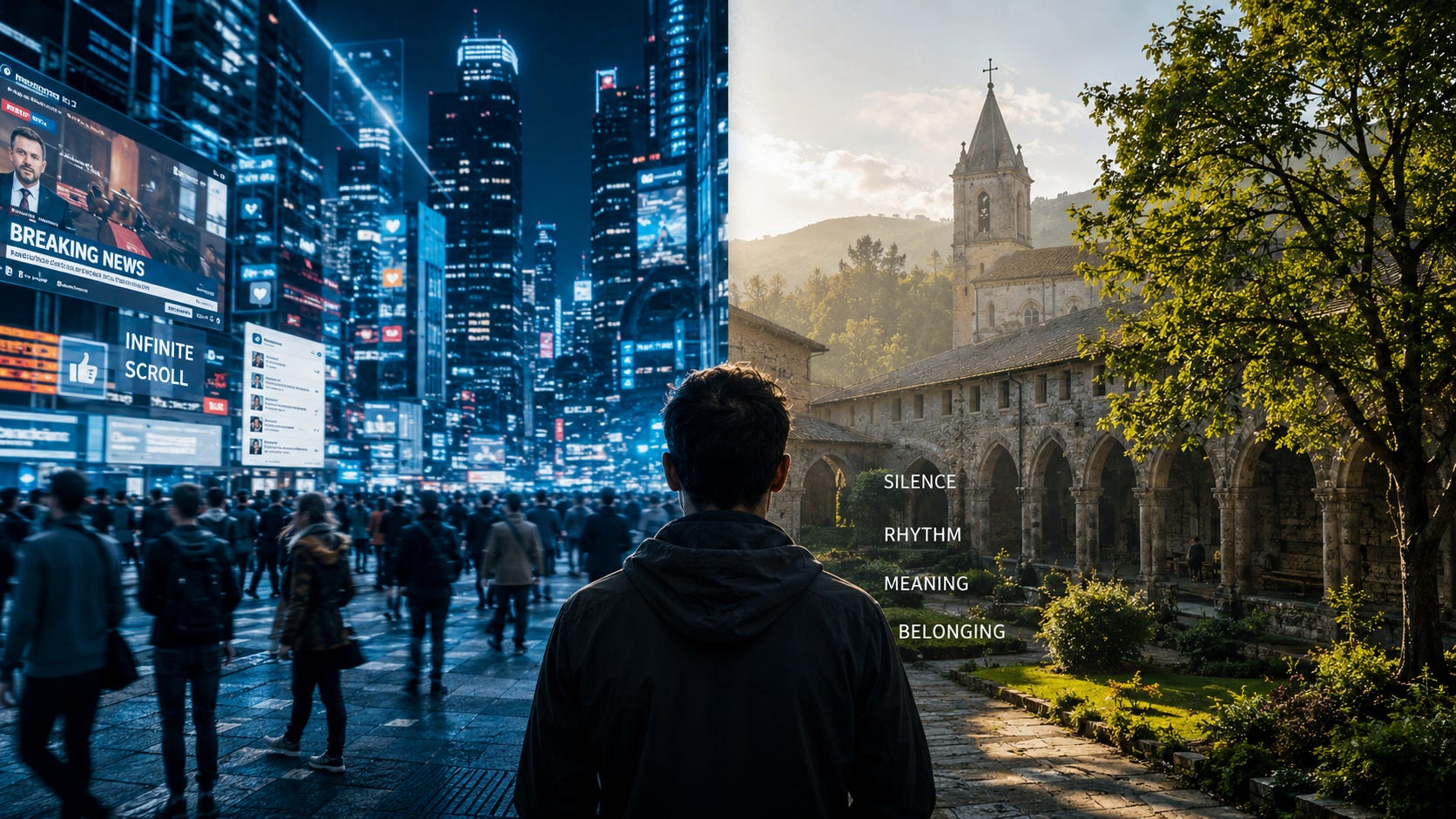
There is a curious sight one may now observe in the modern world. A young man sits alone in a small apartment lit not by candles or hearth-fire, but by the pale blue glow of three screens. One screen streams endless short videos. Another carries the chatter of news, arguments, and advertisements. A third scrolls through messages from people he has not truly spoken to in years. A machine recommends music to him. Another machine suggests what he should purchase, what he should believe, and whom he should fear. Somewhere in the background, another algorithm quietly assembles a portrait of his desires more carefully than any medieval confessor once assembled the state of a human soul.
And yet, in the midst of all this machinery, something strange is happening.
The modern man is becoming obsessed with silence.
He buys noise machines to imitate rainstorms because he no longer hears the weather naturally. He plays recordings of train rides, monastery bells, and old radio broadcasts while he sleeps. He purchases expensive notebooks merely to write slowly by hand. He lights candles in electric rooms. He collects vinyl records not because they are efficient, but precisely because they are not. Young families plant gardens in suburban backyards scarcely larger than monastic courtyards. University students weary of the digital world discover Gregorian chant on streaming platforms built by the very civilization they are trying, for a moment, to escape.
One begins to suspect that modern people are not merely tired.
They are spiritually overclocked.
For the first time in centuries, silence has become a luxury good.
The world promised humanity unlimited connection, unlimited information, unlimited stimulation, unlimited convenience, and unlimited speed. Yet what many souls secretly desire is not acceleration but enclosure. Not infinite connectivity, but walls. Not more noise, but the sound of wind through trees and distant church bells marking the hours.
It is difficult to understand the modern age unless one understands this paradox: the more connected civilization becomes, the more desperately human beings long for places apart.
And so, unexpectedly, the old monastery has begun to haunt the modern imagination once again.
Not necessarily as a literal monastery of stone walls and Benedictine habits, though in some cases that too has returned. Rather, the monastery has returned as an idea — as a symbol of ordered humanity in an age of permanent interruption.
The old monasteries were not merely religious institutions. They were engines of civilization operating according to entirely different principles than the engines of the modern world.
The machine says: faster.
The monastery says: faithful.
The machine says: optimize.
The monastery says: remember.
The machine says: consume.
The monastery says: preserve.
The machine says: never stop.
The monastery rings the bell for silence.
After the collapse of Rome, Europe entered centuries of uncertainty and fragmentation. Roads deteriorated. Libraries vanished. Learning became fragile. Entire regions fell into confusion and violence. Yet scattered across this fractured landscape, small communities of monks quietly kept the lamps burning.
They copied books by hand while kingdoms rose and fell around them. They cultivated gardens. They marked the hours with prayer. They developed methods of agriculture, brewing, architecture, and scholarship. They built clocks not merely to measure productivity, but to sanctify time itself. They believed that ordinary labor could possess dignity because labor itself could become an offering to God.
To the modern mind, this sounds inefficient. And indeed it was inefficient by the standards of industrial civilization.
But the monks were not attempting to produce infinite growth.
They were attempting to preserve a human world.
That distinction matters enormously.
Modern civilization often treats efficiency as though it were the highest moral virtue. We assume that whatever is faster must therefore be better. If a machine can produce something instantly, we call this progress. If communication becomes immediate, we celebrate the destruction of distance. If entertainment becomes infinite, we assume abundance itself is a form of liberation.
Yet the human soul was not designed merely for velocity.
A civilization may accelerate for centuries while slowly forgetting what human beings are for.
This is why so many people today experience a peculiar form of exhaustion that sleep alone cannot cure. The problem is not simply overwork. Medieval peasants often worked harder physically than modern office workers. The problem is not merely busyness. The problem is exposure. The modern citizen lives beneath a perpetual bombardment of stimulation unlike anything in human history.
The machine no longer rests because the machine no longer sleeps.
One may now carry an entire marketplace, newsroom, theater district, casino, and political riot inside his pocket at all times. Every hour of silence is invaded by alerts. Every moment of boredom is instantly medicated by distraction. Solitude has become intolerable because silence itself now feels unnatural.
The tragedy is not simply that people consume too much noise.
The deeper tragedy is that many no longer remember what quiet feels like.
A monk in the twelfth century would likely find modern civilization not impressive, but horrifyingly loud. Not merely physically loud, but spiritually loud. He would observe a civilization in which men scarcely ever stop speaking, yet rarely say anything memorable. He would see endless streams of information combined with startling poverty of wisdom. He would see machinery capable of miraculous production paired with epidemic loneliness and despair.
And perhaps most strangely of all, he would discover that modern men often fear silence more than they fear chaos.
For silence forces a person to encounter himself.
This may explain why so many modern people are rediscovering ancient forms of life without fully understanding what they are seeking. The revival of liturgy, gardening, long-form podcasts, old books, handmade crafts, fountain pens, localism, trains, vinyl records, and even old-time radio all spring from a similar instinct.
People are trying to slow time down enough to feel human again.
There is something revealing in the resurgence of old radio drama. The modern world possesses visual effects beyond anything imagined by the creators of the 1940s. It can generate entire digital universes instantly. It can simulate realities. It can place infinite content before the eyes. And yet countless listeners now willingly return to static-filled broadcasts performed by unseen actors standing before microphones in crowded studios.
Why?
Because old radio leaves room for the imagination.
It does not assault the senses with total visual domination. It invites participation. The listener becomes a collaborator rather than merely a consumer. The mind wanders. The imagination breathes. Human voices possess texture and vulnerability absent from much modern synthetic media.
Old radio is slower.
And therefore, paradoxically, it often feels more alive.
The same phenomenon explains the astonishing rise of long-form conversation in an era supposedly defined by shrinking attention spans. Millions now willingly listen to three-hour interviews and detailed literary discussions. Young people buy thousand-page novels while simultaneously being told that nobody reads anymore. Families leave crowded cities searching for smaller towns, gardens, porches, and parish communities.
These are not isolated trends.
They are symptoms of civilizational hunger.
The modern world has become extraordinarily skilled at delivering stimulation while starving meaning.
Artificial intelligence intensifies this dilemma in profound ways. Machines can now imitate language, music, painting, photography, and even conversation itself. They can produce endless oceans of content with astonishing speed. One may soon generate entire films, books, symphonies, and personalities at the push of a button.
But this creates an unsettling question.
What happens when abundance destroys value?
A handwritten letter possesses meaning partly because a human being sacrificed time to create it. A cathedral matters because generations labored upon it. A novel matters because a mind wrestled with reality long enough to produce it. Human culture has always drawn much of its dignity from limitation, effort, patience, and mortality.
The machine threatens to remove friction from creation itself.
Yet friction is often where humanity resides.
This is why the modern soul increasingly craves things that bear the marks of patience. Bread baked slowly. Music performed imperfectly by real musicians. Stories told by recognizable voices. Old churches worn smooth by generations of prayer. Even imperfections begin to feel comforting because they testify that something human touched them.
The great irony of the digital age is that the more synthetic the world becomes, the more valuable authenticity appears.
And so the monastery returns again.
Not necessarily in literal cloisters, though some young people now do enter them. Rather, the monastic instinct emerges wherever human beings deliberately resist fragmentation. A family that eats dinner together without screens performs a kind of monastic act. A gardener cultivating tomatoes quietly rebels against industrial abstraction. A reader sitting alone with Dickens for three uninterrupted hours practices resistance against the empire of distraction. A craftsman shaping wood carefully by hand declares that efficiency is not the highest good.
Even silence itself becomes revolutionary.
This is perhaps why Benedictine spirituality feels unexpectedly modern despite its ancient origins. The Rule of Saint Benedict was not built upon excitement. It was built upon rhythm. Prayer, labor, reading, rest, and stability formed an integrated life ordered toward sanity rather than stimulation.
Modern civilization increasingly lacks rhythm altogether.
Everything arrives at once. Work invades home. Entertainment invades prayer. Politics invades friendship. News invades sleep. The old boundaries collapse beneath the pressure of permanent connectivity. Human beings become psychologically nomadic, wandering endlessly through streams of information without ever truly inhabiting a place.
But monasteries were built precisely to create places where the soul could dwell.
Their walls were not prisons. They were protections.
The modern world often speaks as though freedom means the removal of all limits. Yet monasteries understood a deeper truth: meaningful freedom frequently requires structure. Music depends upon order. Architecture depends upon limits. Civilization itself depends upon disciplined restraint.
A river without banks becomes a swamp.
And a civilization without silence eventually becomes noise incapable of thought.
It is telling that many of the most peaceful places in the modern world are still libraries, churches, monasteries, old colleges, railway stations, gardens, and quiet cafés — places shaped by rhythm rather than constant stimulation. Human beings continue to seek these places instinctively because the soul remembers what the machine forgets.
The machine forgets that man is not merely a producer or consumer.
He is a creature made for contemplation.
Modernity often assumes contemplation is passive. But contemplation may actually be one of the highest forms of human activity. It is the ability to behold reality without immediately trying to monetize, optimize, weaponize, or consume it. It is the ability to look at stars, architecture, literature, music, prayer, friendship, and nature as gifts rather than resources.
Machines excel at utility.
They cannot experience wonder.
This may ultimately become the great dividing line of the coming age.
The future will not merely separate rich nations from poor nations, or advanced technologies from primitive ones. It may separate civilizations that preserve human attention from those that completely surrender it to machinery.
For attention is not merely an economic resource.
It is the gateway of the soul.
Whatever permanently captures human attention eventually shapes human civilization.
If modern people increasingly feel restless, fragmented, anxious, and spiritually homeless, it may not be because technology itself is evil. Machines can serve magnificent purposes. A cathedral elevator is still an elevator. A monastery may livestream prayer. A physician may use astonishing technologies to heal the sick. An engineer may build systems of extraordinary beauty and usefulness.
The question is not whether machines exist.
The question is whether the machine remains a servant or becomes an atmosphere.
For once machinery colonizes every corner of human life, humanity itself begins slowly to resemble machinery: efficient, distracted, optimized, exhausted, and perpetually restless.
The old monasteries remind us that another form of civilization is possible.
Not a civilization without tools, but a civilization in which tools remain subordinate to wisdom.
Not a civilization without progress, but one that remembers progress toward what.
Not a civilization without information, but one capable of distinguishing knowledge from noise.
And perhaps this explains why so many people now seek refuge in quiet broadcasts, old stories, candlelit rooms, gardens, trains disappearing into evening fog, sacred music echoing through stone churches, and long conversations stretching deep into the night.
They are not escaping reality.
They are searching for it.
Perhaps the future will belong not to those who shout the loudest into the endless machinery of the modern world, but to those who quietly preserve the small human things that machinery cannot manufacture: friendship, memory, craftsmanship, reverence, silence, prayer, and wonder.
The monks once preserved civilization while empires collapsed around them.
The modern world may discover that it needs monasteries again — whether of stone, or simply of spirit.
And somewhere, in a quiet room lit by the warm glow of a lamp rather than the cold glare of a thousand distractions, a human being may once again hear the ancient and liberating sound that modern civilization almost forgot:
silence.