
The Fourth Passenger
Episode I — The Man Who Boarded at Atchison

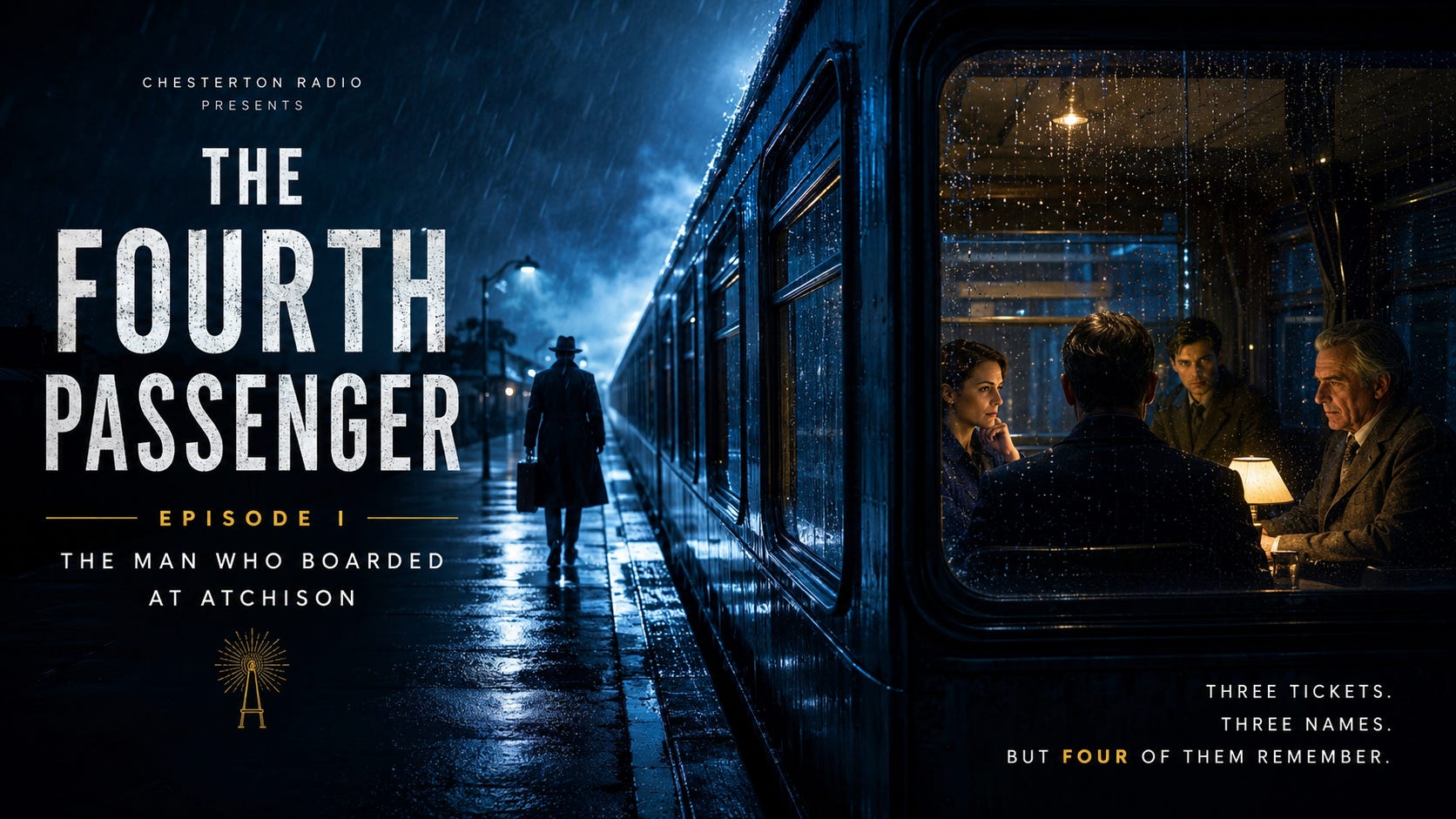
Intro
Some journeys begin with a destination.
Others begin with a question.
Tonight, Chesterton Radio invites you aboard the westbound line departing from Atchison, Kansas — a train moving quietly through rain, darkness, and the sleeping towns of the American Midwest.
Four passengers share a compartment through the night.
At least… that is how one of them remembers it.
By dawn, only three names remain on the manifest.
No record exists of the fourth traveler.
No ticket.
No luggage.
No witness willing to swear he was ever there at all.
And yet something remains behind.
In the tradition of classic railway mysteries, Saturday Night Theatre suspense, and the quiet philosophical unease of the finest literary drama, we present the first installment of a new Chesterton Radio serial:
The Fourth Passenger
Episode I — The Man Who Boarded at Atchison
Settle in.
Listen carefully.
And if, somewhere during the journey, you begin to feel that you have traveled this route before… you may not be entirely mistaken.
The rain began shortly after eleven o’clock, arriving not with thunder or violence, but with the patient certainty of something that had traveled a long distance to get there.
By midnight the streets around the Atchison station were nearly empty.
The old freight warehouses along the riverfront had dissolved into shadows and wet brick. The Missouri moved unseen beyond them somewhere in the darkness, carrying with it whole trees, driftwood, reflections of distant towns, and the black, invisible current of the continent itself. The station lamps shone dimly through the rain like lanterns hung inside fog.
Inside the depot, however, there remained a little island of warmth.
Not comfort exactly. Railway stations are never truly comfortable places after midnight. But there persisted within them a kind of temporary civilization: polished brass rails, tiled floors dampened by boots, low conversations from strangers who would never meet again, the smell of coffee that had stood too long on a burner, and that peculiar atmosphere known only to train stations and ships—an atmosphere made almost entirely of departure.
A porter pushed a rattling cart through the corridor.
Somewhere down the platform a conductor called,
“Westbound Limited now boarding.”
The announcement echoed strangely beneath the high ceiling.
Three passengers waited near the gate.
The first was a woman in her early forties wearing a dark blue traveling coat and carrying a leather satchel that appeared heavier than it should have been. She had the composed exhaustion common among schoolteachers and physicians: the exhaustion of people who spend their lives remaining calm for others. Her name, according to the ticket envelope folded carefully in her glove, was Eleanor Vale.
The second passenger sat two rows away beneath a faded railway advertisement for Colorado Springs. He was broad-shouldered, gray-haired, and dressed in the manner of a businessman who had ceased caring whether his tie remained perfectly straight after nine o’clock. He had the look of a man who once occupied authority comfortably and had lately begun to suspect authority itself might be a temporary illusion. His overnight case bore the initials R.M.H.
The third passenger stood nearest the rain-streaked windows.
He was young—perhaps twenty-six or twenty-seven—and carried no luggage except a canvas rucksack slung over one shoulder. Every few moments he glanced toward the platform as though expecting someone to arrive at the last possible minute.
No one did.
The station clock reached 12:14.
The porter opened the gate.
The three passengers moved out together beneath the long iron canopy toward the sleeping train.
Rain tapped softly against the steel roof overhead.
The Westbound Limited waited in silence, its silver sides reflecting the platform lights in broken ribbons. There was something noble about trains at night. During the day they belonged to schedules and commerce and practical necessity. But after midnight they became something else entirely. One could believe, standing beside them in the rain, that they carried not merely passengers but histories.
The conductor checked their tickets.
“Car Seven,” he said. “Compartment B.”
Eleanor climbed aboard first.
The corridor lights glowed amber against polished wood paneling. The sleeper car smelled faintly of coffee, old upholstery, and steam heat. Somewhere farther forward a radio played low dance music from another age.
She reached Compartment B and paused.
A man was already seated inside.
For a brief instant she assumed she had entered the wrong compartment. Yet the number on the brass plate beside the door was unmistakable.
The stranger rose politely at once.
“I beg your pardon,” he said. “You must be Mrs. Vale.”
His voice was calm and oddly familiar.
Not familiar because she recognized him, but familiar in the way certain places feel familiar the first time one enters them.
“I’m Miss Vale,” she corrected gently.
“Of course,” he said.
He stepped aside courteously as she entered.
By then the other two passengers had arrived behind her.
The businessman frowned immediately.
“I thought this compartment seated four,” he said.
“It does,” replied the stranger.
The young man with the rucksack gave a relieved laugh.
“Well, that settles it then. I was afraid they’d double-booked us.”
The stranger smiled faintly but did not answer.
There was nothing especially remarkable about him at first glance.
He appeared perhaps fifty years old. Dark overcoat. Gray gloves resting beside him on the seat. No hat. His face possessed that difficult quality which prevents immediate description. One could say afterward that he had intelligent eyes or a reserved expression, but neither observation would truly capture him.
What Eleanor noticed most was his stillness.
Most travelers carried with them a slight agitation—as though part of the machinery of motion continued vibrating inside them after boarding. But this man seemed entirely at rest already, as if he had arrived long before the train itself.
The conductor appeared in the doorway.
“All settled?”
“Yes,” said the businessman. “Though I believe one berth remains unassigned.”
The conductor checked his clipboard.
A brief confusion crossed his face.
Then he nodded.
“Quite right,” he said. “Last-minute booking out of Kansas City.”
He glanced toward the stranger.
“Sorry for the inconvenience, sir.”
“No inconvenience at all,” the man replied.
The conductor punched the remaining tickets and moved on.
Moments later the train lurched softly into motion.
Outside, the platform lamps began sliding backward through the rain.
Atchison drifted away.
For a time none of them spoke.
The rhythm of the train settled gradually around them—the deep rolling cadence beneath the floorboards, the occasional metallic sigh from adjoining cars, the faint whistle somewhere ahead beyond the storm.
Finally the young traveler extended a hand.
“Daniel Mercer,” he said. “Graduate student. Or unemployed depending how charitable one feels.”
The businessman shook it.
“Robert Holloway.”
“Sales?” Daniel guessed.
“Accounting.”
Daniel winced theatrically.
“My condolences.”
A smile appeared briefly at the corner of Holloway’s mouth.
Eleanor introduced herself next.
The stranger listened attentively.
“And you, sir?” asked Daniel.
For the first time the man hesitated.
Not awkwardly.
More as though considering which answer belonged to the moment.
“My name,” he said quietly, “is Bell.”
“Just Bell?”
“For tonight, yes.”
Daniel laughed uncertainly, unsure whether this was humor.
But Bell merely looked toward the darkened window where rain traced silver lines across the glass.
The conversation wandered after that into ordinary territories familiar to nighttime trains.
Weather.
Delayed connections.
The strange decline of railway travel.
Daniel spoke enthusiastically about architecture and old industrial towns disappearing across the Midwest. Eleanor admitted she had once loved trains as a child because they made distance feel comprehensible. Holloway contributed dry observations at measured intervals like a man long accustomed to meetings where others preferred hearing themselves speak.
Only Bell spoke rarely.
Yet whenever he did, the compartment seemed to grow quieter.
At one point Daniel remarked that America no longer built beautiful public places.
Bell regarded him thoughtfully.
“That is because people no longer believe they will remain anywhere long enough to deserve beauty.”
No one answered immediately.
Not because the statement was profound exactly, but because it possessed the peculiar weight of something true which had not previously been spoken aloud.
Later Eleanor asked where he was traveling.
“West,” Bell replied.
“That’s rather broad.”
“Yes,” he said softly. “But accurate.”
Around one-thirty the porter arrived to convert the compartment for sleeping.
Berths folded down from the walls.
Blankets appeared.
Lights dimmed.
The train continued westward through the rain.
Eleanor lay awake longer than the others.
The motion of trains had always made sleep difficult for her. One never fully surrendered consciousness aboard them. Part of the mind remained alert to every whistle and vibration as though guarding against unknown stations in the night.
Across from her, Holloway was already snoring faintly.
Daniel shifted occasionally in the upper berth.
Bell sat awake beside the window.
Not reading.
Not smoking.
Simply watching the darkness outside.
At length Eleanor whispered,
“Do you travel often?”
“Yes.”
“You seem accustomed to it.”
“I am accustomed to departures.”
There was something so quietly sorrowful in the reply that she regretted asking further questions.
After several moments Bell spoke again.
“Do you know what is most strange about railways?”
She smiled faintly in the darkness.
“There are many candidates.”
“They reveal,” he said, “how briefly human lives touch one another.”
The wheels murmured beneath them.
“People enter together for a few hours. They speak more honestly than they would elsewhere. Then they disappear forever into separate cities.”
“That sounds rather lonely.”
“It is lonely.”
The rain had stopped outside.
Now only the moonlit plains slid silently past beyond the glass.
Eleanor felt suddenly that the compartment itself had become detached from ordinary geography.
Not lost.
Merely separate.
A moving room suspended between sleeping towns.
“Do you ever see them again?” she asked quietly.
“Sometimes,” Bell answered.
Then after a pause:
“But never in the same way.”
At some point afterward she slept.
When Eleanor awoke, pale morning light filled the compartment.
The train had stopped.
A station platform stood outside beneath a gray dawn sky.
For several moments she remained disoriented.
Then she realized something was wrong.
One berth was empty.
Not merely empty.
Unused.
The blankets were folded neatly against the wall.
No coat.
No gloves.
No trace Bell had occupied the compartment at all.
Daniel climbed down from the upper berth rubbing his eyes.
“Morning,” he muttered.
Then he stopped.
“Where’d he go?”
Holloway looked up from adjusting his tie.
“Who?”
“The fourth passenger.”
Holloway stared at him.
“There wasn’t a fourth passenger.”
Daniel frowned.
“What are you talking about? Bell.”
Neither Eleanor nor Daniel missed the expression that crossed Holloway’s face then.
Not confusion.
Concern.
The kind of concern reserved for someone who realizes another person may be entirely serious about something impossible.
“There were three of us in this compartment,” Holloway said carefully. “You, Miss Vale, and myself.”
Daniel gave a short laugh.
“Very funny.”
“I’m not joking.”
The train began moving again.
Eleanor felt an unexpected chill.
“You spoke with him,” she said to Holloway. “Last night. About the compartment.”
“No,” Holloway replied slowly. “I spoke with the conductor.”
Silence settled heavily over them.
Daniel turned toward the empty berth.
“He was right there.”
No one answered.
Moments later the conductor entered carrying fresh coffee.
“Morning folks.”
Daniel stood immediately.
“The man traveling with us—where did he disembark?”
The conductor blinked.
“What man?”
“The fourth passenger.”
The conductor glanced around the compartment.
Then down at the tickets clipped beside the door.
“Sir,” he said gently, “this compartment only carried three passengers from Atchison.”
Daniel stared at him.
“That’s impossible.”
The conductor removed the ticket stubs and checked them again.
Three names.
Eleanor Vale.
Robert Holloway.
Daniel Mercer.
Nothing else.
The conductor looked mildly uncomfortable now.
“Perhaps you dreamed someone boarded during the night.”
“No,” Eleanor said quietly.
The conductor gave her a polite but uncertain nod and withdrew.
The compartment remained silent after he left.
The train rolled westward through pale fields washed silver by morning rain.
Finally Eleanor reached for her coat.
As she slipped her hand into the pocket, her fingers touched something unfamiliar.
She froze.
Then slowly withdrew a small object wrapped in gray paper.
The others leaned forward.
Inside the paper lay an old brass railway token darkened with age.
Stamped across its surface were the words:
WESTBOUND LIMITED
COMPARTMENT B
1947
And beneath them, almost worn away entirely:
PASSENGER FOUR
Outro
You’ve been listening to The Fourth Passenger — Episode I: The Man Who Boarded at Atchison.
Tomorrow evening, the journey continues with:
Episode II — The Compartment Without a Name
The railway company insists no fourth passenger existed.
But memory is becoming unreliable.
A photograph taken during the night reveals something impossible.
A conductor begins to doubt his own records.
And somewhere along the westbound line, a forgotten station waits in the dark.
If you enjoyed tonight’s story, consider subscribing to Chesterton Radio on Substack, where new episodes, original fiction, literary deep dives, classic radio reflections, and companion broadcasts continue throughout the week.
And if these stories mean something to you — if they remind you that mystery, beauty, and human conversation still belong in the modern world — consider becoming a supporting subscriber.
It helps keep the signal alive.
Until tomorrow night:
Mind the timetable.
Watch the windows after midnight.
And should a stranger board your compartment in the rain…
try to remember whether there were three passengers when the journey began.
Good night from Chesterton Radio in Atchison, Kansas.