
The Eighth Day
A Gabriel Syme Chronicle

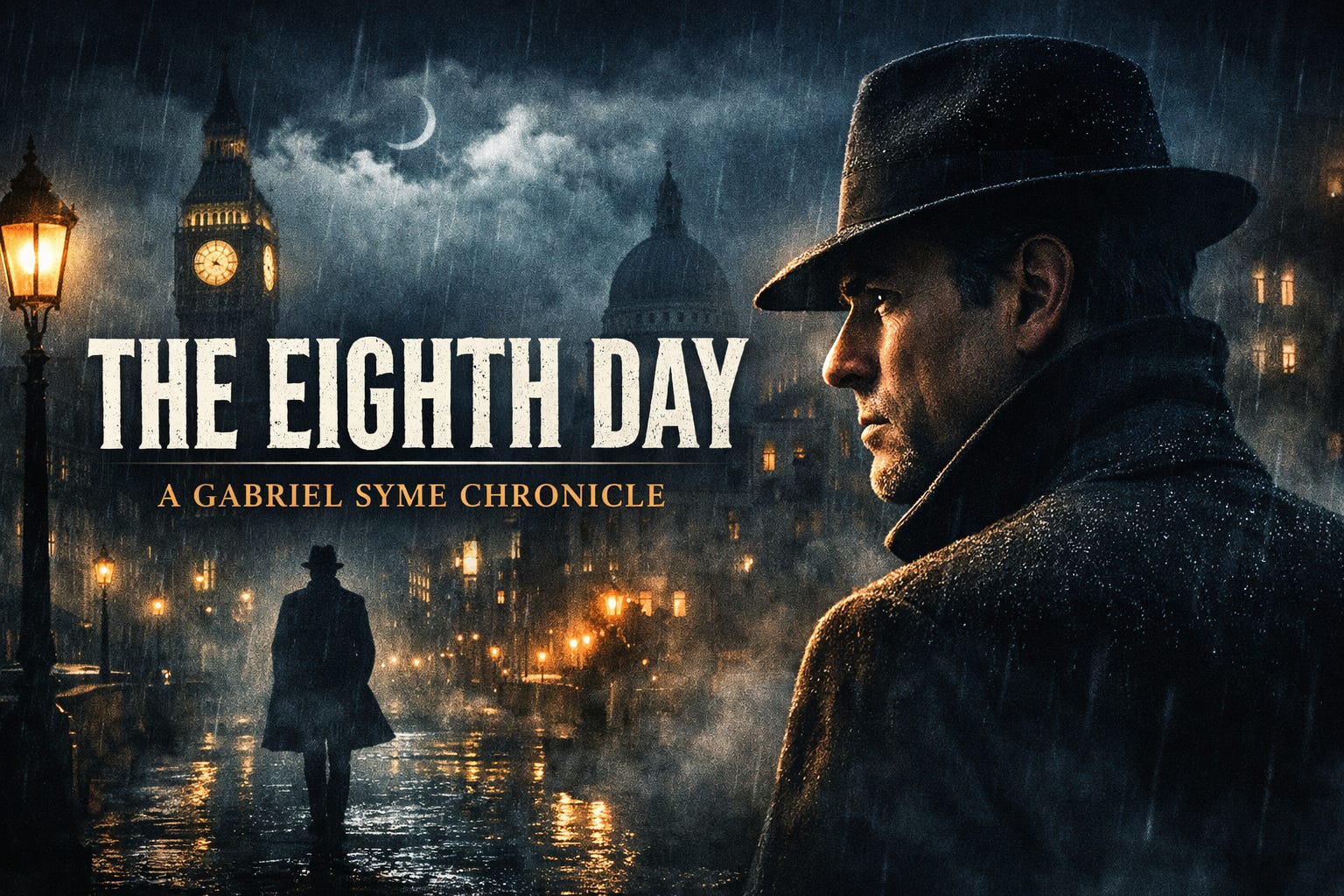
Something has changed in London.
Not with bombs. Not with banners.
But with edits.
Gabriel Syme returns in a new chronicle of intellectual intrigue — where the enemy is not chaos, but the quiet erasure of reality itself.
Welcome to The Eighth Day.
Chapter One: The Man Who Was Remembered
London was quieter than it had been in his youth, which is to say it was louder in ways no one could hear.
Gabriel Syme stood beneath a streetlamp that flickered with bureaucratic indifference and watched the rain rearrange the city. The drops fell with the confidence of old laws; the pavement received them without protest. He had always admired that about rain. It did not hold meetings about its identity.
He was older now. His coat, once defiant, had softened at the collar. His hat was not so much tilted as negotiated. But his eyes remained inconvenient.
A letter had summoned him.
It had not been sealed.
It had not been signed.
It had not even been written in ink.
The words were pressed into the paper as if impressed by a hand unwilling to leave fingerprints:
Mr. Syme,
We regret to inform you that Thursday has been revised.
Dinner at eight.
No address. Only coordinates.
Syme folded the letter as one folds a flag at the end of a war that is not entirely over.
He did not tell anyone he was going.
He suspected someone already knew.
The building was modern in the way that buildings now prefer — glass without confession. It rose like an apology. The doorman did not ask his name.
“You’re expected,” the man said, in a tone usually reserved for funerals and tax audits.
The elevator ascended without visible cables.
On the twelfth floor, the doors opened onto a dining room that might have belonged to a king who feared decoration. A long table stood beneath a chandelier shaped like an algorithm. Eight chairs were arranged with geometric mercy.
Seven were filled.
Syme entered as the eighth.
No one introduced themselves.
No one asked how he had been.
They spoke as if he had only stepped out for a moment to fetch the century.
“We were just discussing continuity,” said a woman whose face seemed edited for clarity. “Mr. Syme, you always preferred paradox to progress, did you not?”
“I prefer progress that contains paradox,” Syme replied, removing his gloves. “Otherwise it tends to devour itself.”
A man to his left smiled in the way a surgeon might before anesthesia.
“We no longer use weekdays,” he said conversationally. “They implied order. We have adopted conditions.”
“Conditions?” Syme asked.
“Yes. Fluidity. Consensus. Revision. Null. Emergence. Sustainability.” The man paused. “And of course — Equity.”
“Which one are you?” Syme asked.
The woman at the head of the table leaned forward.
“We are not individuals in that sense,” she said. “We are functions.”
Syme laughed gently.
“That is precisely what an individual would say before committing mischief.”
There was no laughter in reply.
Wine was poured, though no bottle was visible.
The courses arrived without servants.
A screen at the far wall flickered to life.
It displayed a headline:
HISTORICAL ARCHIVE UPDATED
A smaller subtitle read:
Irreconcilable elements removed for coherence.
Syme felt something ancient stir in his chest — not anger, but recognition.
“You are curators,” he said softly.
“We are gardeners,” the woman corrected. “Reality must be pruned. It grows wild otherwise.”
“And who,” Syme asked, “decides which branches offend?”
The man called Revision spoke next.
“Offense is not the metric. Stability is.”
A silence followed that was too symmetrical to be natural.
Syme reached for his wine.
It tasted like something filtered.
“You have not asked why you are here,” said the woman.
“I assumed you would eventually explain yourselves,” Syme replied.
She tilted her head.
“You are here because you were once Thursday.”
Syme did not move.
Rain streaked the windows like an old memory.
“And Thursday,” she continued, “was built upon the charming superstition that chaos masks order.”
“That superstition,” Syme said, “kept bombs from becoming philosophy.”
“Yes,” she said. “But now we have matured. We do not explode buildings. We dissolve definitions.”
The screen changed again.
Images flickered — statues removed, books revised, words relabeled, biological diagrams updated.
A bakery shuttered for refusing to rename bread.
A teacher dismissed for teaching grammar as if it were gravity.
A child corrected for distinguishing between mother and metaphor.
“You see,” said the man called Null, “when there is no fixed point, there can be no conflict. Conflict requires edges.”
“And edges,” Syme said, “are the only way to draw a circle.”
The woman studied him carefully.
“You remain attached to structure.”
“I remain attached to sanity.”
Dessert appeared — a confection so symmetrical it seemed designed by committee.
The chandelier dimmed.
“We have convened you,” said Equity, “because you represent a dangerous possibility.”
“I am flattered,” Syme replied.
“You believe reality resists revision.”
“It does,” Syme said. “Even your chairs do. Sit wrongly and they protest.”
“Not if one removes the category of wrong,” said Fluidity.
Syme looked around the table slowly.
“You have mistaken exhaustion for enlightenment,” he said quietly. “The world resists you not because it is oppressive — but because it is alive.”
A faint tremor passed through the glass walls.
Outside, lightning briefly sketched the city in honest lines.
The woman rose.
“There will be an announcement tomorrow,” she said. “A minor adjustment. A reclassification of certain permanent features.”
“Such as?” Syme asked.
“Human nature.”
The word lingered in the air like incense before a trial.
Syme stood as well.
“You may alter headlines,” he said, “but you cannot edit hunger.”
The man called Emergence leaned forward.
“We already have.”
The elevator descended alone.
Syme stepped into the rain once more.
The letter in his pocket felt heavier.
Across the street, a bakery sign flickered.
Inside, a single light remained on.
The word BREAD glowed stubbornly above the window.
A young man stood within, kneading dough as if participating in a rebellion older than politics.
Syme smiled faintly.
Thursday had not been revised.
It had been challenged.
He adjusted his hat — not tilted, but deliberate.
Somewhere above him, glass towers debated gravity.
But the rain still fell.
And it fell downward.
If you believe that words still have weight,
that bread is not improved by renaming it,
and that reality does not require revision—
then you already understand why stories like this must be told.
The Eighth Day continues next week.
Chesterton Radio exists because readers choose to sustain it.
If you would like to help keep the lamps lit, consider becoming a supporting subscriber.