
The Blind Carpenter
A Gabriel Syme Mystery of Hidden Design and the Men Who Hold the World Together

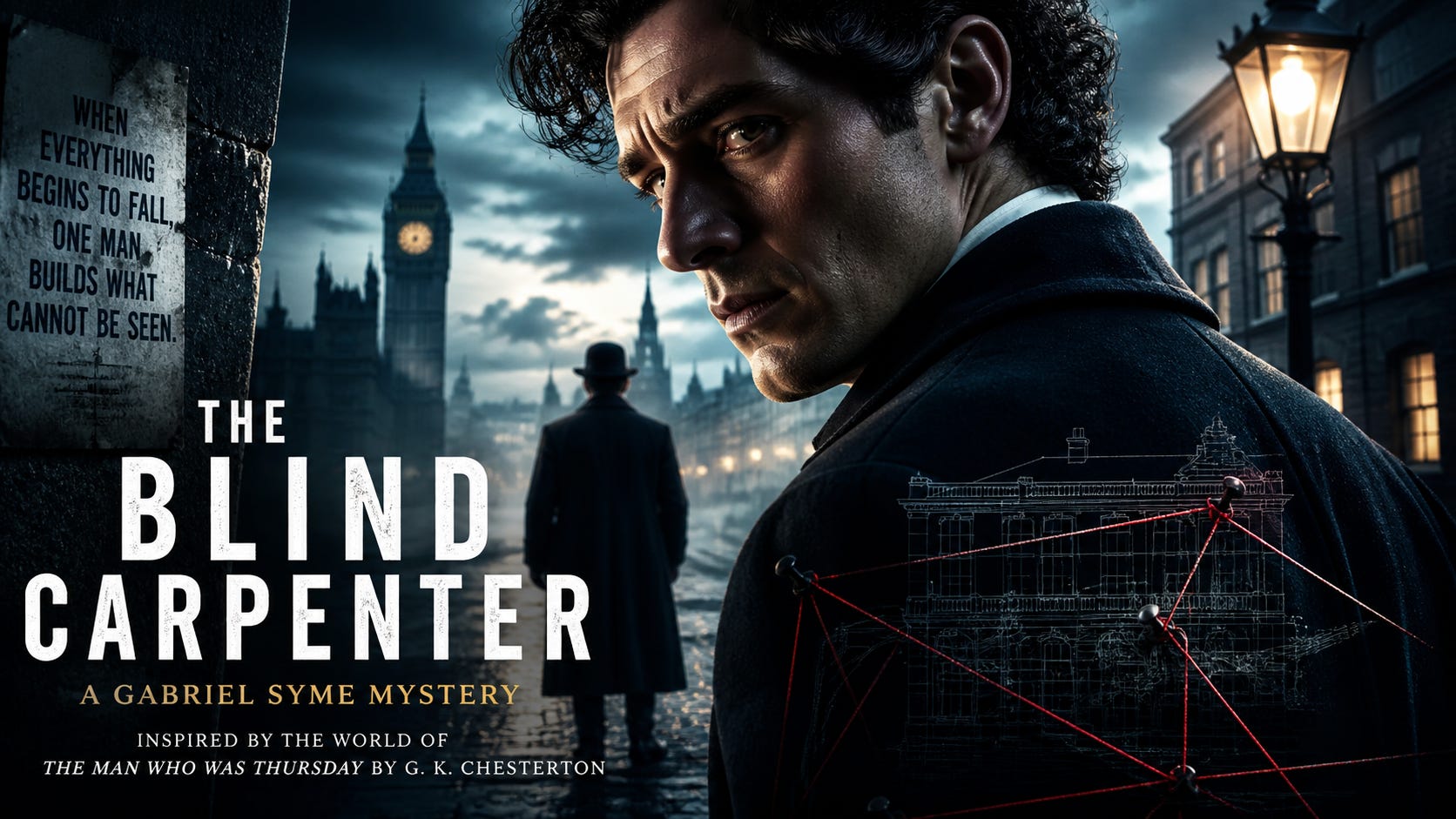
Gabriel Syme first appeared in G.K. Chesterton’s The Man Who Was Thursday, where reality itself proved stranger than conspiracy. This story follows him into another mystery—one no less unsettling.
The First Arrangement
There are some crimes that shout, and some that whisper; but the most dangerous are those that are politely arranged. In a quiet London room, a chair gives way, a beam shifts, and a man nearly dies—not by violence, but by agreement. Gabriel Syme, poet turned detective, begins to suspect that the world is not merely unstable, but adjusted—that unseen hands are placing things just so, not to break them, but to let them break themselves. And somewhere between a blind carpenter who builds what cannot be seen and a smiling antagonist who prefers things to fall, Syme discovers that the true struggle is not between order and chaos—but between those who hold, and those who quietly let go.
THE BLIND CARPENTER
A Gabriel Syme Story
Part I
There are rooms which appear to have been built by architects and rooms which appear to have been built by accomplices. The library of Sir Julian Maine belonged emphatically to the latter class.
It was not merely that the furniture was well chosen; it was that it seemed to have been chosen with intent. The chairs did not invite rest so much as agreement. The long table did not merely hold papers; it arranged them into significance. Even the books along the wall—heavy, sober volumes in brown and black—had the air of having been consulted in advance, as if they had been asked not what they contained but what they would support.
Gabriel Syme stood near the hearth, turning his hat slowly in his hands, and regarded the room with a certain polite suspicion.
Sir Julian Maine, who had spent much of his life in public offices where things were decided without being explained, stood opposite him, speaking with controlled urgency.
“I am not an excitable man, Mr. Syme,” he said. “I have seen governments fall, currencies collapse, and reputations dissolve in a week. I do not alarm easily.”
“That is precisely why I am listening,” said Syme.
Sir Julian nodded, and crossed to the writing table.
It was a careful crossing.
He did not avoid any obstacle; there was nothing obvious to avoid. But he passed slightly wide of a chair near the centre of the room, as a man might pass wide of a stranger in a dark alley without admitting to himself that he had done so.
Syme noticed it, and said nothing.
“I have received these,” Sir Julian continued, handing over a folded paper.
Syme opened it.
On the page were several diagrams: circles intersecting lines, triangles inscribed within squares, and a number of small black dots placed at apparently meaningless points.
“Most threats,” said Syme, “have the advantage of being written in English.”
“These are not threats,” said Sir Julian. “They are… arrangements.”
Syme raised an eyebrow.
“That is a more alarming word.”
“There were three of them. Each arrived without explanation. Each corresponded—so far as I can tell—to a place in this room.”
Syme looked up.
“And what happens at these places?”
Sir Julian hesitated.
“That,” he said, “is what I should prefer not to discover.”
Syme walked slowly across the room, paper in hand. He compared the diagram to the visible furniture, the positions of table, chair, and shelf. He paused near the chair Sir Julian had avoided.
“Have you touched this chair today?” he asked.
“No.”
“Sat in it?”
“No.”
“Why not?”
Sir Julian’s composure faltered slightly.
“I had the impression—an absurd impression—that it was… unsound.”
Syme crouched beside the chair.
It appeared solid. The wood was polished, the joints clean. But as he pressed lightly on one leg, he felt—not movement exactly—but a reluctance to remain as it was.
He stood.
“Has anything else in the room been moved recently?”
“No. At least—not by me.”
“Servants?”
“They clean, of course. But nothing is rearranged.”
Syme glanced again at the diagrams.
“Have you shown these to the police?”
“I was advised not to.”
“By whom?”
Sir Julian hesitated, then answered with evident reluctance.
“A man who called on me yesterday. He did not give his name.”
“And his advice?”
“That I should not disturb the arrangement.”
Syme smiled faintly.
“That is excellent advice—for the arrangement.”
Sir Julian did not return the smile.
At that moment, there came a faint sound from above.
It was very slight: the smallest creak of timber.
Both men looked up.
The beam that ran across the ceiling was dark and polished with age. It appeared as immovable as the traditions of Parliament.
Syme stepped back.
The room was perfectly still.
Then a book on the table shifted—not falling, but leaning.
“Down,” said Syme quietly.
Sir Julian did not move.
Syme seized him by the arm and dragged him backward.
The movement triggered the room.
The chair gave way—not violently, but precisely. One leg split along a concealed weakness. The table tilted by a fraction. A brass paperweight rolled across its surface, struck a stack of books, and displaced them. The books slid, one by one, with a dreadful deliberation.
A bracket high on the wall loosened.
The beam above shifted just enough.
Everything happened in sequence, each movement prepared by the last.
It was not chaos.
It was choreography.
The bracket fell exactly where Sir Julian had been standing.
The sound, when it struck the floor, was not loud.
That was what made it intolerable.
Silence followed.
Sir Julian sat heavily on the carpet, his face pale.
“What was that?” he said.
Syme looked slowly around the room.
“The room,” he said, “has been instructed.”
The Blind Carpenter
A Gabriel Syme Story
Part II
The police came, as the police generally do, with boots, notebooks, and that honest official expression which means that no conclusion has yet been reached, but several wrong ones are already standing in line.
The inspector in charge was a broad, square man named Harker, whose face had the mournful dignity of a bulldog asked to understand metaphysics. He listened to Sir Julian’s account, inspected the fallen bracket, tapped the broken chair-leg with a pencil, and frowned with increasing satisfaction.
“Well,” he said at last, “it’s plain enough what happened.”
“That,” said Syme, “is almost always the first sign that it has not happened.”
Inspector Harker looked at him with professional patience.
“The chair leg was cracked. The table was overloaded. Bracket loose. Beam settled. One thing knocked another.”
“Exactly,” said Syme. “A very sociable accident.”
The inspector ignored this.
“These old houses,” he continued, “are full of surprises.”
“Yes,” said Syme. “But this one had an appointment.”
Sir Julian, who had recovered some of his dignity, stood by the mantelpiece with a glass of brandy in his hand. He looked older than he had before the accident, as if the fallen bracket had not merely missed his head but brushed something invisible from his face.
“You believe this was attempted murder?” he asked.
“I believe,” said Syme, “that someone has discovered a way to make murder look like housekeeping.”
Inspector Harker snorted.
“With respect, Mr. Syme, you can’t hang a man for making a chair badly.”
“No,” said Syme. “But you may have to hang him for making it too well.”
The inspector turned away with an air of official mercy, and Syme bent again over the diagram Sir Julian had given him. The dots no longer looked meaningless. They were positions. Points of pressure. Places where a careless man would see furniture and a careful murderer would see destiny.
He went to the damaged chair and turned it on its side. The crack in the leg was not new; but neither was it natural. It had been weakened along the grain, not enough to fail at once, but enough to fail when a precise additional weight or vibration reached it. The table leg nearest it bore a slight shaving. The paperweight was not on the portion of the table where a paperweight would naturally lie; it had been placed where it could roll.
Syme stood.
“Sir Julian,” he said, “who has been in this room in the last forty-eight hours?”
“Servants. Myself. You. The unnamed visitor.”
“No tradesmen?”
“A man came to repair the lock on that cabinet.”
“Name?”
“I do not know. He was sent by the agency.”
“What did he look like?”
Sir Julian considered.
“Tallish. Smooth. Dark hair. Quite well dressed for a tradesman.”
“Did he carry tools?”
“Yes.”
“Did he use them?”
Sir Julian frowned.
“I suppose so. He was in the room perhaps ten minutes.”
“Did he repair the lock?”
“No,” said Sir Julian slowly. “Now I think of it, he said the cabinet was beyond his scope and recommended a carpenter.”
Syme’s face changed.
“A carpenter?”
“Yes.”
“Did he give you a name?”
“No. Merely said that I should hear from one.”
The inspector made a note.
“That’s something, anyhow.”
“It is more than something,” said Syme. “It is the first honest thing in the room.”
He left the house shortly after. He did not wait for official permission. Official permission is useful when crossing frontiers, but seldom when crossing from fact into meaning.
London received him with a mild rain, that fine dirty drizzle which does not fall from the sky so much as emerge from the city itself. The lamps had begun to glow though it was still afternoon, and every wet pavement reflected London upside down, which Syme thought was probably the more accurate view of it.
He walked because he did not yet know where he was going. He had learned that when thought is stiff, movement may loosen it. The diagram remained folded in his pocket, but its pattern seemed to reappear everywhere: in the crossing of streets, in the rails of omnibuses, in the ribs of umbrellas, in the wheels of carts.
He passed a tea shop proclaiming HONEST TEA.
“That,” he said to himself, “is either unnecessary or false.”
A few doors later came TRUE UMBRELLAS.
He paused.
“The commercial classes,” he reflected, “are becoming dangerously theological.”
Then he saw the sign.
It hung above a narrow shop-front between a stationer and a shop that sold orthopedic boots.
CARPENTRY DONE BY A BLIND MAN
The words were painted plainly, without ornament. That plainness arrested him. London is full of extravagant claims, but this was not extravagant. It did not say “miraculous carpentry,” or “celebrated blind craftsman,” or “chairs repaired while you wait and wonder.” It stated a fact as if facts were enough.
Syme stood under the sign in the rain.
“A blind carpenter,” he said softly. “There is a phrase which has either escaped from a parable or from a madhouse.”
He opened the door.
A bell rang once.
The shop within was long and narrow, lit by a grey window at the front and a hanging lamp at the back. The smell of clean wood filled it: oak, pine, varnish, sawdust. It was a pleasant smell, but the pleasantness did not reassure Syme. There is nothing more sinister than comfort found in the wrong place.
The first thing he noticed was order.
Not tidiness merely, but order. The tools hung upon the wall in precise rows. Planes, chisels, saws, awls, mallets, braces, squares: each rested in a place so exact that its absence would have cried out like a missing tooth. Boards leaned upright in graduated sizes. Wooden pegs filled shallow trays. Shavings lay in curls around the workbench, but even they seemed to have fallen with discipline.
At the bench stood a man, working.
His hair was iron-grey. His face was lean and quiet. His eyes were open, pale, and useless.
He was planing a strip of oak.
The movement of his hands made Syme uneasy. It was too beautiful. There was no groping, no tentative touch, no adjustment after error. The plane slid forward, withdrew, slid again. The curl of wood rose and fell, thin as paper.
Without turning, the man said, “Good afternoon, Mr. Syme.”
Syme removed his hat.
“You have me at a disadvantage.”
“No,” said the carpenter. “I have no such advantage.”
“You know my name.”
“I know your step.”
“That is worse. A name is public property. A step is a private confession.”
The carpenter smiled faintly.
“Most men confess by walking.”
Syme came farther into the shop.
“And what have I confessed?”
“That you are impatient with riddles but unwilling to abandon them.”
“You are a dangerous judge of footsteps.”
“I am a carpenter,” said the blind man. “I listen for load.”
Syme laid the folded diagram on the bench.
“Then listen to this.”
The carpenter did not touch the paper.
“Sir Julian Maine is alive?”
“Yes.”
“Then the chair failed too late.”
Syme watched him closely.
“You knew about the chair.”
“I knew enough.”
“You arranged for Sir Julian to send for me?”
“I arranged for him to be afraid of not sending for you.”
“That is a delicate distinction.”
“Most important distinctions are delicate.”
Syme leaned against the bench.
“Who are you?”
“Abel.”
“Abel what?”
“Abel is enough.”
“It was not enough for the first Abel.”
The blind carpenter stopped planing for the first time. His face showed neither anger nor amusement, but Syme felt the sentence had struck something.
“No,” said Abel. “It was not.”
There was a silence.
Syme glanced round the shop again.
“Did you make Sir Julian’s chair?”
“No.”
“Did you weaken it?”
“No.”
“Did you know it was weakened?”
“Yes.”
“And you did not warn him plainly?”
“I warned him as plainly as he could bear.”
Syme’s eyes narrowed.
“I have met murderers with better manners.”
“And I,” said Abel, “have met honest men who would rather be killed by a fact than saved by a symbol.”
Syme laughed despite himself.
“My dear sir, I begin to suspect you are not blind at all. No blind man would talk so confidently about what people refuse to see.”
“On the contrary,” said Abel. “Only a blind man can afford to believe that sight is overrated.”
He took a chisel from the wall without searching for it and laid it on the bench.
“Sight is the most popular of the senses because it flatters pride. A man sees a wall and thinks he knows the house. He sees a face and thinks he knows the soul. He sees a chair and thinks it will hold him.”
“And you?”
“I touch the joint.”
Syme picked up the chisel and examined it.
“You are suggesting that Sir Julian’s room was not attacked, but joined wrongly.”
“No. It was joined very well.”
“For murder?”
“For collapse. Murder was only one of the uses.”
At that moment there came from the dimmest corner of the shop a soft laugh.
It was not a loud laugh, nor even a merry one. It had the exact politeness of a man applauding a performer whom he intends to shoot afterward.
Syme turned.
A figure rose from a deep chair near the back wall. The chair had hidden him completely, though Syme could not afterwards decide whether this was because the corner was dark or because the man had some talent for resembling furniture when convenient.
He was slim, dark-haired, and dressed with quiet elegance. His face was smooth, almost young, but his eyes had the old amusement of a man who has never been surprised except by virtue.
“Mr. Gabriel Syme,” he said, bowing. “The celebrated poet-policeman. I have always admired that combination. It proves that even the state occasionally employs imagination, though usually by accident.”
“And you,” said Syme, “are the gentleman who repairs locks by recommending carpenters.”
The stranger smiled.
“Not repairs. Liberates.”
“Locks?”
“Situations.”
He stepped forward and offered a hand. Syme did not take it.
“Crook,” said the man. “Mr. Crook.”
Syme glanced at Abel.
“That is a bold name to use in company.”
“A family name,” said Crook. “I have found it saves time. Respectable men spend half their lives pretending not to be what their names would tell us if names were honest.”
“You are frank, then.”
“No,” said Crook. “Only economical.”
He walked to a small stool near the wall and lifted it with two fingers.
“Abel makes admirable furniture,” he said. “He believes in the old superstition that things should stand.”
“It is not an uncommon prejudice.”
“No. Priests, policemen, architects, husbands, and bankers are devoted to it. They all share the curious conviction that a vertical object is morally superior to a horizontal one.”
He set the stool in the middle of the floor.
It was small, plain, three-legged, and apparently solid.
Crook touched one leg lightly.
“Sit down, Mr. Syme.”
“Thank you,” said Syme. “I never sit when a philosopher offers me furniture.”
Crook laughed.
“Excellent. Suspicion is the beginning of balance.”
He flicked the stool.
It collapsed instantly.
Not broke. Collapsed. The legs slid outward, the seat dropped, and the whole thing lay on the floor in three obedient pieces.
Crook looked down at it with affection.
“There,” he said. “Truth.”
Syme looked at the broken stool.
“It resembles bad carpentry.”
“It resembles honest carpentry. Everything wishes to fall. Every upright thing is an argument against its own nature. The stone falls, the tree falls, the man falls, the empire falls. Abel lies to wood. I invite wood to confess.”
Abel spoke without turning.
“You do not invite. You tempt.”
Crook bowed slightly toward him.
“My dear Abel, temptation is only an invitation addressed to something that already wants to accept.”
Syme said, “And Sir Julian’s chair accepted?”
“Sir Julian’s chair had been unhappy for years.”
“You tried to kill him.”
Crook’s expression became almost reproachful.
“How crude. I did not try to kill Sir Julian. I placed several truths near him and waited for them to agree.”
“You expected the agreement to be fatal.”
“I expected it to be accurate.”
Syme moved closer to him.
“I have known anarchists before. They threw bombs.”
“Children,” said Crook. “Bombs are vulgar. They confess impatience. A bomb is a man shouting at matter. I prefer to whisper.”
“And what are you whispering to London?”
Crook’s smile thinned.
“That it is tired.”
The word hung in the shop.
Outside, rain tapped against the window. Inside, Abel’s blind face remained still, but his hand rested now upon the edge of the bench with quiet force.
Crook continued.
“Look at this city. Houses propped against houses. Laws propped against customs. Fortunes propped against lies. Marriages propped against habit. Governments propped against fear. Churches propped against memory. Everything patched, wedged, braced, and painted. I merely remove the wedges.”
“And then?”
“And then we see what was true.”
Syme said, “A corpse is not truer than a man because it is lying down.”
Crook’s eyes brightened.
“That is very good. You have a gift for epigram, Mr. Syme. It is the last refuge of those who still wish the world to be witty rather than naked.”
Abel said, “Leave.”
Crook turned to him.
“You hear? The blind carpenter dismisses the visible sinner. There is almost too much symbolism; it becomes indecent.”
“Leave,” repeated Abel.
Crook picked up his gloves from the chair.
At the door he paused beside Syme.
“You should be careful,” he said. “Now that you know furniture can betray you, you may find the whole city rather intimate.”
He opened the door and stepped into the rain.
The bell rang once.
Then he was gone.
For several seconds neither man spoke.
Syme walked to the collapsed stool and nudged it with his foot.
“He is mad.”
“Yes,” said Abel.
“But not confused.”
“No.”
“That is worse.”
“Yes.”
Syme turned.
“What is he doing?”
Abel began gathering the pieces of the stool.
“He is making an argument.”
“With chairs?”
“With anything that stands.”
Syme looked toward the wet window.
“And you?”
Abel fitted one leg back into the stool, feeling the joint with his thumb.
“I answer.”
The next morning Syme learned what Abel meant.
It began outside a baker’s shop in Fleet Street. Syme had gone there not because he expected to find crime among loaves, though London has produced stranger scandals, but because one of Sir Julian’s diagrams had included a point that corresponded roughly to that address.
The morning was loud and damp. Carts clattered. Boys shouted headlines. Clerks hurried past with the anxious step of men who feared being late to work that would outlive them. A baker’s assistant stood on the pavement carrying a tray of rolls and looking as if he had lost faith in bread.
Syme watched the shop-front.
Nothing happened.
That was what alarmed him.
After ten minutes, a barrel rolled from a delivery cart across the street. It was not rolling fast. It rolled with an innocent, stupid, cylindrical cheerfulness. A driver shouted. A horse shifted. A boy jumped aside.
The barrel struck the curb, bounced, and came to rest near a drain.
Several men laughed.
Syme did not.
He had seen that the horse’s shift had forced a hansom cab half a yard farther into the road. The hansom delayed an omnibus. The omnibus halted beside a ladder leaning against the baker’s wall. A workman at the top of the ladder leaned out to steady himself.
Above him, a cracked stone cornice trembled.
Syme ran.
He did not know exactly where to run, which is the disadvantage of dealing with intelligent disaster. He seized the bottom of the ladder and dragged it sideways just as the stone came down. It struck the pavement, shattered, and sent fragments across the street.
The workman swore. The crowd shouted. The horse bolted.
At that instant a stack of timber beside the shop door, delivered apparently by mistake, toppled outward and blocked the horse’s path. The animal reared, then stopped.
Syme stood breathing hard.
A small elderly man near him said, “Lucky that wood was there.”
Syme looked at the timber.
On the end of the top board was a small mark: a carpenter’s triangle cut into the grain.
Abel.
Syme turned slowly and saw Crook across the street.
He was standing beneath a striped awning, holding an umbrella, smiling with sincere appreciation. He lifted two fingers to his hat, as if congratulating Syme on a move in chess.
Then he vanished behind an omnibus.
The second incident came that afternoon near Ludgate Hill.
A church bell was to ring at two. Syme knew this because Abel had sent him a note consisting of only four words:
Listen when bells disagree.
Syme hated cryptic instructions almost as much as he hated obvious explanations, but he went.
The church was old, soot-blackened, and wedged between commercial buildings like a saint trapped at a bankers’ dinner. At two o’clock, the bell did not ring.
A crowd of clerks, released from nearby offices, began crossing the road at the usual moment when the bell should have sounded. At the same time, a cart heavily laden with iron rods came downhill faster than it should.
Syme saw the whole pattern in a flash.
The missing bell had altered the crowd’s rhythm. The crowd delayed the cart. The cart swerved toward a narrow passage where three children were playing with a hoop.
Syme rushed to the church door, found it locked, and cursed with almost theological restraint. Then he saw the bell rope through a broken pane in the side entrance. It hung slack.
He smashed the pane with his elbow, reached through, seized the rope, and pulled with all his weight.
The bell rang once.
A harsh, violent note.
The crowd stopped and turned.
The cart had just enough space to pass.
The iron rods slid loose and clattered harmlessly into the gutter.
Syme looked at the rope. It had been cut through in three strands—almost enough to fail, not quite enough to be noticed. Around the remaining strands was bound a narrow strip of fresh leather, holding it for one final pull.
Abel again.
As Syme stepped back into the street, a voice behind him said, “Very athletic for a poet.”
Crook stood in the churchyard gate.
“You are following me badly,” said Syme.
“No,” said Crook. “You are following me beautifully. That is the inconvenience.”
“You cut the rope.”
“I persuaded it to remember it was hemp.”
“You nearly killed three children.”
Crook looked genuinely offended.
“My dear Syme, sentiment is the most disorderly of all mental habits. Children die every day.”
“And therefore these should?”
“Therefore these are not special.”
Syme’s face hardened.
“That is where you are wrong. Every child is special. It is grown men who become interchangeable by effort.”
Crook stared at him for a moment, then laughed softly.
“You really are more dangerous than Abel said.”
“Abel talks about me?”
“Only as one discusses an unstable beam.”
Syme advanced a step.
Crook did not retreat.
“You think me cruel,” Crook said. “I am not cruel. Cruelty enjoys pain. I enjoy truth.”
“Truth again.”
“Yes. You object because my truth bruises people. But your truth is padded with cushions, upholstered with illusions, varnished with public sentiment. You believe things ought to stand because they have stood yesterday. Abel believes they ought to stand because he has touched their joints. I believe they ought to fall because they can.”
“A philosophy,” said Syme, “that must make breakfast difficult.”
Crook smiled.
“Not at all. Toast is already fallen bread.”
Syme almost laughed, and disliked himself for it. The danger in Crook was not that he was humorless, but that his humor had no charity in it. He could see the joke in the universe, but not the joke’s redemption.
Crook stepped closer.
“Tomorrow,” he said, “you will begin to understand scale. Today you have saved a politician and three children. Very touching. Tomorrow you may attempt London.”
“What happens tomorrow?”
Crook’s face became bright and still.
“At four o’clock,” he said, “the city will tell the truth.”
Then he struck the iron gate with the ferrule of his umbrella.
The gate swung inward. Syme instinctively stepped aside.
A heavy stone urn from the gatepost above fell and smashed exactly where his head had been.
By the time the dust cleared, Crook was gone.
That evening Syme returned to the carpenter’s shop.
He found Abel not at the bench but in the back room, which Syme had not yet seen. It was larger than the shop-front suggested, lit by three hanging lamps and crowded with constructions that seemed at first nonsensical. Wooden frames, counterweighted arms, model staircases, hanging cords, miniature bridges, blocks, pegs, maps, and pulleys filled the room from floor to ceiling. Strings stretched across it in dozens of directions, some taut, some slack, some running through small brass eyes screwed into the walls.
At the centre stood a large incomplete frame of oak.
It rose taller than a man and was braced at strange angles. It looked partly like a chair, partly like a scaffold, partly like a musical instrument designed for a giant with a grim taste in hymns.
Abel stood beside it, running his fingers over a joint.
“You are losing,” said Syme.
Abel did not turn.
“Yes.”
Syme waited for qualification. None came.
“That is a dishearteningly simple answer.”
“It is a simple condition.”
Syme walked round the frame.
“What is this?”
“A correction.”
“For what?”
“For an error not yet complete.”
“Crook says tomorrow at four.”
“Yes.”
“And what happens then?”
Abel placed a peg into one of the joints and tapped it once with a mallet.
“A conclusion.”
Syme sighed.
“I sometimes wonder whether the modern world went wrong when men stopped answering questions and started naming abysses.”
Abel smiled faintly.
“Crook has placed many small failures across the city. None is large. A loosened support. A delayed bell. A missing wheel-pin. A diverted crowd. A door that will not open. A door that will open too easily. A signal changed three minutes late. A horse frightened at the wrong corner. A magistrate delayed. A theatre filled and emptied at the wrong time. Individually, accidents. Together, an argument.”
“What argument?”
“That the city should fall.”
Syme looked at the network of strings.
“And you are building an answer?”
“Yes.”
“Can you stop him?”
“No.”
Syme turned sharply.
“Then what can you do?”
Abel touched the frame.
“I can give the fall somewhere else to go.”
Syme stared at him.
The lamps hummed faintly. Outside, rain struck the window. The great frame stood between them like a wooden question.
“That,” said Syme slowly, “sounds like sacrifice disguised as engineering.”
“It is all engineering,” said Abel. “The Cross was erected by practical men.”
Syme was silent.
Then he asked the question he had avoided.
“Why are you blind?”
Abel’s hand stopped.
For a long while he did not answer.
Then he said, “Because when I could see, I saw wrongly.”
He sat on a low bench beside the frame.
“Crook and I were boys together. Apprentices—not to wood, but to an old man who thought he could teach us the structure of things. He taught us weights, stresses, causes, consequences. He showed us that nothing stands alone. A window depends on a wall, a wall upon a foundation, a foundation upon earth, earth upon God knows what. He meant us to become humble.”
“And Crook?”
“Crook became honest instead.”
“That sounds less bad.”
“It is sometimes worse. Humility sees dependence and gives thanks. Pride sees dependence and calls it fraud.”
Abel’s face turned slightly toward the lamp, though his eyes saw none of it.
“There was a factory. Bad beams. Bad owners. Bad calculations. I saw the failure before it happened. I could have warned them. I did not. I wished to see whether my calculation was right.”
Syme said nothing.
“It was right,” Abel said. “Seventeen men died.”
His voice remained level, but the steadiness made the confession more terrible.
“Afterward I woke in hospital. My eyes remained. The world did not. Since then I have known that seeing is not innocence.”
“And Crook?”
“He came to me afterward. He said the collapse had been beautiful because it had been truthful. That was the day I knew he had become my brother’s murderer, though he had touched nothing.”
Syme looked at the frame.
“And you have been answering him ever since?”
“Yes.”
“By carpentry.”
“By repentance.”
A sound came from the front shop.
A bell.
Not the doorbell. A smaller sound. Metal against glass.
Syme turned.
Before he could move, the front window shattered inward. A heavy iron weight flew through the room, struck one of the hanging frames, and sent a chain of tools clattering from the wall.
Abel moved left before Syme saw why. A falling saw missed him by an inch and buried itself in the bench.
Syme ran into the front shop.
The street outside was empty except for a boy with a handcart disappearing round the corner. On the floor among the glass lay the iron weight. A card was tied to it with black thread.
Syme picked it up.
On it was written:
FOUR O’CLOCK.
DO BRING THE POET.
—CROOK
Syme returned to the back room.
Abel had already begun resetting the disturbed tools, his blind hands moving quickly.
“He is impatient,” said Syme.
“No,” said Abel.
“What then?”
“Certain.”
Syme looked again at the card.
“Tomorrow, then.”
“Yes.”
“And what do you need from me?”
Abel turned toward him.
“For now? Sleep.”
“That is the most unreasonable request yet.”
“You will need your strength.”
“For what?”
Abel laid his hand on the great wooden frame.
“To stand.”
The Blind Carpenter
A Gabriel Syme Story
Part III
Syme did not sleep.
This was partly because Abel had advised it, and Syme had that inveterate English distrust of advice that sounds both wise and impossible. But it was chiefly because London, once suspected, is not a city that permits sleep.
He sat for two hours in his rooms with his boots on, watching the small square of window lighten gradually from black to grey. The furniture around him, formerly innocent companions of bachelor inconvenience, had become a parliament of possible traitors. The chair in which he sat seemed to him less like a chair than like a temporary treaty between wood, glue, gravity, and optimism. The table near the window leaned slightly—not enough to be condemned, but enough to suggest opinions. The curtain cord hung beside the wall with the expression of a snake waiting for theology.
At last, with a sudden impatience, he sprang up and laughed.
“This is intolerable,” he said aloud. “If I am to be murdered by domestic objects, I would rather meet them in the street.”
He breakfasted at a coffee-house near the Strand, where the waiter dropped a spoon and Syme nearly drew his revolver. He then spent ten minutes apologizing with so much eloquence that the waiter concluded he was either a gentleman or insane, which in certain districts of London came to much the same thing.
At half past eight a boy entered the coffee-house, looked round with that air of preternatural intelligence common to messenger boys and street sparrows, and approached Syme.
“Mr. Syme?”
“Yes.”
“Blind gent sent this.”
He handed over a small wooden token, about the size of a large coin. On one side was cut a triangle. On the other, three words:
TEMPLE BAR. NINE.
Syme looked at the boy.
“What did the blind gentleman look like?”
“Couldn’t say.”
“That is either a philosophical answer or a lazy one.”
“He had a hat,” said the boy defensively.
“A conclusive identification. Did he say anything else?”
“Said not to be early.”
Syme glanced at the clock.
It was twenty minutes to nine.
“Ah,” he said. “A man who asks punctuality of a poet is already half a tyrant.”
He paid and went out.
The morning had the bright, sharp air that often follows rain in London, as if the city had been washed but not morally improved. Omnibuses lumbered by, horses steamed, clerks hurried eastward, and newspaper boys screamed fresh disasters with professional hope. At Temple Bar, or what remained of its memory in the habits of men, Syme found nothing at first but the usual congestion of purposeful confusion.
Then he saw it.
A furniture van had halted at an angle near the curb. The driver stood arguing with a constable. Two men were unloading a tall wardrobe from the back. It was a heavy, dark piece, absurdly ornate, with carved cherubs on top that looked less angelic than predatory.
Syme crossed toward it.
Before he reached the van, the front wheel sank suddenly into a shallow hole in the road. The van tilted. The wardrobe slid.
One of the workmen shouted.
The wardrobe began to fall—not toward the street, but toward the pavement, where a woman carrying a baby had just stopped beside a lamppost.
Syme ran.
So did a dozen others. But they ran as crowds do, in all directions and into one another. Syme, seeing he could not reach the woman in time, flung himself against the wardrobe itself. For one wild instant he became part of its fall. His shoulder struck the polished wood; pain shot down his arm. The wardrobe slowed, turned half an inch, and struck the lamppost instead of the woman.
The lamppost bent but held.
The woman screamed. The baby, with admirable English stoicism, continued chewing a glove.
The constable seized Syme by the collar.
“Here now! What are you about?”
“Furniture criticism,” said Syme, gasping. “A neglected branch of public safety.”
The constable stared.
At that moment an elderly shopkeeper came running from a nearby doorway.
“My lamppost!” he cried, though it was not his lamppost and had probably never been emotionally close to him.
Syme ignored him. He crouched by the van wheel. The hole into which it had sunk was not a pothole. It had been cut. Not widely. Not crudely. A small crescent had been removed from the road surface where the iron rim would strike under load.
He then examined the wardrobe.
One of its rear feet had been shortened by perhaps a quarter of an inch.
That was all.
A hole and a short foot.
A city may be nearly murdered by smaller things.
He stood and saw, pasted to the back of the wardrobe, a scrap of paper bearing a single black line: a diagonal slash through a square.
Crook’s mark, if such a man could be said to sign anything.
Then he saw, wedged into the hollow base of the lamppost, a fresh piece of oak cut to a taper. It had braced the post from within. Without it, the lamppost would have snapped, the wardrobe would have fallen, and the woman and child would have been crushed.
On the oak was Abel’s small triangle.
Syme turned slowly, searching the crowd.
No Abel. No Crook.
Only London: annoyed, curious, late for work.
A cab drew up beside him. The cabman leaned down and said, “Mr. Syme?”
“Yes.”
“Blind gent says get in.”
Syme looked at the cabman.
“Did the blind gent say where?”
“Billingsgate.”
“Of course,” said Syme. “When theology becomes carpentry, it naturally ends in fish.”
He climbed in.
The cab rattled eastward through streets that seemed, to Syme’s newly awakened suspicion, less like thoroughfares than like the exposed workings of a clock. Every crossing was a calculation. Every halt of traffic was a temporary miracle. He saw how one cart compelled another, how a barrel delayed a boy, how a dog altered the path of a banker, how the banker’s delay caused a flower girl to step aside, and how the flower girl’s step caused a gentleman with a red beard to drop his umbrella into the gutter.
Formerly such things had seemed to him comic. Now they were still comic, but more solemnly so. Comedy, he reflected, is not the denial of order but the discovery that order has a sense of humor.
At Billingsgate the air struck him like a theological argument conducted by fish. The market was noisy, wet, slippery, and aggressively alive. Men shouted over crates. Porters carried baskets. Scales swung. Water ran along the stones. The whole place was an empire of surfaces on which no man should trust his footing or his philosophy.
Syme saw Abel standing under an archway.
The blind carpenter looked entirely out of place among the shouting fishmongers, and yet less lost than Syme felt. He held a walking stick in one hand and a folded paper in the other.
“You came,” said Abel.
“I was summoned by cab, cod, and Providence,” said Syme. “What is happening here?”
Abel held out the paper.
It was a map, not of the market only, but of several adjoining streets and alleys. Certain points were marked in pencil.
“Crook has altered three lines of movement,” Abel said.
“Human movement?”
“Carts. Men. Water.”
“Water?”
Abel turned his head slightly.
“Do you hear the pump?”
Syme listened. Beneath the shouting and the clatter, there was a steady mechanical knocking from somewhere behind the market.
“Yes.”
“It should stop in four minutes.”
“And if it does?”
“That gutter floods. The porters take the upper lane. A coal cart is delayed. A brewer’s wagon passes two minutes early. A horse shies at the smell of tar. The wagon strikes the temporary platform outside Markham’s warehouse.”
“And then?”
“The platform falls into the street.”
“On whom?”
Abel’s face was grave.
“On no one important.”
Syme looked at him sharply.
“No one important?”
“That is why Crook chose it. The first collapse need not kill a minister or a child. It only needs to move traffic.”
Syme understood.
“It is not the death. It is the timing.”
“Yes. At four o’clock, every delayed and advanced thing must meet.”
Syme folded the map.
“And the pump?”
Abel pointed.
“There.”
Across the market, beyond two rows of stalls, a narrow passage led to a yard where the pump-house stood.
Syme started toward it.
Abel caught his sleeve.
“Not that way.”
“Why?”
“Because Crook knows you will run.”
Syme stopped.
“That is becoming an inconvenient habit of his.”
“Walk,” said Abel. “And slip once.”
“What?”
“Slip once. Near the eel baskets. Not badly.”
Syme stared.
“My dear Abel, I have received many instructions in dangerous circumstances, but never before have I been told to fall down with moderation.”
“Do it.”
Syme sighed.
“There is no tyranny like that of the practical mystic.”
He walked into the market.
At first he felt absurdly self-conscious. It is one thing to risk death; it is another to perform a planned stumble before fishmongers. He passed a man gutting fish, a boy washing a stall, two porters arguing about the weight of a crate, and then saw the eel baskets.
At that moment, someone shouted behind him.
Syme allowed himself to turn too quickly. His foot slid on wet stone. He fell against a stack of baskets, knocking them sideways into the path of a porter carrying a box of ice.
The porter swore magnificently. The ice box tipped. Water and shattered ice spilled across the passage.
A cart horse entering the passage stopped short, refusing the glistening ground. Its driver cursed, pulled, and lost half a minute.
Syme rose, wet and bruised.
A fishwife laughed at him.
“Mind your feet, mister!”
“Madam,” said Syme, bowing, “I have spent the morning attempting precisely that.”
He continued to the pump-house.
Behind him, the delayed cart had blocked two others. The whole market pattern shifted—not greatly, but enough.
Inside the pump-house, the air was hot and metallic. A small engine worked noisily. Its belt turned on a wheel. The belt had been cut halfway through and treated with some dark grease. It would last a few minutes, perhaps less.
Syme looked round desperately.
There was no spare belt.
Then he saw it: a leather strap hanging from a nail, too short by itself, but enough if doubled and fastened.
He seized it, climbed onto the engine frame, and worked with clumsy haste. Twice his fingers slipped. Once the belt snapped against his wrist hard enough to draw blood. He had no skill for machinery and resented the fact that machinery had chosen such a moment to notice.
At last he bound the cut belt with the strap. It jerked, shuddered, held.
The pump continued knocking.
Syme climbed down and nearly collided with Crook.
The man stood in the doorway, immaculate amid steam and fish-stink, holding a folded newspaper.
“I must compliment you,” Crook said. “That fall in the market was almost artistic. Not graceful, of course, but Christian.”
Syme wiped blood from his wrist.
“You are early.”
“I am everywhere early. That is the distinction between us.”
“You cut the belt.”
“I weakened it. Cutting is vulgar. A clean cut is a confession of impatience.”
Syme glanced past him. There was no one else in the yard.
Crook stepped inside.
“You know, Mr. Syme, Abel is making you superstitious. Soon you will believe that every accident has intention.”
“And you will tell me none has?”
“No. I will tell you something much worse. Every accident has opportunity.”
He tapped the engine lightly with his gloved hand.
“This pump does not hate those men outside. The horse does not hate the crowd. The platform does not hate the skull it may break. That is what makes the universe so refreshing. It can destroy without malice.”
“But you have malice enough for all of it.”
Crook’s smile faded.
“You still imagine me a villain in a romance. A black figure with a dagger. But I am more modest. I am an editor. I remove the unnecessary adjectives from reality.”
“And leave nouns?”
“And verbs,” said Crook. “Especially verbs. Fall. Break. End.”
Syme stepped closer.
“You speak as if collapse were truth. But collapse may be only laziness. A drunk lying in the gutter is not more truthful than a saint kneeling in a chapel merely because both are low.”
Crook’s eyes glittered.
“Excellent again. You fence well.”
“I am not fencing.”
“No. That is why you are dangerous.”
From outside came a sudden shout.
Crook smiled and moved aside enough for Syme to see through the door. In the yard, a pile of crates had begun to slide from the top of a cart. A boy stood below them, frozen.
Syme rushed past Crook.
It was a simple trap, and therefore almost successful. As he leapt toward the boy, his foot caught on a wire stretched inches above the ground. He fell forward, hit the stones hard, and rolled. The crates came down.
But the boy was no longer there.
Abel had appeared from the side passage and pulled him clear.
The crates smashed open, spilling fish across the yard.
Crook applauded softly from the pump-house doorway.
“Very moving,” he said. “Abel saves the child. The poet embraces the pavement. Everyone contributes according to his gifts.”
Syme struggled to his feet.
Crook bowed and vanished through the rear door of the pump-house.
Syme ran after him, but the door opened onto three alleys, all crowded, all crooked, all empty of Crook.
When he returned, Abel was kneeling beside the boy, who was crying more from surprise than injury.
“You knew about the wire,” Syme said.
“I heard him place it.”
“And did not mention it?”
“You had to fall there.”
Syme stared at him.
“I am beginning to dislike being an instrument of salvation. It is too hard on the elbows.”
Abel rose.
“You did well.”
“I fell well.”
“Sometimes that is enough.”
The boy’s mother arrived then, and gratitude, explanations, accusations, and fish began to mix freely. Syme drew Abel aside.
“How many more?”
“Before four? Many.”
“Can we stop them all?”
“No.”
“Then what are we doing?”
Abel’s blind face turned toward the unseen city.
“Choosing which failures matter.”
By noon, Syme had ceased to think of London as a city and begun to think of it as a vast, badly maintained organ, with Crook pulling out stops and Abel trying to restore harmony with splinters of wood and bruised policemen.
The next point was a warehouse near the river.
A magistrate was to be delayed there by a false message. The delay would prevent him from signing an order. The unsigned order would keep a road open. The open road would carry traffic toward Bell Yard at exactly the wrong hour. Syme only half understood this and suspected that Abel half understood ten times as much.
They reached the warehouse at twelve-forty.
It was a tall brick building with a loading platform and a narrow staircase inside leading to offices above. Men moved barrels on the ground floor. The air smelled of rope, dust, and tea.
“The message,” said Abel, “will come by boy.”
“Every conspiracy in London employs boys,” said Syme. “It is the last respectable industry for the young.”
Abel touched the stair rail.
“This is wrong.”
“What is?”
“The rail has been loosened.”
Syme looked up the stairs.
“Then the magistrate is to fall?”
“No. You are.”
Before Syme could answer, a voice called from above.
“Mr. Syme?”
A man in a brown coat stood at the top landing, waving a paper.
Syme took one step upward.
Abel said sharply, “Wait.”
The man above dropped the paper.
It fluttered down the stairwell.
Instinctively, Syme reached for it. As he did, a barrel from the upper landing rolled loose and came thundering down the stairs.
There was no time to descend.
Syme sprang sideways, seized the loosened rail, and felt it tear away from the wall.
For a moment he hung over the stairwell, the rail in his hands, the barrel crashing past beneath him. The rail wrenched free. He fell.
He did not hit the floor.
A rope tightened round his chest.
Abel had thrown it.
Syme swung against the wall, breath driven out of him, while the barrel smashed below and burst into a cloud of flour.
For a moment the warehouse was white with it. Men shouted. The world became ghostly. Abel stood below, rope in both hands, looking like blind justice after an accident in a bakery.
Syme coughed.
“I dislike,” he said weakly, “being saved by symbolism.”
The man in the brown coat above had vanished.
Abel lowered him.
On the floor, among the flour, Syme found the fluttered paper.
It was blank except for one sentence:
A man who wants to save balance should not lean too far.
Syme crumpled it.
“That man is beginning to repeat himself.”
“No,” said Abel. “He is circling the centre.”
“What centre?”
“Bell Yard.”
Syme remembered the theatre Abel had mentioned.
“Why there?”
“Because theatres are built for suspended disbelief.”
“This is no time for literary criticism.”
“It is a time for exact definitions,” said Abel. “Crook needs many people in motion, and many people suddenly stopped. He needs expectation, doors, stairs, galleries, ropes, gas lines, old beams, false exits, and a crowd that believes what it sees.”
“A theatre,” said Syme slowly.
“Yes.”
“What performance?”
Abel’s expression changed.
“There is a charitable lecture at three. Sir Julian Maine is to speak.”
Syme stared.
“Sir Julian? After yesterday?”
“He insisted.”
“Of course he did. Public men would rather die visibly than live quietly.”
Syme seized his hat.
“We go to Bell Yard.”
“Not yet,” said Abel.
“Why not?”
“Because Crook wants us there early.”
“And if we arrive late?”
“He wants that too.”
Syme looked at him in exasperation.
“Then what does he not want?”
Abel placed a hand on the great warehouse door beside him.
“He does not want us to arrive having changed the route.”
What followed was not a chase in the ordinary sense, for they did not pursue Crook so much as pursue the consequences of his passing.
At one corner they turned a coal cart into the wrong street and thereby prevented a line of cabs from entering Fleet Street. At another, Syme bribed three boys to roll hoops across a crossing, delaying a carriage whose passenger was carrying false instructions. Abel stopped before a row of houses, listened for ten seconds to nothing Syme could hear, then hammered a wedge beneath a basement door and prevented it from swinging open into a crowd.
Each act seemed absurdly small.
Each act, Abel said, mattered.
Syme began to feel that he had entered one of those nightmares in which a man must save the world by placing a teacup correctly.
At half past two they reached a quiet lane behind a printer’s shop. Abel stopped so suddenly that Syme nearly collided with him.
“What is it?”
Abel held up a hand.
From the open window above came the clicking of type.
“A notice is being printed,” Abel said.
“What notice?”
“That the lecture at Bell Yard is cancelled.”
Syme looked up.
“And it is not?”
“No.”
“Why print it?”
“To empty the theatre.”
“I thought Crook needed a crowd.”
“He needs the wrong crowd in the wrong place. He needs the first crowd to leave, the second to enter, and the exits to reverse their function.”
Syme did not wait for the rest. He ran through the printer’s door.
Inside, a thin young printer with ink on his fingers looked up in alarm.
“Here now—”
Syme snatched the proof from the press.
LECTURE CANCELLED OWING TO DANGER IN BUILDING.
“Who ordered this?” Syme demanded.
“Gentleman. Paid cash.”
“Dark hair? Smiled like a well-dressed knife?”
The printer blinked.
“Could say so.”
Syme tore the notice in half.
The printer protested. Syme gave him money, more than enough, and said, “Print instead: LECTURE PROCEEDS AS ANNOUNCED. NO DANGER IN BUILDING.”
The printer looked doubtful.
“But if there is danger?”
“My dear sir,” said Syme, “there is always danger in buildings. That is why architecture is a moral art. Print it.”
The printer obeyed.
When Syme returned to the lane, Abel was gone.
For one cold moment, Syme stood utterly still.
Then he heard a sound.
Applause.
Not from the street. Not from the printer’s shop. From somewhere above or beyond, faint and solitary.
He turned.
Crook stood at the far end of the lane, clapping softly.
“Very good,” said Crook. “You preserved the audience.”
“Where is Abel?”
“Where all good carpenters go.”
Syme stepped toward him.
Crook raised one finger.
“Careful.”
Syme stopped.
Between them, almost invisible in the narrow lane, a rope crossed from wall to wall at ankle height. Above it, suspended from a pulley, hung a stack of printer’s formes heavy with lead type.
Crook smiled.
“You see? Education hangs over us all.”
Syme looked at the pulley, the rope, the weights.
“Where is Abel?”
Crook’s face became almost tender.
“You are fond of him.”
“I am fond of people who prevent murder. It is a narrow prejudice, but sincere.”
“He is at Bell Yard,” Crook said. “Building beautifully. He still thinks the theatre is the centre.”
“And it is not?”
Crook leaned slightly forward.
“Everything is the centre, Mr. Syme. That is what makes collapse so democratic.”
He drew a knife and cut the rope beside him.
The lead formes dropped.
Syme flung himself backward through the printer’s doorway as they crashed down, smashing stones from the lane. By the time he rose, Crook was gone again.
Syme did not chase him.
He ran for Bell Yard.
The old theatre stood in a cramped court behind shuttered shops, its faded front decorated with plaster masks of comedy and tragedy. Both were cracked. The comic mask had lost half its smile; the tragic mask had acquired one by accident.
A crowd had gathered outside.
Some held notices saying the lecture would proceed. Others held torn notices saying it had been cancelled. A policeman argued with a porter. A woman demanded to know whether the building was safe. A man selling roasted chestnuts declared that nothing in London was safe, but some things were warmer than others.
Syme pushed through.
Inside, the lobby was confusion. Men entered, left, returned, contradicted one another, and stood exactly where they should not. Syme saw at once how useful such people were to Crook. A crowd is a machine that believes itself emotional.
He forced his way into the auditorium.
The theatre was larger than it had seemed from outside. Dusty red seats sloped toward a stage framed by a cracked proscenium arch. Ropes hung in the wings. Old scenery leaned in stacks. The galleries curved overhead like tired eyebrows.
On the stage stood Abel’s great wooden frame.
It had been assembled.
Abel stood beside it, alone, tightening a brace.
He turned his blind face toward Syme.
“You are late.”
“I was almost educated to death by printers.”
“Crook?”
“Yes.”
Abel nodded.
“He is here.”
“Where?”
The blind carpenter lifted his head.
“Above. Below. In the walls. In the crowd. In the hour.”
“That answer would be more useful if I were a prophet.”
Abel handed him a wooden peg.
“Then be a man. Put this there.”
Syme climbed onto the stage and drove the peg into the joint Abel indicated. The frame shuddered slightly, like a living thing accepting a bone.
“What now?”
“Now,” said Abel, “we discover whether repentance is stronger than arithmetic.”
From the upper gallery came a slow, solitary clap.
Then another.
Then a third.
Crook leaned over the rail, elegant and calm.
“My dear Abel,” he called down, “you have surpassed yourself. I had not expected the frame to be so beautiful.”
Abel did not look up.
“You expected it.”
“Yes,” said Crook. “But beauty is always a surprise, even when one intends to ruin it.”
Syme stepped forward.
“Come down.”
Crook smiled.
“I shall. At four.”
The clock in the theatre lobby began to strike the quarter-hour.
Three forty-five.
The crowd outside pressed at the doors.
The theatre creaked around them.
Abel turned to Syme.
“When the hour comes,” he said, “stand inside the frame.”
Syme looked at the oak structure, at the ropes, the counterweights, the wedges, the old beams overhead, and the smiling man in the gallery.
“I had hoped,” he said, “for a less architectural death.”
Abel’s voice was quiet.
“It is not built for your death.”
“What is it built for?”
Abel placed a hand on the frame.
“For your weight.”
The Blind Carpenter
A Gabriel Syme Story
Part IV
At three minutes to four, the theatre was full.
Not full in the comfortable sense, but crowded in that uneasy London fashion where half the people are convinced they ought not to be there and the other half are convinced they must remain in order to prove something to someone else. The earlier confusion of contradictory notices had achieved precisely what Crook required: the wrong people had left, the wrong people had come, and those who stayed did so with a vague resentment that made them stubborn.
Sir Julian Maine stood in the wings, pale but composed, holding his notes with the obstinate dignity of a man who has decided that being killed in public is preferable to being ignored in private.
Syme found him just before the hour.
“You should not be here,” Syme said.
“My dear fellow,” said Sir Julian, “I have spent my life being where I ought not to be. It would be a pity to change now.”
“This is not a debate.”
“On the contrary,” said Sir Julian, glancing toward the auditorium, “it is the most important debate I have ever attended.”
Syme lowered his voice.
“The building is unsafe.”
“All buildings are unsafe,” said Sir Julian calmly. “That is why we build them.”
Syme opened his mouth to argue, then closed it again. There are moments when argument is merely another form of delay.
“Very well,” he said. “If you must speak, speak quickly.”
Sir Julian smiled faintly.
“My dear Syme, I have never in my life spoken quickly.”
At that moment the clock in the lobby struck four.
The first stroke echoed through the theatre with a curious clarity, as if the building itself had listened.
The second stroke followed, slightly out of time.
The third—
—and then the bells outside joined it.
Not in unison.
Never in unison.
Church bells, clock bells, distant factory bells, carriage bells: all answering, all disagreeing, all insisting upon their own authority. It was as if time itself had been broken into arguments.
The theatre responded.
A beam creaked above the gallery.
A rope tightened in the flies.
A door at the back of the auditorium swung inward, though no one had touched it.
Syme felt the entire structure lean—not visibly, not in any way that could be measured by a plumb line, but in that moral sense in which a thing confesses it has been persuaded.
Abel’s voice came from the stage.
“Now.”
Syme did not hesitate.
He stepped into the wooden frame.
It closed around him like a question that had already decided its answer. The bars at either side came to his hands naturally, as if they had been shaped for him long ago. The base beneath his feet shifted half an inch, settling his weight into the structure.
“Hold,” said Abel.
Syme held.
Above him, Crook began to descend from the gallery.
He did not hurry.
He walked down the narrow side stair with the composure of a man arriving precisely at the moment he had arranged. His gloves were immaculate. His expression was almost kind.
“Ladies and gentlemen,” he said, his voice carrying without effort, “you are about to witness a demonstration.”
A murmur passed through the audience. Some rose. Others remained seated out of that peculiar English instinct which insists upon politeness in the presence of danger.
Sir Julian stepped forward, as if to speak.
At that instant, the first failure occurred.
A section of the upper gallery shifted. Not collapsed—shifted. The movement passed through the structure like a whisper. The people seated there cried out and rose together. Their sudden motion threw weight to one side.
A support beam answered.
The beam had been weakened—not enough to break, but enough to bend.
Below, a door that had been jammed suddenly gave way. The crowd near it surged forward. A staircase designed for orderly descent became a funnel.
Everything began to move.
Not wildly.
Precisely.
Syme felt the frame respond. The weight of the building passed through it in a series of pressures—first from above, then from the side, then from beneath. The wood creaked, but it did not give.
Abel moved around the structure, adjusting wedges, tightening cords, placing small blocks with astonishing speed. His blindness was no handicap; it was an advantage. He did not look for the danger. He felt it arrive.
Crook reached the stage.
“You cannot stop it,” he said quietly.
“I am not stopping it,” said Abel. “I am answering it.”
Crook smiled.
“That is the weakness of your kind. You always answer. You never conclude.”
He stepped toward the base of the frame.
Syme saw his intention instantly.
A small wedge held the lower brace in place. Remove it, and the entire structure would shift just enough to misdirect the weight. Not collapse—but misalign. The correction would fail.
Syme tightened his grip.
Crook moved with that same delicate precision Syme had seen before—not striking, not rushing, but placing. His hand reached the wedge.
Syme kicked.
It was not an elegant movement. It lacked philosophy. But it had force.
Crook staggered back half a step.
“You see?” said Syme through his teeth. “I am not entirely a piece of furniture.”
Crook’s eyes flashed.
“No,” he said. “You are an obstruction.”
Above them, a second failure.
A gas line in the gallery ruptured. The smell spread instantly. Someone struck a match.
Abel shouted, “No light!”
Too late.
The flame flared—and went out.
Not by accident.
A rope had snapped at that precise moment, striking the match from the man’s hand.
Crook laughed softly.
“Even I admire that one.”
The theatre trembled again.
Outside, something crashed—perhaps a cart, perhaps a wall. The sound fed back into the building, as if London itself were participating.
Syme felt the weight increase.
It was no longer local. It was no longer merely the theatre.
The city leaned.
That was the only way to describe it. Somewhere beyond walls and streets, beyond carts and crowds, the accumulated adjustments of the day converged. Delayed movements met advanced ones. Paths crossed that should not have crossed. Timings aligned that should have disagreed.
Everything that had been prepared reached its conclusion.
And that conclusion was here.
Crook stepped in again.
This time he did not go for the wedge.
He went for Syme.
The attack was sudden and precise. Crook seized the side bar and twisted, not to break Syme’s grip, but to shift his weight. If Syme leaned even slightly out of alignment, the frame would redistribute its load incorrectly.
Syme understood too late.
The movement was subtle. Not a blow. A persuasion.
He felt his balance go.
At that instant, Abel struck the upper brace with his mallet.
The vibration passed through the frame.
Syme’s footing shifted—back into alignment.
Crook released him and stepped away, breathing hard for the first time.
“You cannot win,” Crook said.
“I do not intend to win,” said Abel. “I intend to hold.”
The difference hung in the air.
Crook looked at Syme.
“And you?” he said.
Syme’s arms ached. His shoulders burned. His legs trembled under the pressure of forces he could not see and did not understand.
“I intend,” he said slowly, “to be very disagreeable.”
Crook smiled again, but there was strain in it now.
“Very well,” he said. “Let us be disagreeable together.”
The third failure came.
A section of the stage floor split. Not beneath the frame, but near it. A gap opened. A plank fell away. The structure lurched.
Syme cried out.
Abel moved instantly, sliding a block beneath the shifted support. His hands found the place as if guided by memory.
Crook darted forward again.
This time Syme did not wait.
He lunged.
The two men collided within the narrow space of the frame. There was no room for a proper fight. No room for swings or retreats. Only pressure. Position. Weight.
Crook tried again to shift him.
Syme drove forward, forcing him back against the outer brace.
For one instant they stood face to face, breath to breath.
Crook’s voice was low.
“You still think this matters.”
“Yes,” said Syme.
“Why?”
Syme hesitated.
Then he said, “Because it is here.”
Crook’s expression changed.
Not softened.
Altered.
For the first time, something like doubt—not belief, not repentance, but a disturbance—passed through his face.
“You are a curious creature,” he said.
“So I am told.”
Above them, the final strain.
The great beam over the proscenium shifted.
It had been weakened, not enough to fall, but enough to lean. The lean transferred to the side supports. The supports pressed against the walls. The walls answered with cracks that ran like lines in a map.
The entire theatre seemed to take a breath.
Then—
it did not collapse.
It settled.
The movement passed through the frame, into Syme, through Syme into the base, into the wedges, the blocks, the cords, the accumulated acts of Abel’s careful repentance.
The cascade had come.
And found somewhere to go.
Silence followed.
Not complete silence—the city still murmured, a cart still rattled, a woman still cried—but the silence of something that has ceased to threaten.
Syme loosened his grip.
His arms dropped.
His legs nearly failed him.
Abel stepped back from the frame.
“It is done,” he said.
Crook stood very still.
For a long moment he did not move.
Then he laughed.
Not loudly.
Not bitterly.
Almost with admiration.
“Very good,” he said. “Very good indeed.”
He turned toward the back of the stage.
“Where are you going?” said Syme.
Crook paused.
“Nowhere,” he said. “Everywhere. I have made my point.”
“And failed.”
Crook shook his head.
“No. I have demonstrated.”
“Demonstrated what?”
Crook looked back at them.
“That it can be done.”
Then he stepped through the curtain and was gone.
The theatre emptied slowly.
No one could quite explain what had happened. Some spoke of a structural fault. Others of a near panic. One gentleman insisted it had been a rehearsal. Sir Julian Maine attempted to deliver his lecture to a diminished but attentive audience, and succeeded in speaking for nearly twenty minutes before anyone noticed that the subject had entirely escaped him.
Syme sat on the edge of the stage, watching the last of the crowd leave.
Abel stood beside the frame.
“You saved them,” said Syme.
“No,” said Abel. “We held them.”
“That is not a distinction that will interest the newspapers.”
“It is the only distinction that matters.”
Syme looked at him.
“What was he?”
Abel’s blind face turned slightly.
“A man who refuses meaning.”
“That is a curious crime.”
“It is a common one.”
“And you?”
Abel touched the wood of the frame.
“A man who answers it.”
Syme laughed weakly.
“With wedges.”
“Yes.”
They stood in silence.
At last Syme rose.
“I suppose,” he said, “that I shall go home and distrust my furniture.”
“You should,” said Abel.
“And you?”
“I shall go on working.”
“Where?”
Abel smiled faintly.
“Where I am needed.”
Syme looked at him closely.
“You are going to disappear.”
“Yes.”
“That is very inconvenient.”
“Yes.”
Abel picked up his tools.
“I have one advantage,” he said. “I do not need to see where I am going.”
He walked toward the side door and was gone.
That evening, Syme walked again through the streets of London.
They looked as they had always looked.
That was the difficulty.
Men argued. Women shopped. Children played. Clerks hurried. A drunk slept against a wall with the perfect confidence of a philosopher who has solved everything by refusing to wake.
Nothing had changed.
Everything had changed.
Syme paused at a crossing.
A cart passed too close to a cab. A man stepped aside. A boy ran between them. A dog barked. A woman laughed. A lamppost stood.
The world held.
Then, across the street, he saw him.
Crook.
Standing beneath a gas lamp, perfectly composed, as if he had never been in a collapsing theatre, as if he had never touched a wedge or a rope or a man’s balance.
He lifted his hat.
A gesture of courtesy.
Or challenge.
Syme did not move.
Crook smiled.
Then he stepped into the crowd.
And vanished.
Syme stood for a long time.
Then he laughed.
Not with comfort.
Not with relief.
But with recognition.
“It is a dreadful thing,” he said softly, “to discover that the world is held together… not by strength… but by balance.”
He turned and walked on.
“And that someone,” he added, “is always leaning the other way.”
The Blind Carpenter
A Gabriel Syme Story
Part V (Aftermath and the Unsettled Balance)
If a city could sigh, London would have done so that night.
But cities, like Englishmen, prefer to express relief by resuming inconvenience.
By morning, everything was normal.
Which is to say—everything was improbable.
Gabriel Syme woke late, not because he had slept well, but because exhaustion had at last succeeded where philosophy had failed. When he opened his eyes, the room appeared entirely innocent again. The chair was upright. The table was still. The curtain cord had resumed its duties without serpentine ambition.
He sat up slowly.
“I do not trust you,” he said to the chair.
The chair did not reply, which Syme took as confirmation rather than reassurance.
He rose, dressed, and went out into the street.
London received him with its usual indifference. Newspapers had already decided what had happened. One declared:
MINOR STRUCTURAL INCIDENT IN CITY THEATRE
Another:
PUBLIC DISTURBANCE—NO SERIOUS INJURIES
A third, more imaginative, suggested:
PANIC CAUSED BY FALSE ALARM—SPEECH PROCEEDS
Syme bought all three.
“Truth,” he reflected, “is never printed in one paper. It is divided among several and mislaid.”
He walked toward Bell Yard.
The theatre was closed.
A notice hung on the door:
BUILDING UNDER REPAIR
Syme smiled faintly.
“That,” he said, “is the most accurate statement yet.”
He stood for some time looking at the door, as if expecting it to confess.
It did not.
A man passing by said, “Closed for good, I expect. Old place was never safe.”
“On the contrary,” said Syme. “It was saved.”
The man shrugged.
“Same thing,” he said, and went on.
Syme turned away.
He found himself, almost without intention, walking toward the narrow street where Abel’s shop had stood.
He knew before he reached it what he would find.
The sign was gone.
The window was empty.
Inside, the shop had been stripped of everything—tools, bench, boards, even the shavings. It had the peculiar cleanliness of a room that has been carefully erased rather than merely abandoned.
A new sign had been hung above the door:
TO LET
Syme stood under it.
“That,” he said, “is either very practical or very blasphemous.”
He entered.
The bell rang once.
Inside, the emptiness was almost louder than the former order. The walls bore faint marks where tools had hung. The floor showed pale outlines where boards had leaned. Even the air seemed thinner.
Syme walked to the back.
The door to the inner room stood open.
It too was empty.
Only one thing remained.
On the far wall, where the strings and frames had once crossed like a map of invisible necessity, a single wooden peg had been left driven halfway into the plaster.
Syme approached it.
He touched it.
It was firm.
“Of course,” he said. “He would not leave a hole.”
He stood there for a long moment.
Then he laughed quietly.
“I should have liked to know you,” he said to the empty room.
A voice behind him replied:
“You did.”
Syme turned.
Crook stood in the doorway.
He looked exactly as he had before—unmarked, composed, faintly amused. The rain had not touched him; the collapse had not disordered him; the world had not inconvenienced him.
“You have an unfortunate habit,” said Syme, “of appearing when one has just begun to feel safe.”
“Safety,” said Crook, “is a form of sleep.”
“And you are in the habit of waking people.”
“I am in the habit of removing their pillows.”
Syme glanced around the empty shop.
“You are late. The carpenter has gone.”
“Yes,” said Crook. “He always does.”
“Do you pursue him?”
Crook shook his head.
“That would be absurd. He pursues me.”
Syme raised an eyebrow.
“I had not observed it.”
“No,” said Crook. “Because he does it by repairing what I have undone. It is a tedious form of pursuit, but effective.”
Syme leaned against the wall.
“You failed yesterday.”
Crook smiled.
“Did I?”
“The city stands.”
“For the moment.”
“That is usually how standing is measured.”
Crook stepped into the room.
“You still think in moments. That is your difficulty. Abel also thinks in moments, though he pretends to think in eternity. I think in tendencies.”
“And the tendency is…?”
“Downward,” said Crook simply.
Syme folded his arms.
“You are a pessimist.”
“No,” said Crook. “I am a realist. Everything that stands is resisting. Everything that resists is tiring. Everything that tires will fall.”
“And everything that falls,” said Syme, “can be lifted.”
Crook’s eyes flickered.
“Can it?”
“Yes.”
“By whom?”
Syme considered.
“By someone who believes it is worth lifting.”
Crook laughed.
“And why should anything be worth lifting?”
Syme hesitated.
Then he said, “Because it is there.”
Crook looked at him intently.
“That is not an answer.”
“It is the only one I have.”
“It is a very bad one.”
“It is also the one that saved your demonstration.”
Crook smiled again, but the smile had altered slightly. It was no longer entirely amused. There was a trace—very faint—of something like curiosity.
“You are an inconvenient man, Mr. Syme.”
“I am a policeman. It is my profession.”
“No,” said Crook. “It is your nature. You interfere.”
“And you arrange.”
“Yes.”
They stood facing each other in the empty shop.
Outside, a cart passed. A child laughed. Somewhere a door slammed.
Ordinary sounds.
Impossible sounds.
Syme said, “What will you do now?”
Crook considered.
“The same thing I did yesterday. And the day before.”
“Which is?”
“Place things.”
“And Abel?”
“Answer them.”
Syme looked at the peg in the wall.
“And if he is not there to answer?”
Crook’s gaze followed his.
“Then someone else will.”
He looked back at Syme.
“Perhaps you.”
Syme laughed.
“My dear Mr. Crook, I have enough difficulty placing my hat in the correct position. I do not propose to arrange London.”
“You already have,” said Crook quietly.
Syme frowned.
“When?”
“Yesterday. At the market. At the pump. At the warehouse. At the theatre.”
“That was accident.”
“That was participation.”
Syme shook his head.
“I am not a carpenter.”
“No,” said Crook. “You are worse. You are a man who believes in meaning.”
“And you do not?”
Crook’s expression grew still.
“I believe in necessity.”
“And what is necessary?”
“That which happens.”
“That is not belief,” said Syme. “That is surrender.”
Crook’s eyes flashed.
“It is honesty.”
“It is laziness.”
Crook took a step forward.
“Do you think it is easy to accept that nothing stands?”
“Yes,” said Syme. “It is the easiest thing in the world. It requires no effort. It requires only that you stop holding.”
Crook was silent.
For the first time since Syme had met him, he did not reply immediately.
At last he said, “You will see.”
“Possibly,” said Syme. “But I prefer to see things that remain.”
Crook turned toward the door.
“As you wish,” he said. “Continue to admire your furniture.”
He paused on the threshold.
“Four o’clock will come again,” he added.
“Four o’clock always comes again,” said Syme.
“Yes,” said Crook. “That is why it is useful.”
He stepped out into the street.
Syme followed.
For a moment he could still see him—moving easily through the crowd, neither hurried nor delayed, as if time made allowances for him.
Then a carriage passed.
A man with a bundle turned.
A woman stopped.
And Crook was gone.
Syme stood in the street.
He did not attempt to follow.
He understood now that Crook could not be pursued in the ordinary sense. He was not a man moving through London. He was a tendency moving through events.
Syme turned and walked.
He did not know where he was going.
But he found, as he walked, that he had begun to notice things.
A loose paving stone near a crossing.
A door that swung too freely.
A cart wheel with a worn rim.
A ladder set at a dangerous angle.
Small things.
Nothing.
Everything.
He paused beside the ladder.
A man stood at the top, painting a sign.
The ladder leaned slightly.
Syme stepped forward and set his foot against the base.
The man above looked down.
“Thank you,” he said.
“Not at all,” said Syme.
He moved on.
At the next corner, a boy ran across the street without looking. A carriage turned sharply. Syme caught the boy by the collar and pulled him back.
“Mind where you’re going,” he said.
“Yes, sir,” said the boy.
Syme released him.
He walked on.
After a while, he began to laugh.
Not loudly.
Not wildly.
But with a growing amusement that had something in it of fear and something of delight.
“This is intolerable,” he said. “I am becoming practical.”
He stopped at a crossing and looked back the way he had come.
London stretched behind him—smoky, noisy, absurd, miraculous London. It stood, as it had stood for centuries, by virtue of things that should not have held and did.
He thought of Abel.
Blind, patient, stubborn Abel.
Placing wedges.
Answering collapse.
He thought of Crook.
Elegant, precise, relentless Crook.
Removing them.
Then he looked down at his own hands.
They were scratched, bruised, stained with dust and blood.
“Very well,” he said quietly.
He stepped off the curb and crossed the street.
That evening, as the lamps were lit and the city settled into its habitual unrest, Gabriel Syme passed once more beneath the gaslight at the corner where he had last seen Crook.
For a moment he thought he saw him again.
A figure.
Still.
Watching.
He stopped.
The figure lifted its head.
A face emerged from shadow.
Not Crook.
A stranger.
Syme nodded and walked on.
But as he went, he spoke aloud:
“It is a dreadful thing to discover that the world is held together not by laws… nor by strength… but by balance.”
He paused.
“And that someone,” he added, “is always leaning the other way.”
Then, after a moment:
“And that one must lean back.”
He smiled.
And disappeared into London.
The Blind Carpenter
A Gabriel Syme Story
Part VI (Epilogue — The Hour Returns)
It was some weeks later that Syme first heard the bells again.
He had not expected them.
This was not because he believed the matter concluded, but because he had begun, like all reasonable men, to forget it slightly. Forgetfulness is not the enemy of truth; it is the condition under which truth may return with authority.
He was walking near Lincoln’s Inn, thinking of nothing in particular and everything in general, when a clock struck four.
One bell.
Then another.
Then a third.
And then—
a hesitation.
Not silence.
Not failure.
A disagreement.
Syme stopped in the street.
The sound was slight—so slight that no one else noticed it. The clerks continued walking. A cab passed. A woman argued with a shopkeeper about oranges. A dog pursued a philosophical inquiry into a lamppost.
But Syme heard it.
One bell had been late.
By less than a second.
But enough.
He turned slowly.
“Ah,” he said. “We are not finished.”
He did not run.
This was the first sign that he had learned something.
He walked.
Carefully.
Observing.
Not searching for Crook—he knew better—but watching for that subtle change in the conversation of things.
At the corner ahead, a cart stood at an awkward angle.
Not obstructing.
Not yet.
But suggestive.
A man struggled with a crate.
A boy waited to cross.
A window above stood open.
Syme approached.
He did not intervene.
Not immediately.
Instead, he stood still.
And watched.
The crate slipped slightly.
The boy stepped forward.
The cart shifted.
The window creaked.
Everything was prepared.
Everything was about to agree.
Syme stepped forward—and did nothing dramatic.
He placed his hand lightly on the crate.
That was all.
The man adjusted his grip.
The boy waited.
The cart settled.
The window remained open, but did not fall.
The moment passed.
Not prevented.
Answered.
Syme withdrew his hand.
“That,” he said quietly, “is intolerably simple.”
He walked on.
After some distance, he saw him.
Crook stood beneath a narrow awning, precisely as before, as if he had been waiting not for Syme but for the hour.
“You are improving,” said Crook.
“I am becoming dull,” said Syme. “It is a professional hazard.”
Crook smiled.
“No. You are becoming precise.”
“That is worse.”
“Yes,” said Crook. “For me.”
They stood facing one another in the ordinary afternoon.
Nothing dramatic.
Nothing arranged.
And yet everything was.
“You heard the bell,” said Crook.
“Yes.”
“It was not very impressive.”
“No.”
“That is the point.”
Syme nodded.
“You are learning subtlety.”
“I am refining honesty.”
Syme considered him.
“You did not come to destroy anything.”
Crook shook his head.
“No.”
“Then why come?”
“To observe.”
“What?”
Crook’s gaze moved slightly—not at Syme, but through him, as if Syme were part of a structure he was evaluating.
“You,” he said.
Syme sighed.
“That is extremely inconvenient.”
“Yes.”
“And your conclusion?”
Crook paused.
For the first time, the pause was not calculated.
“You are…” he began.
Then stopped.
Syme waited.
Crook finished:
“Unstable.”
Syme laughed.
“My dear Mr. Crook, that is the kindest thing anyone has said to me all week.”
“You were predictable before.”
“I am still predictable.”
“No,” said Crook. “You are choosing.”
Syme nodded.
“Yes. It is a new and unpleasant habit.”
Crook studied him.
“That makes you dangerous.”
“To you?”
“To everything.”
Syme looked around the street.
“Everything already is.”
Crook smiled faintly.
“Not quite.”
They stood in silence for a moment.
Then Syme said:
“You will try again.”
“Yes.”
“And I will answer.”
“Yes.”
“And Abel?”
Crook’s expression shifted—very slightly.
“He continues.”
“Where?”
Crook shrugged.
“Wherever something holds.”
Syme nodded slowly.
“That is a large territory.”
“Yes,” said Crook. “And shrinking.”
Syme looked at him sharply.
Crook held his gaze.
Then, very quietly:
“Or growing.”
A cart passed between them.
When it cleared—
Crook was gone.
Syme did not move.
He stood for a long time, watching the place where Crook had been.
Then he looked down.
At his feet, unnoticed by anyone else, lay a small wooden wedge.
Plain.
Precise.
Necessary.
He bent and picked it up.
It fit perfectly in his hand.
He turned it once.
Then slipped it into his pocket.
As he walked on, the city resumed its usual argument with itself.
A door slammed.
A child laughed.
A man cursed.
A bell rang—this time on time.
Syme smiled slightly.
“It is a dreadful thing,” he said, “to discover that the world is held together… not by laws… nor by strength… but by balance.”
He paused.
“And that someone is always leaning the other way.”
He took a few more steps.
Then added:
“And that one must lean back.”
The Balance that Reminds
Perhaps the most unsettling discovery is not that the world can fall—but that it does not. That beneath every ordinary street, every upright wall, every chair that holds and every hour that passes, there exists a fragile and ongoing balance, constantly answered, constantly opposed. And if, as Syme suspects, someone somewhere is always leaning the other way, then the burden—and the privilege—falls to us to lean back. For in the end, the world is not preserved by strength alone, nor by certainty, but by the quiet, stubborn refusal to let things fall when they so easily might.
About Chesterton Radio
Chesterton Radio is a home for stories that still believe something is true—classic radio drama, great books, and original productions that explore the mystery, humor, and meaning woven into ordinary life. If this story resonated with you, you’re already part of what we’re building: a place where imagination serves truth, and where even a quiet tale might hold the world together for a moment. You can listen daily, read new work, and support the project at ChestertonRadio.Substack.com. Your subscription and support help keep the signal alive—and keep the lamp lit for stories worth telling.