
Magnificent Humanity
A Chestertonian Deep Dive into Pope Leo XIV’s First Encyclical on AI, Power, and the Human Soul

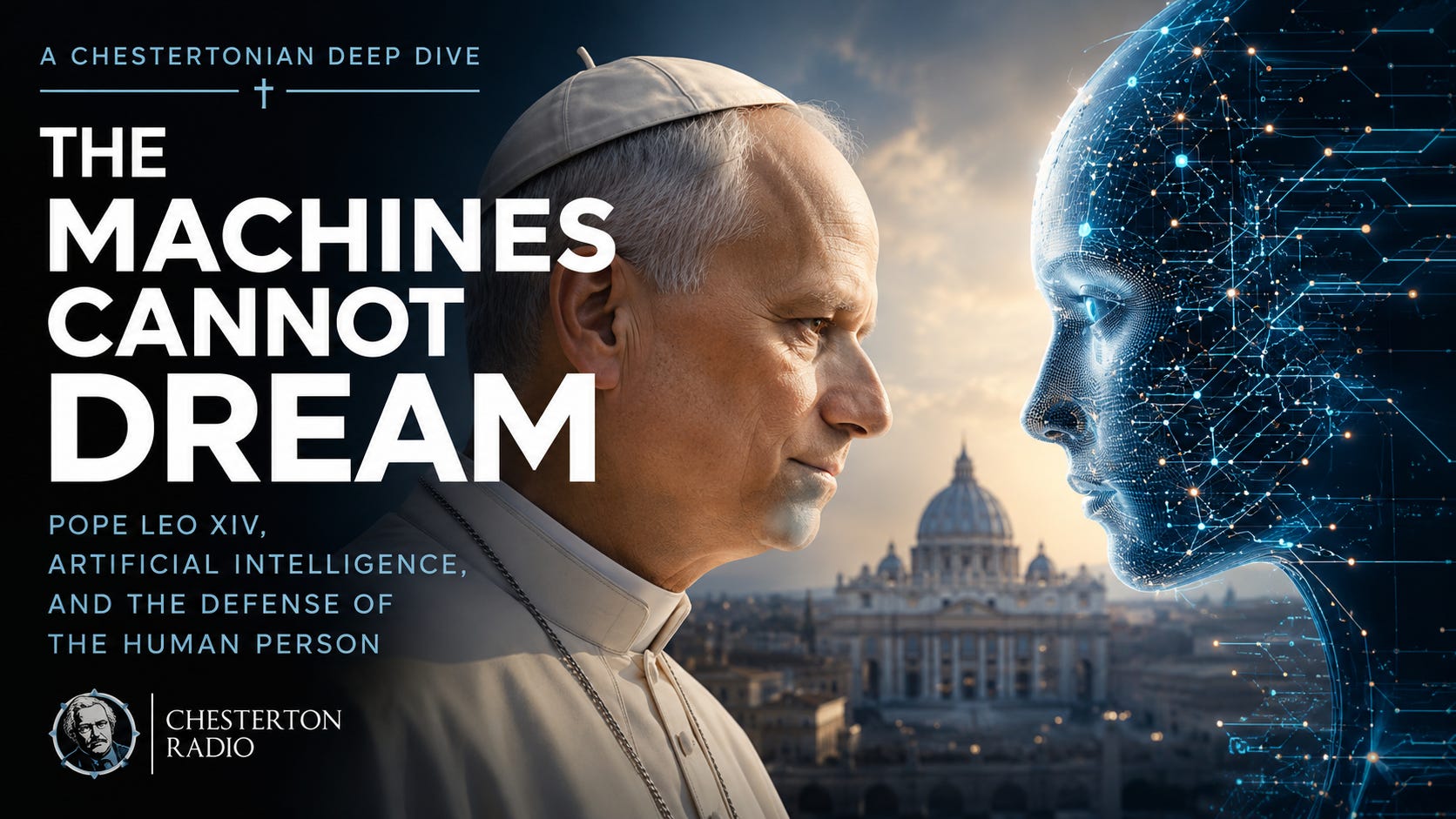
When the smoke first rose above the Vatican and the name “Leo” was spoken again after more than a century, many Catholics immediately thought of factories.
Not cathedrals.
Factories.
For the last Pope Leo — Pope Leo XIII — walked into the chaos of the Industrial Revolution and wrote Rerum Novarum, the document that became the cornerstone of modern Catholic social teaching. It was the Church stepping directly into the machine age and saying, with startling boldness, that man was not made for the machine.
Now Pope Leo XIV has done something remarkably similar.
His first encyclical, Magnifica Humanitas — “Magnificent Humanity” — is not merely a document about artificial intelligence. It is a document about man. About memory. About dignity. About whether civilization will still recognize the human face when it is surrounded by glowing screens and synthetic minds.
And in a deeply Chestertonian way, the encyclical is not anti-technology.
It is anti-idolatry.
The Return of the Old Battle
The great mistake modern people make about technology is imagining that technology creates new moral problems.
It rarely does.
It usually resurrects old ones.
The locomotive did not invent greed.
The printing press did not invent lies.
The atom bomb did not invent murder.
And artificial intelligence has not invented pride.
It has merely given pride a server farm.
This is the central insight running beneath Magnifica Humanitas. Pope Leo repeatedly insists that technology is never morally neutral because it absorbs the intentions, appetites, and philosophies of those who create and deploy it.
That sentence alone may become one of the defining lines of the early twenty-first century.
For thirty years, Silicon Valley has preached a strange new gospel: that technological progress is inherently moral simply because it is progress. Faster means better. Larger means wiser. More connected means more human.
Chesterton would have laughed aloud at such a proposition.
He once warned that modernity often means “the uncritical admiration of mere change.” And here again the Church has arrived precisely where Chesterton would expect her: defending the permanent things against the intoxication of novelty.
Pope Leo’s warning about a “new Tower of Babel” is especially revealing.
The biblical Babel story is not merely about architecture. It is about centralized power masquerading as human progress. It is about mankind attempting to become godlike through technique, organization, and ambition. The punishment was not simply destruction — it was fragmentation. Men ceased understanding one another.
And what is the internet age if not a strange technological Babel?
Never in history have men communicated more while understanding each other less.
The Most Chestertonian Line in the Encyclical
Buried inside the encyclical is an idea Chesterton himself returned to repeatedly: intelligence is not the same thing as personhood.
Modern technologists increasingly speak as though consciousness is merely computation with sufficient scale. But the Pope draws a bright line between information processing and the mystery of the human soul.
This matters enormously.
Because once humanity accepts the idea that man is merely a biological machine, the next logical step is to replace him with a more efficient one.
Chesterton foresaw this danger long before computers existed. In works like The Everlasting Man and Orthodoxy, he argued repeatedly that modern society was becoming less humane precisely when it claimed to become more scientific.
Machines are wonderful servants.
They are catastrophic metaphysics.
And Pope Leo understands that the crisis of AI is not ultimately technical.
It is theological.
If man is only data, then he can be optimized.
If man is only labor, then he can be automated.
If man is only appetite, then he can be manipulated.
If man is only biology, then he can be redesigned.
But Christianity insists on something scandalously irrational to the modern technocrat:
Man possesses an immortal dignity that cannot be measured economically.
That is why the encyclical’s defense of workers feels so important. Leo XIV directly links AI displacement to the older labor struggles confronted by Leo XIII during the Industrial Revolution.
The parallel is exact.
The nineteenth century threatened to reduce men into machine components.
The twenty-first threatens to eliminate the components entirely.
“Disarming AI”
One of the strongest sections of the encyclical concerns warfare.
Pope Leo condemns the normalization of autonomous weapons systems and argues that AI must be “disarmed” from the mentality of domination and militarized competition.
This is perhaps the most prophetic portion of the document.
Modern warfare increasingly removes the human face from violence. A medieval knight had to look into the eyes of the man he killed. Drone warfare already weakens this connection. Autonomous targeting threatens to erase it entirely.
Chesterton once observed that the modern world often grows cruel precisely because it grows abstract.
When decisions become systems, responsibility evaporates.
The encyclical is fundamentally arguing that moral responsibility cannot be delegated to algorithms.
A machine cannot possess prudence.
A machine cannot possess mercy.
A machine cannot possess conscience.
And perhaps most importantly:
A machine cannot repent.
The Attack on Technocratic Elites
Many commentators will describe Magnifica Humanitas as anti-Silicon Valley. That is only partially true.
The encyclical is not against invention.
It is against oligarchy.
Pope Leo repeatedly warns against allowing a small number of corporations or ideological actors to control the moral architecture of civilization through technological dominance.
This concern is profoundly Catholic and profoundly Chestertonian.
Chesterton distrusted concentrations of power whether they appeared in governments, monopolies, newspapers, or industrial systems. His distributism was not nostalgia for peasant cottages. It was a defense of ordinary human freedom against structures too large to remain humane.
And AI threatens to create perhaps the greatest concentration of informational power in human history.
The Pope appears to understand this instinctively.
If a handful of companies mediate communication, labor, education, entertainment, medicine, finance, and eventually cognition itself, then civilization risks becoming less democratic than feudal Europe ever was.
For at least the medieval peasant knew the name of his lord.
Why This Encyclical Matters Beyond Catholicism
Many secular observers may underestimate this document because they misunderstand what an encyclical is.
An encyclical is not merely an internal church memo.
Historically, these documents often become intellectual landmarks precisely because the Church thinks in centuries rather than election cycles.
When Leo XIII wrote Rerum Novarum, industrial capitalism was still young. Yet his warnings about labor exploitation, unchecked capital, and human dignity became foundational moral reference points for generations.
Leo XIV appears to be attempting something similar.
He is asking whether humanity will remain human in an age increasingly tempted to outsource judgment, memory, creativity, labor, and eventually identity itself.
And notably, he does not answer with panic.
He answers with anthropology.
The encyclical repeatedly insists that technology should serve communion rather than isolation, truth rather than manipulation, dignity rather than efficiency alone.
That may sound idealistic.
But Chesterton understood something modernity often forgets:
The world is ultimately governed by what men believe man is.
If man is sacred, civilization forms one shape.
If man is disposable, it forms another.
The Most Surprising Thing About Magnifica Humanitas
Perhaps the most surprising thing about the encyclical is its tone.
It is not fearful.
It is mournful.
There is a profound sadness beneath the document — the sadness of a civilization forgetting itself.
The Pope seems less afraid that machines will become human than that humans will become machine-like.
That is a very different warning.
And it may be the right one.
For the danger of AI may not be that computers begin thinking like men.
The danger may be that men begin thinking like computers:
calculating without wisdom,
communicating without communion,
remembering without understanding,
and producing without wonder.
Chesterton once wrote that the world will never starve for want of wonders, but only for want of wonder.
Magnifica Humanitas feels, in many ways, like an encyclical written to recover wonder before efficiency devours it entirely.
And perhaps that is why the title matters so much.
Not magnificent technology.
Not magnificent systems.
Not magnificent intelligence.
Magnificent humanity.Postscript — Keep the Signal Alive
There is something strangely fitting about discussing artificial intelligence through an old medium.
Chesterton Radio exists because we believe modern civilization does not merely suffer from a shortage of information. It suffers from a shortage of memory.
The old voices still matter.
The old stories still matter.
The old prayers still matter.
And perhaps now, more than ever, the old truths about man still matter.
In an age increasingly tempted to reduce human beings to data points, consumers, demographics, labor units, political tribes, or programmable systems, the task of preserving humanity may become one of the great cultural labors of our time.
That is why Chesterton Radio exists.
Not merely to archive the past —
but to defend the human voice against a world becoming mechanical.
Here, we still believe:
that stories shape souls,
that beauty matters,
that conversation is holier than algorithms,
and that a human being is infinitely more mysterious than any machine he creates.
If this article meant something to you, consider supporting Chesterton Radio and helping us continue building The Open Door — our ongoing broadcast of classic radio drama, literature, cultural commentary, music, prayer, and original Chestertonian storytelling.
🚪 The Open Door is always on.
You can listen live anytime at:
The Open Door Live Stream
And for full essays, deep dives, original fiction, daily reflections, and the growing Chesterton Radio archive, visit:
Chesterton Radio on Substack
Because the world does not need colder machines.
It needs warmer men.
Thank you
Dream on Believer!!!!!!!