
God Only Knows
Brian Wilson, Fragile Joy, and the Harmony Beneath America

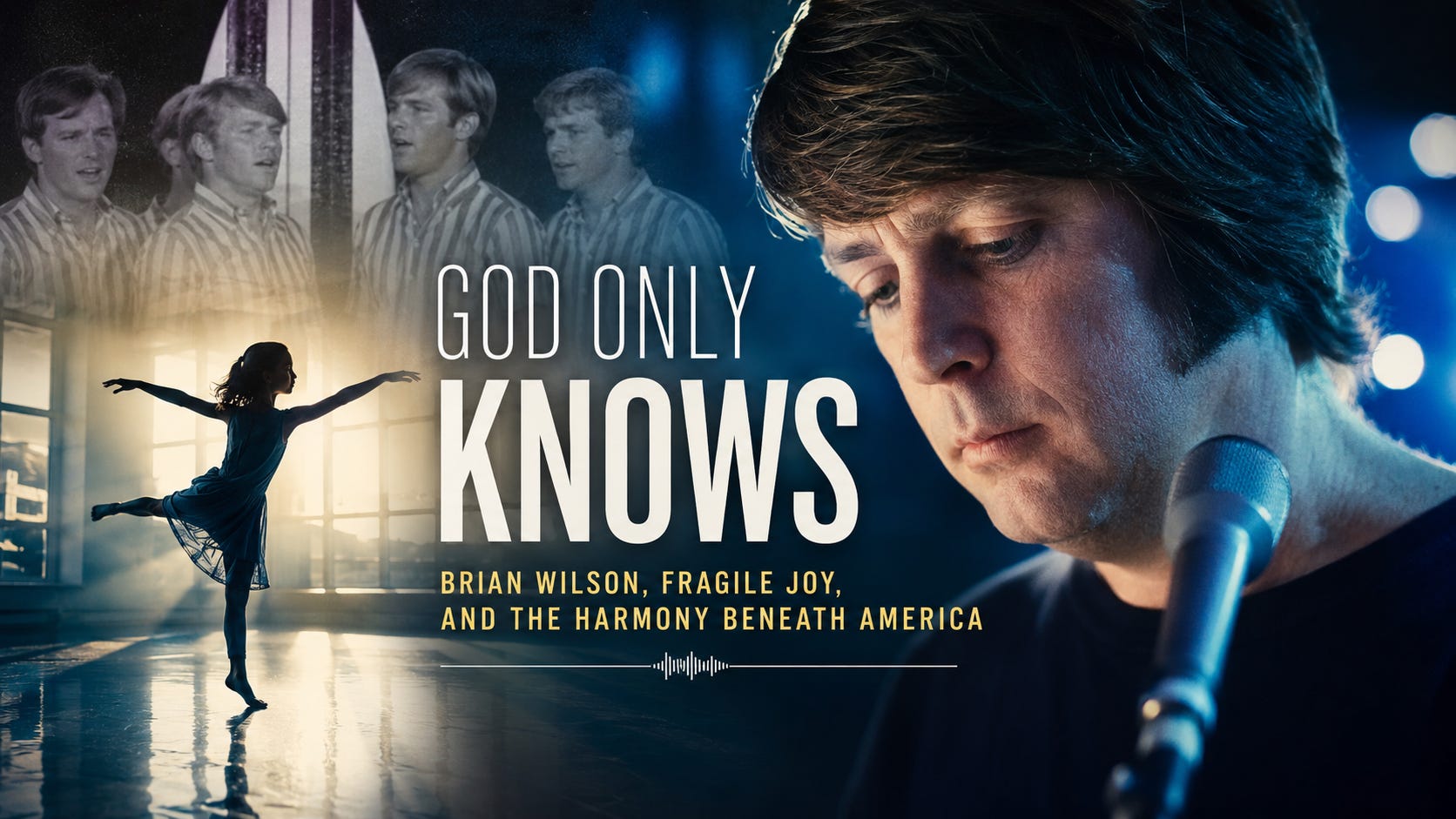
Intro
There are certain voices that seem to belong permanently to summer.
Not merely to the season itself, but to the idea of summer — to long roads beneath open skies, transistor radios glowing softly after dark, distant fireworks, teenage dreams, and the strange conviction, felt most strongly in youth, that happiness might somehow last forever.
For many Americans, the music of Brian Wilson and The Beach Boys became part of that emotional landscape. Their harmonies sounded effortless, sunlit, innocent. Yet beneath the beauty there was always another current flowing quietly underneath: longing, fragility, melancholy, and the fear that joy itself might disappear the moment one became fully conscious of it.
This is not merely an essay about Pet Sounds, or California, or popular music.
It is an essay about fragile gifts.
About people who perceive beauty differently than the rest of the world.
About harmonies heard before they can be explained.
About children who recognize realities before adults can name them.
About dance, memory, vulnerability, and the mysterious persistence of wonder in a civilization increasingly embarrassed by wonder itself.
Chesterton once wrote that the world would never starve for want of wonders, but only for want of wonder.
Brian Wilson spent much of his life trying to preserve that wonder in music.
And perhaps that is why his songs still matter.
There are some musicians who belong not merely to history, but to households.
Their music drifts through kitchens and long drives and late evenings after the rest of the world has gone quiet. Their songs become attached to lamps glowing in dark rooms, children unable to sleep, family jokes repeated for years, and strange little memories that survive long after greater events have been forgotten.
For our family, Brian Wilson and The Beach Boys became part of that landscape.
When our youngest daughter was little and could not sleep, she and I would sometimes sit late at night watching old Beach Boys videos. Her favorite was a grainy black-and-white “lost concert” film from 1964. The Beach Boys looked impossibly young. They wore the narrow striped shirts and short, painfully earnest performance pants that belonged to another America entirely — an America of station wagons and transistor radios and optimistic highways stretching endlessly toward the Pacific.
At one point Mike Love sang:
“If she had a set of wings then I know she could fly…”
and flapped his arms like a child doing the chicken dance.
We laughed every single time.
Years later, while walking along the River Walk, our daughter suddenly pointed across the crowd at a random man and shouted loudly:
“Mom! He looks like The Beach Boys!”
Not like a Beach Boy.
Like The Beach Boys themselves.
Children sometimes understand mythology better than adults do.
Because the Beach Boys were never merely a musical group. They became, for millions of Americans, a kind of emotional memory — a vision of youth, sunlight, movement, freedom, and uncomplicated happiness. They represented not simply California, but a broader American confidence that life itself might somehow remain permanently young.
Yet beneath the harmonies there was always another feeling entirely.
Even as a child, our daughter seemed to sense beauty differently than most people. She is dyslexic, and from an early age she often perceived the world in ways that bypassed ordinary explanation. Before she could properly read, we once visited St. Norbert’s Abbey cemetery in Wisconsin containing field after field of identical white crosses. She suddenly ran ahead of us, climbed onto one of the cross beams, wrapped her arms around it, and shouted:
“I found him!”
It was my late uncle’s grave. He was a Norbertine priest and had baptized me, married my wife and I and baptized both our girls.
To this day I cannot fully explain how she recognized it.
Perhaps she did not recognize it intellectually at all. Perhaps she recognized it emotionally.
Chesterton understood something modern society often forgets: there are people who read words, and there are people who read realities.
The modern world prizes analysis, categorization, speed, optimization, and measurable outcomes. It trusts systems more readily than intuition. Yet some human beings move through life by another form of perception entirely — through pattern, atmosphere, symbolism, movement, harmony, emotional recognition. They often doubt themselves because the world rarely knows how to measure what they can do.
Brian Wilson was one of those people.
To describe Wilson merely as a songwriter is almost misleading. He was not simply writing melodies. He was constructing emotional architecture. He heard harmonies in layers and textures most people could not perceive. His songs do not merely proceed forward; they shimmer, rise, collapse, drift, and ache simultaneously. They often feel less like compositions than memories one somehow forgot having.
This is especially true of Pet Sounds.
People often describe Pet Sounds as one of the greatest albums ever recorded, but such statements, though true, somehow fail to capture what the album actually is. Great albums are common enough in critical language. Pet Sounds is something stranger. It is the sound of innocence becoming self-conscious. It is the sound of sunlight discovering melancholy.
The earlier Beach Boys records celebrated motion:
cars,
surfboards,
summer nights,
young romance,
America in perpetual forward movement.
Then suddenly Wilson turned inward.
The beaches remained, but now the soul itself had become uncertain.
Songs like “Wouldn’t It Be Nice” are frequently mistaken for cheerful pop songs because the melodies sparkle so brightly. But the song is built around longing. It is not a celebration of fulfillment; it is a prayer for stability, permanence, home, adulthood, and tenderness. Beneath the joy lies yearning.
That combination — radiant beauty carrying hidden sorrow — became Wilson’s great artistic signature.
Chesterton once wrote that the world will never starve for want of wonders, but only for want of wonder. Brian Wilson’s music often sounds like a man desperately attempting to preserve wonder before modern life could extinguish it entirely.
And modern life nearly extinguished him.
The story of Wilson’s collapse has been told many times:
mental illness,
isolation,
drugs,
fame,
exploitation,
fear,
the crushing pressure of genius turned inward upon itself.
But the deeper tragedy may not simply be that Wilson suffered. The deeper tragedy is that modern celebrity culture had no real place for a soul like his. Rock stardom rewarded swagger, appetite, confidence, and mythmaking. Wilson possessed almost none of those qualities naturally. He remained strangely childlike — emotionally exposed, uncertain, vulnerable to both praise and criticism.
Chesterton warned repeatedly about societies that produce specialists while neglecting humanity. Wilson became, in a sense, a specialist in beauty while lacking the ordinary protections that make human life stable:
community,
routine,
groundedness,
domestic peace,
the ability to withdraw from spectacle.
And yet the beauty endured.
That may be the real miracle.
Years later, Wilson would return to perform Smile live with his band. The original Smile project had collapsed under impossible expectations and psychological strain. For decades it became one of popular music’s great unfinished cathedrals — an album almost mythological in its incompletion.
But eventually Wilson came back to it.
Not as the frightened young genius trying to build perfection.
As an older man simply trying to finish the song.
That distinction matters enormously.
Modern culture worships perfection. Chesterton understood that completion is often far more beautiful.
The miracle was not merely that Wilson finished Smile. The miracle was that he survived long enough to sing it.
Watching those later performances is deeply moving because the harmonies remain, but now they are accompanied by visible fragility. Wilson no longer appears as the golden California prodigy. He appears human — wounded, aging, tentative, grateful. The music becomes less triumphant and more merciful.
And perhaps that is why it matters more.
Our daughter eventually found something similar in dance.
For years she doubted whether she truly belonged on an elite dance team. Some teammates lived at the studio. Dance consumed their identities entirely. She never felt she matched their certainty or confidence. We told her repeatedly:
“Ricky wouldn’t keep you there if you weren’t good.”
Still, doubt persisted.
Yet one day her solo performance moved her hardened professional choreographer to tears. He told her so directly in front of the entire team.
Not because she was flashy.
Not because she was loud.
Not because she projected invincible confidence.
But because something truthful emerged through the performance.
That is what great art does.
It reveals realities ordinary language struggles to reach.
Now, in college, she has begun finally appreciating her own abilities. She dances confidently. She choreographs routines. She teaches younger children at the Raven School of Dance in Atchison. Beauty is no longer merely something she fears losing. It has become something she passes forward.
That may be one of the most important transitions in human life.
To stop asking:
“Am I good enough?”
and begin asking:
“How can I help others discover beauty too?”
Recently we found a poem she wrote years ago called Fireworks. Though simple, it contains remarkable emotional intelligence. The poem describes colors and movement and performance and music gradually converging into “perfect symphony” emerging from “our one united heart.” Then, after the beauty fades, darkness and worry quietly return once more.
It struck me immediately that the poem unknowingly resembled Brian Wilson’s music.
The harmonies rise.
Everything glows.
For one impossible moment life feels unified and radiant.
Then the darkness returns softly around the edges.
But the beauty mattered anyway.
Perhaps that is the entire point.
Chesterton believed joy was not naive optimism. Real joy existed alongside suffering, uncertainty, and mortality. In fact, joy became more meaningful precisely because darkness existed around it. Fireworks are beautiful partly because they vanish. Harmonies matter because silence returns. Childhood matters because it passes.
Wilson understood this intuitively long before many critics understood it intellectually.
That is why songs like “God Only Knows” still feel almost unbearably sincere in a cynical age. Modern music often hides behind irony, detachment, aggression, or self-conscious coolness. Wilson’s music dared to sound grateful, frightened, tender, dependent, and vulnerable all at once.
There is something almost liturgical about it.
“God only knows what I’d be without you.”
The line remains powerful because it acknowledges dependence rather than denying it. Modern culture trains people to perform self-sufficiency. Wilson’s greatest songs admit the terrifying and beautiful truth that human beings are bound to one another emotionally.
Chesterton would have understood that immediately.
He believed love itself is a form of gratitude.
And perhaps that is why Brian Wilson’s music continues surviving generations that no longer recognize the America that originally produced it. The cars changed. The beaches changed. The culture fragmented. Confidence dissolved into anxiety. Yet the harmonies remain strangely alive because they speak to something more permanent than nostalgia.
They speak to the fragile human longing for unity:
between people,
between generations,
between beauty and truth,
between childhood wonder and adult sorrow.
That longing survives in music.
It survives in dance.
It survives in families.
It survives in small late-night rituals between parents and children.
It survives in teachers quietly guiding nervous students.
It survives in poems written by young dancers trying to describe beauty before they fully understand it themselves.
And perhaps that is the real legacy of Brian Wilson.
Not merely songs.
Not merely California mythology.
But the stubborn preservation of wonder inside a world increasingly determined to outgrow it.
Chesterton once suggested that angels can fly because they take themselves lightly.
Brian Wilson’s music often sounds like a man struggling desperately beneath enormous weight while still trying to remember how to fly.
Sometimes, against all odds, he succeeded.
And for a few luminous moments, the rest of us rose with him
Outro / Postscript
The older one becomes, the more one realizes that civilization itself is held together by surprisingly fragile things.
Songs sung late at night.
Children learning dances in small studios.
Families laughing at old black-and-white concert footage.
Teachers encouraging frightened students.
Poems written quietly by young artists who do not yet understand the depth of what they are trying to express.
Modern society speaks constantly about power, disruption, scale, optimization, and innovation. Yet human beings continue surviving largely because beauty still passes mysteriously from one soul to another.
A harmony.
A movement.
A memory.
A voice.
That may ultimately be why Pet Sounds endures.
Not because it captured perfection, but because it captured vulnerability without surrendering to despair.
The harmonies tremble.
The voices crack slightly around the edges.
The joy is never entirely secure.
And yet the beauty remains.
Perhaps that is the deepest Chestertonian truth hidden inside Brian Wilson’s music: joy is not the absence of sorrow. Joy is the courage to keep singing anyway.
And somewhere tonight, in some quiet room, another parent and child may still be watching those old Beach Boys videos together — laughing at the striped shirts and impossible harmonies — while something far more important passes invisibly between them.
A sense that beauty still matters.
A sense that wonder is still alive.
A sense, however fragile, that the human heart was made for harmony.
— Chesterton Radio
Broadcasting from Atchison, Kansas
Where the signal still reaches beyond the noise.