

There are radio programs that entertain.
There are radio programs that tell stories.
And then there are those rare broadcasts that seem to stand directly in the path of history — programs that do not merely report events but somehow speak to the soul of a nation at the moment it most needs to hear itself.
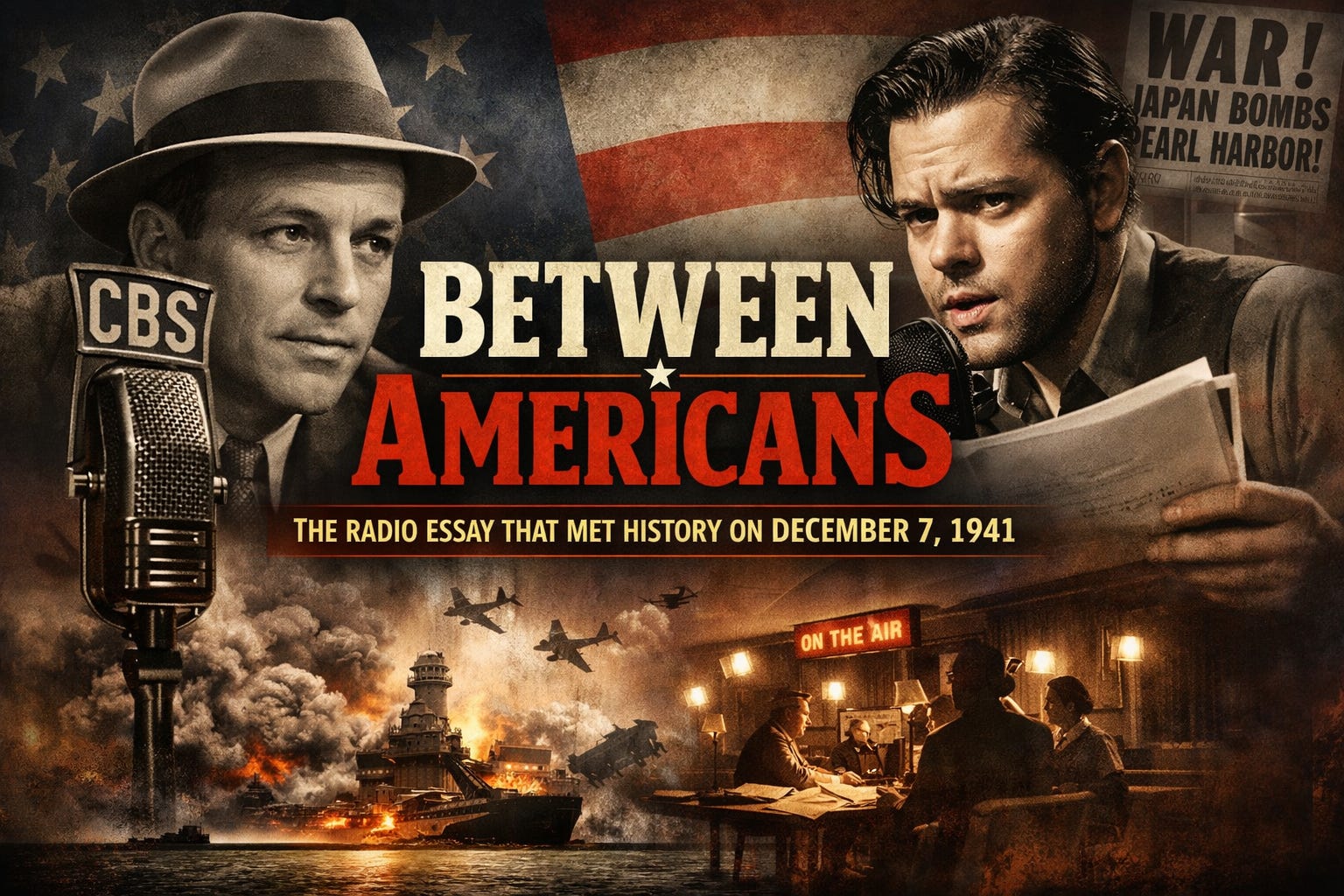
Between Americans is one of those broadcasts.
Written by the great radio dramatist Norman Corwin — often called the “poet laureate of radio” — the program first aired on July 6, 1941 as part of the CBS experimental series Columbia Workshop.
At the time, America was deeply divided over a question dominating newspapers, town halls, and dinner tables:
Should the United States enter the war raging overseas?
Corwin did not attempt to settle that argument.
Instead, he attempted something far more unusual.
He reminded Americans that they were, in fact, Americans.
A Nation Arguing With Itself
By the summer of 1941 the national mood had become tense and uncertain. Isolationists and interventionists debated fiercely over the future of the country.
Political rhetoric was growing sharper.
Corwin’s response was neither a speech nor a debate.
Instead, he created what he called a “sound portrait of America.”
Rather than telling a conventional story, the program wandered through the everyday experiences of American life.
Listeners heard references to:
hot dog stands and auto repair garages
baseball arguments and square dances
coastal beaches and prairie crossroads
small American towns named after distant places — Paris, Texas; Cairo, Illinois; Athens, Georgia.
The effect was subtle but powerful.
Corwin reminded listeners that beyond political arguments lay a shared landscape of habits, communities, and ordinary lives.
What America Means
As the script unfolded, Corwin turned toward a deeper question:
What exactly holds Americans together?
His answer lay in the nation’s founding ideals.
The program quoted from the Constitution and the Bill of Rights, emphasizing the freedoms that define American civic life:
freedom of the press
the right to assemble
the right to a fair trial
the freedom to criticize leaders openly.
At one point the script even referenced the fact that Abraham Lincoln’s Gettysburg Address had once been harshly criticized in newspapers.
The implication was clear.
Disagreement has always been part of American democracy.
Americans are not united because they agree about everything.
They are united because they are free to argue.
The America That Isn’t Perfect
One of the most striking features of Between Americans is its honesty.
Corwin did not pretend the country was flawless. Instead, he acknowledged what he called America’s “incorrigible bad lands and corable slums.”
The script openly mentioned:
political corruption
neglected communities
and the forgotten struggles of Native Americans who fought “against great odds” to keep their land.
This honesty was central to Corwin’s vision.
The message was not that America was perfect.
The message was that America belonged to everyone — including those who criticized it.
December 7, 1941
The program might have remained a thoughtful but little-known radio essay.
Then history intervened.
Later in 1941 the script was scheduled for revival on the popular radio series Gulf Screen Guild Theatre.
The narrator would be none other than Orson Welles.
The broadcast date had been scheduled months earlier.
December 7, 1941.
That morning Japanese aircraft attacked Pearl Harbor.
Radio networks abandoned normal programming as Americans listened in stunned silence to continuous news bulletins.
That evening, the scheduled broadcast finally aired.
Hosted by Roger Pryor, announced by Bud Hiestand, and accompanied by Oscar Bradley’s orchestra, Between Americans became the first complete regularly scheduled program to air after the day’s emergency coverage.
Suddenly Corwin’s reflection on American identity sounded less like philosophy and more like a national meditation.
Words written months earlier now seemed written for that very hour.
Newspapers later described the broadcast as an “American Odyssey.”
The Foundation of a Radio Monument
The influence of Between Americans did not end that night.
Just eight days later Corwin produced one of the most famous broadcasts in radio history:
“We Hold These Truths.”
The program celebrated the 150th anniversary of the Bill of Rights and reached an estimated 63 million listeners — nearly half the population of the United States.
But the emotional groundwork for that monumental broadcast had already been laid.
Between Americans reminded Americans what their country actually was.
Listen to the Original Broadcast
You can hear the historic program here on Chesterton Radio.
After the Curtain: A Discussion
How Orson Welles Invented the YouTube Vlog
To explore the extraordinary context of this broadcast, we created a deep-dive discussion
In “How Orson Welles Invented the YouTube Vlog,” the hosts examine:
why Norman Corwin wrote the original script in 1941
how Orson Welles’ narration turns the piece into something surprisingly modern
and why the program feels uncannily similar to a personal monologue one might encounter on today’s internet platforms.
In a sense, Welles was doing something in 1941 that millions of creators attempt today — speaking directly and personally to a national audience about the meaning of their shared life.
🎧 Listen to the discussion:
.
A Chestertonian Reflection
G.K. Chesterton once wrote that democracy means “government by the most humble of all human authorities — the average man.”
Norman Corwin’s radio essay might be described as the sound of that average man speaking.
Not in a speech.
Not in a manifesto.
But in the quiet accumulation of ordinary life: baseball arguments, roadside diners, small towns, and the freedom to complain about all of them.
A nation does not remain united because it agrees about everything.
It remains united because it remembers that the argument itself belongs to everyone.
And that, perhaps, is the thing that lies between Americans.
Chesterton Radio is listener-supported.
If you enjoy these explorations of classic radio drama, cultural history, and storytelling, consider supporting the work through the Chesterton Radio Substack community. Your support helps keep these remarkable voices from the wireless archive alive for a new generation.